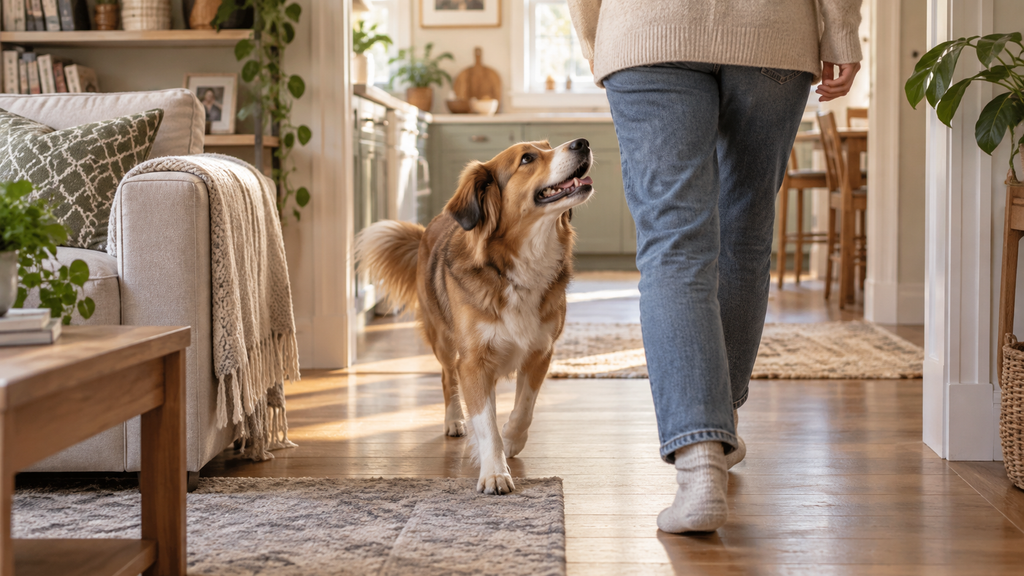
You get up from the couch.
Your dog gets up too.
You walk to the kitchen.
They are right behind you.
You go to the bathroom.
Still there.
Sometimes it feels like you have a little four-legged shadow following you from room to room.
A lot of people call these dogs “Velcro dogs.”
But why do some dogs want to be near us all the time?
The answer is not always anxiety.
Sometimes it is affection.
Sometimes it is habit.
Sometimes you are simply the person who controls all the good things in their world.
And sometimes, yes, following can be part of a bigger anxiety problem.
The important part is looking at what your dog does when you are actually gone.
Sometimes Your Dog Just Likes Being With You
Dogs are social animals.
Many enjoy staying close to the people they know and trust.
If your dog follows you around the house but can also relax on their own, sleep while you are busy, and remain calm when you leave, the behavior may simply be part of their personality.
Some dogs naturally want more contact than others.
And that is not necessarily a problem.
You May Be the Person Who Makes Good Things Happen
Think about your dog’s day from their point of view.
Who fills the food bowl?
Who opens the door for walks?
Who gets the treats?
Who starts playtime?
Who scratches that perfect spot behind the ears?
If the answer is mostly you, it makes sense that your dog pays close attention to where you go.
AKC notes that positive reinforcement can contribute to following behavior. If being near you regularly leads to food, affection, attention, or fun, your dog can learn that staying close is worthwhile.
In other words, they may love you.
But they also know you are where the interesting stuff happens.
Dogs Are Very Good at Learning Our Routines
Dogs notice patterns we barely think about.
You put on certain shoes.
Walk.
You open one cabinet.
Treats.
You grab your keys.
Someone may be leaving.
Over time, dogs learn what our movements predict.
So sometimes your dog is not following you simply because they cannot stand being apart.
They may be trying to figure out what is about to happen next.
If walking toward the kitchen sometimes leads to food, it makes sense that they want to come check.
Some Dogs Are Naturally More People-Focused
Individual temperament matters.
Breeding history can matter too.
Some working and herding breeds were developed to spend a lot of time paying attention to people and working alongside them.
AKC notes that this kind of human focus can contribute to especially close following behavior in some dogs.
But breed does not determine everything.
You can have an independent dog from a traditionally people-oriented breed and a mixed-breed dog who follows you absolutely everywhere.
Every dog is an individual.
Is Following You Everywhere a Sign of Separation Anxiety?
Not by itself.
This is one of the most important things to know.
Merck Veterinary Manual notes that dogs who show close attachment behaviors, including following family members around the house, are not necessarily at greater risk for separation anxiety than dogs who do not follow people closely.
The real question is:
What happens when you leave?
A dog with separation anxiety may show genuine distress when separated from a caregiver.
That can include:
- persistent barking or howling
- pacing
- destructive behavior, especially near doors or exits
- house soiling
- drooling
- restlessness
- refusing food
- attempts to escape
- difficulty settling
- extreme distress as you prepare to leave
These signs often begin around departure or shortly after the owner leaves.
A dog who happily follows you around all evening but then sleeps peacefully when you leave for work is not showing the same pattern.
Your Camera Can Tell You More Than Guessing Can
One of the best ways to understand what happens when you leave is to watch.
Merck and VCA both recommend video as a useful way to evaluate separation-related behavior.
A pet camera or even a simple recording can help answer questions like:
Does your dog settle after a few minutes?
Do they sleep?
Do they pace continuously?
Do they bark only when someone passes the window?
Do they panic as soon as the door closes?
That information can be much more useful than assuming that following behavior during the day means your dog cannot cope alone.
What If My Dog Suddenly Becomes Much More Clingy?
A sudden change deserves more attention.
If an independent dog suddenly begins following you everywhere, think about what else has changed.
Older dogs may become more dependent if they are losing vision or hearing.
Pain or illness can also change behavior.
AKC notes that sudden clinginess may warrant a veterinary checkup, particularly when it is unusual for that dog.
Look for other changes too:
- appetite
- drinking
- sleep
- mobility
- bathroom habits
- energy
- confusion
- panting
- sensitivity to touch
Behavior changes can sometimes be the first clue that a dog does not feel well.
Is It Bad to Let Your Dog Follow You?
Usually, no.
There is nothing wrong with enjoying your dog’s company.
You do not need to push them away just because they like sitting near you.
The goal is balance.
Ideally, a dog can enjoy being close to you and feel comfortable relaxing independently.
That might mean teaching them to settle on a bed while you move around the room.
Giving them a chew or food puzzle somewhere away from you.
Letting other family members handle walks and feeding.
Or rewarding calm behavior when your dog chooses to relax on their own.
VCA recommends teaching dogs to relax independently while the owner is still home before expecting them to handle longer absences comfortably.
Do Not Suddenly Force Independence
If your dog really does become distressed when separated from you, simply shutting them in another room and waiting for them to “get used to it” may not help.
For dogs with true separation distress, Merck recommends gradual training that keeps practice absences short enough that the dog remains below the point of panic.
Moderate or severe cases can take time and may benefit from veterinary or qualified behavior-professional support.
The goal is not to prove that the dog can survive being upset.
The goal is to help them learn that being alone can actually feel safe.
Following You Can Also Be Completely Ordinary
There is another possibility that is much less dramatic.
Your dog follows you because they want to know what you are doing.
That is it.
No hidden problem.
No diagnosis.
No deep psychological explanation.
You are part of their environment, and probably the most interesting part of it.
So they watch.
They follow.
They wait.
And occasionally they stare at you while you are in the bathroom as if you are the strange one.
Angel Jake Note 🐾
I think we sometimes worry about dog behavior because we want every little thing to mean something.
“My dog follows me everywhere. Is something wrong?”
Sometimes, maybe.
But sometimes your dog just likes being near you.
And I think the important thing is not whether they follow.
It is whether they can also feel safe when they cannot.
A dog who chooses to lie beside you because they enjoy your company is very different from a dog who panics because you walked out the door.
That difference matters.
So enjoy your little shadow.
Let them follow you into the kitchen.
Let them sit outside the bathroom door if they want.
But also help them learn that their own bed is safe.
Another room is safe.
And being alone for a while can be safe too.
Love does not have to mean being together every second.
Sometimes a secure dog is one who knows:
“You leave sometimes. And you always come back.”
Veterinary & Behavior Sources
This article was prepared using information from the Merck Veterinary Manual, VCA Animal Hospitals, and the American Kennel Club.
Veterinary behavior references distinguish normal close attachment from separation-related distress. Following an owner around the home alone is not enough to diagnose separation anxiety; diagnosis depends on what happens during actual separation and requires consideration of other possible causes.
Disclaimer
This article is for general educational purposes and does not replace veterinary or professional behavioral advice.
If your dog suddenly becomes unusually clingy, shows signs of illness or pain, or experiences intense distress when left alone, talk with your veterinarian or a qualified canine behavior professional.