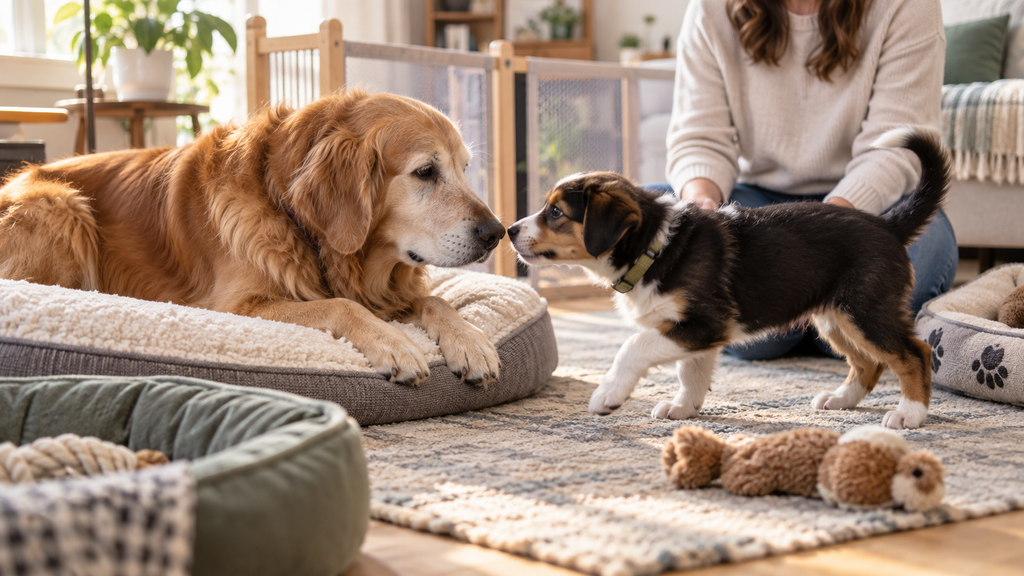
Bringing home a new puppy can be exciting.
But if you already have an older dog, the experience may feel very different for them.
You may imagine the two dogs meeting, sniffing each other, and becoming best friends right away.
Sometimes that happens.
But often, it does not.
And that is completely normal.
Dogs need time to build relationships, just like people do.
An older dog may not be thrilled about having a puppy jumping on them, stealing toys, or following them everywhere.
That does not automatically mean they will never get along.
It usually means they need a slower introduction and clear boundaries.
Start Somewhere Neutral
If possible, let the dogs meet outside the home first.
A quiet, neutral location can feel less threatening to the dog who already lives in the house.
One helpful approach is to have one person handle each dog and take them on a short walk together.
They do not need to greet face-to-face immediately.
Let them walk, sniff, and notice each other without pressure.
The goal of the first meeting is not to make them play.
It is simply to help them be comfortable in the same space.
Keep the First Interactions Short
A puppy can be a lot.
They may jump.
They may bite at ears.
They may follow the older dog everywhere.
And they may not understand when the other dog has had enough.
That is why short interactions are often better in the beginning.
Let them spend a little time together, then give both dogs a break.
A puppy who is tired and overstimulated can become even more annoying to an older dog.
And an older dog who cannot get away may become increasingly frustrated.
Give Your Older Dog a Safe Space
Your older dog should always have somewhere they can go without being followed.
That might be:
- a favorite bed
- another room
- a gated area
- a couch the puppy cannot access
- a quiet crate or resting space
This is especially important for senior dogs.
Older dogs may have arthritis, pain, hearing loss, vision changes, or simply less patience for constant play.
They should not have to entertain the puppy all day.
Giving them space is not separating the family.
It is helping both dogs feel safe.
Do Not Leave Them Alone Together Too Soon
Even if the first meeting goes well, supervise their interactions.
Puppies are still learning dog communication.
They may ignore warnings from an older dog or continue trying to play after the older dog wants to stop.
Until you are confident that both dogs are comfortable together, use baby gates, playpens, crates, or separate rooms when you cannot supervise them.
That is not punishment.
It is management.
And good management prevents problems before they start.
Feed Them Separately
Food can create tension even between dogs who normally get along.
In the beginning, feed the dogs in separate areas.
Do the same with high-value chews and treats.
You may also want to put away favorite toys during early interactions until you know whether either dog tends to guard resources.
Fresh water should always be available, and having more than one water bowl can be helpful in a multi-dog home.
Do Not Force Them to Play
Your puppy may want to play constantly.
Your older dog may not.
That is okay.
One of the biggest mistakes is expecting the older dog to become the puppy’s full-time playmate.
An adult or senior dog should be allowed to walk away.
If the puppy keeps following and bothering them, redirect the puppy.
Give the puppy another activity.
A chew.
A training session.
A nap.
A short walk.
Your older dog should not have to repeatedly defend their personal space.
Is Growling Always Bad?
Not necessarily.
Growling is communication.
An older dog may growl to tell a puppy:
“That is enough.”
Punishing every growl can remove an important warning signal.
Instead, look at the whole situation.
Did the puppy keep jumping on the older dog?
Was the older dog trying to walk away?
Was the puppy ignoring repeated signals?
In that case, the better response may be to calmly separate them and give the older dog a break.
However, repeated lunging, intense aggression, biting, or interactions that feel unsafe should not simply be dismissed as normal correction.
If you are worried about either dog’s behavior, talk with a qualified trainer or veterinary behavior professional.
Learn What Comfortable Play Looks Like
Healthy play often looks loose and relaxed.
You may see:
- play bows
- wiggly bodies
- taking turns chasing
- pauses during play
- both dogs choosing to come back
The important part is that both dogs are participating.
If one dog repeatedly tries to escape, hides, freezes, stays on the ground while the other dog overwhelms them, or never chooses to restart the interaction, it may be time for a break.
One simple test is to gently move the more energetic dog away for a moment.
If the other dog comes back and tries to continue playing, that is a good sign.
If they walk away or settle somewhere else, respect that choice.
Keep Your Older Dog’s Routine
A new puppy can take over the entire household.
There are potty breaks.
Training.
Feeding.
Chewing.
Accidents.
And suddenly almost every minute seems to revolve around the puppy.
Try not to let your older dog lose everything familiar at the same time.
Keep their normal walk when possible.
Spend time with them alone.
Continue their favorite routines.
They should still feel like their life belongs to them too.
This can be especially important for a senior dog who is comfortable with predictable routines.
Make Sure the Puppy Gets Enough Rest
Young puppies need a lot of sleep.
A puppy who has been awake too long may become wild, bitey, and unable to settle.
That energy often gets directed toward the older dog.
Scheduled naps, crate time, or quiet playpen time can give both dogs a much-needed break.
The goal is not to keep them separated forever.
It is to create enough calm time that their interactions have a better chance of going well.
Do Not Expect Instant Friendship
Some dogs become close quickly.
Others simply learn to coexist peacefully.
Both outcomes are okay.
Your dogs do not have to sleep together or play together all day to have a successful relationship.
It may take days.
It may take weeks.
For some dogs, it may take months.
Try not to judge the relationship based on the first few meetings.
What matters more is whether both dogs gradually become more comfortable.
When You May Need Professional Help
Seek help from a veterinarian or qualified behavior professional if:
- one dog repeatedly tries to attack the other
- biting causes injury
- one dog is constantly hiding or fearful
- resource guarding is getting worse
- the older dog appears chronically stressed
- you cannot safely manage them in the home
Pain can also change behavior.
If an older dog suddenly becomes much more irritable, a veterinary examination may be worthwhile.
The issue may not be the puppy alone.
Angel Jake Note 🐾
I think we sometimes expect dogs to understand our decisions immediately.
We bring home a puppy and think:
“Look! I brought you a friend.”
But the older dog did not ask for a puppy.
Their home changed overnight.
Their routine changed.
There is suddenly another dog touching their things, following them, and demanding attention.
So I think it is okay if they need time.
The goal should not be to force them to love each other.
The goal should be to make both dogs feel safe enough for a relationship to grow naturally.
Give the puppy boundaries.
Give the older dog space.
Give both of them individual attention.
And give the relationship time.
Sometimes the best friendships do not begin with instant love.
They begin with learning how to peacefully share the same room.
Sources
This article was prepared using guidance from the American Kennel Club on introducing puppies to adult and senior dogs.
AKC recommends neutral-territory introductions, close supervision, separate feeding, safe spaces, maintaining the older dog’s routine, and giving both dogs regular breaks during the adjustment period.
Disclaimer
This article provides general educational information and is not a substitute for individualized veterinary or behavioral advice.
Dogs vary widely in temperament, health, social history, and behavior. If interactions involve serious aggression, injury, or persistent fear, seek help from a veterinarian or qualified canine behavior professional.