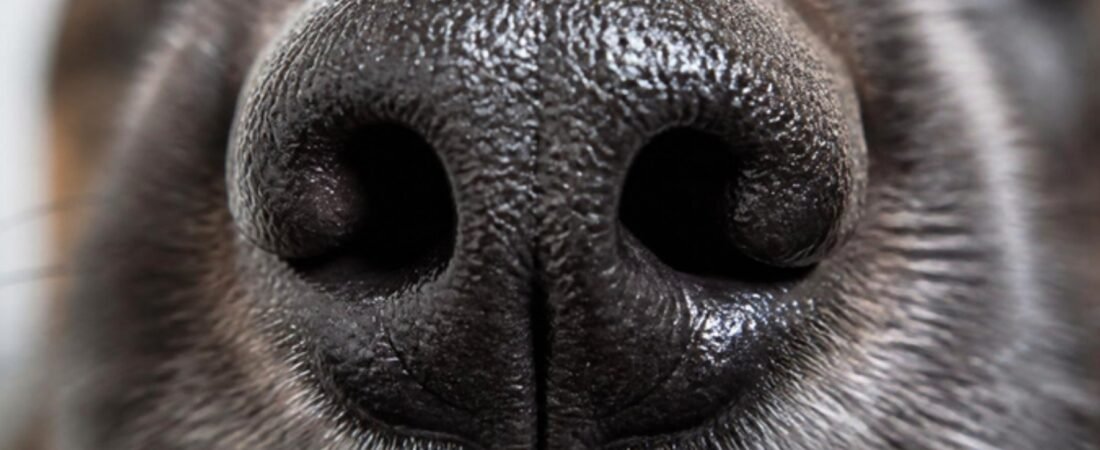
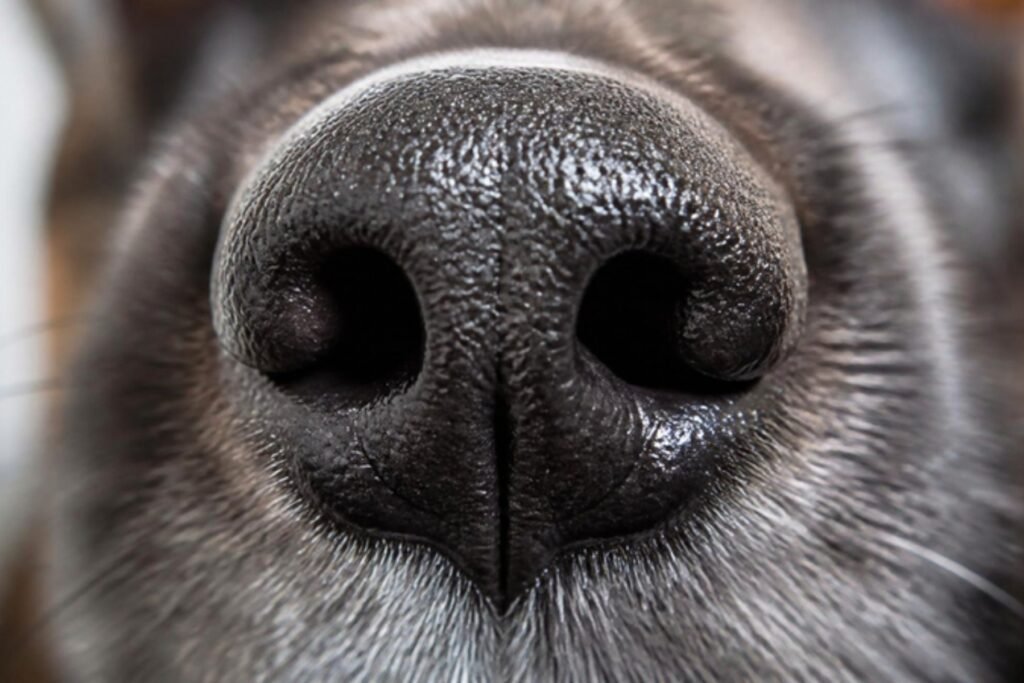
Every dog parent knows that cold, wet little boop. Sometimes it’s a gentle nudge on your hand. Sometimes it’s a surprise poke on the back of your leg while you’re cooking. Either way, it’s one of the most familiar feelings in the world if you live with a dog.
But have you ever wondered why their noses are wet in the first place? The answer turns out to be much cooler than I expected. That damp nose helps dogs smell, may help them feel heat from across the room, and even carries a pattern that’s as unique as a fingerprint.
Why is a dog’s nose wet?
According to VCA Animal Hospitals, a dog’s nose stays moist in a few ways:
- Mucus. Special glands inside the nose make a thin layer of mucus that keeps it damp.
- Licking. Dogs lick their noses often, which keeps them clean and wet.
- Exploring. Sniffing through grass, plants, and puddles adds a little extra moisture along the way.
And that moisture isn’t just an accident. It has a real job.
A wet nose is a better nose
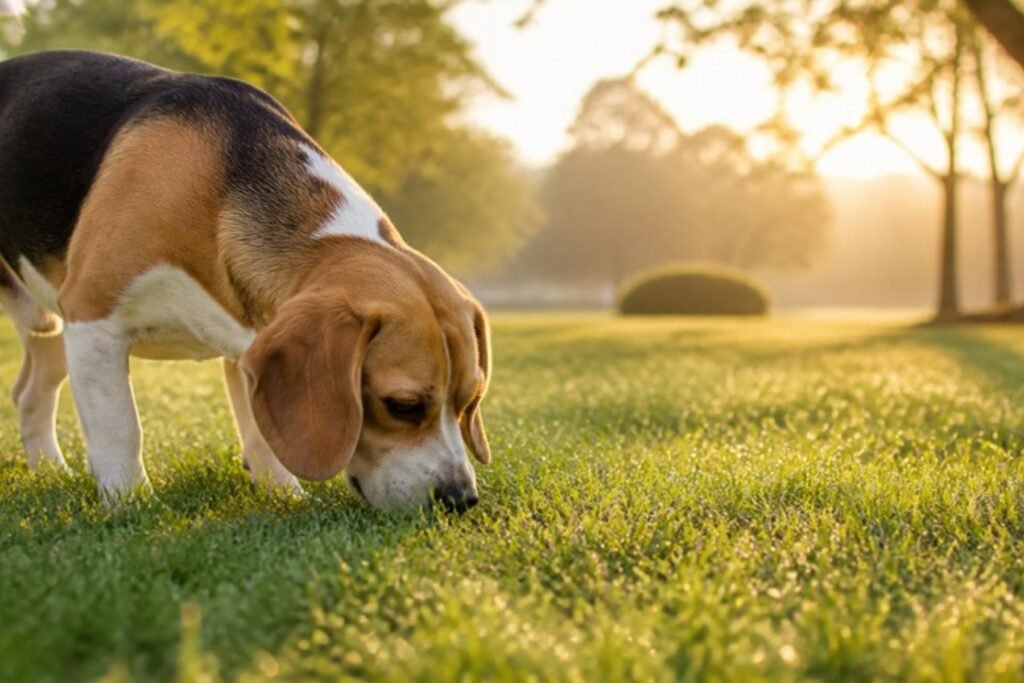
The American Kennel Club explains that scent particles stick better to moist surfaces. So a wet nose can catch and hold more smells from the air and the ground.
Here’s the part I love. When a dog licks their nose, they’re not only cleaning it. VCA notes that licking helps carry those scent particles to the roof of the mouth, where a scent organ called the vomeronasal organ, or Jacobson’s organ, can process them. In other words, dogs can almost “taste” a smell.
It’s no wonder their noses are so powerful. VCA says dogs have more than 100 million scent receptors, compared with about 6 million in people, and that they can smell somewhere between 1,000 and 10,000 times better than we can.
That cold nose may sense heat
This is the fact that really made me stop and say “wow.”
In 2020, researchers from Lund University in Sweden and Eötvös Loránd University in Hungary published a study in Scientific Reports showing that dogs can sense weak heat with the tip of their nose.
They found that a dog’s nose tip is usually colder than the air around it. At about 86°F (30°C), it was around 5°C (9°F) cooler, and on a freezing day, around 8°C (14°F) cooler. That cold, wet surface may make it easier to notice warmth.
In the experiment, trained dogs could tell a warm object from a neutral one from about 1.6 meters (a little over 5 feet) away, even though the two looked and smelled the same. Brain scans of 13 awake dogs also showed a response when they were shown something warm.
💡 Did you know? According to the researchers, the only other mammal known to have this kind of heat-sensing ability is the vampire bat. Lead researcher Ronald Kröger said it had taken “a rather long time” to discover, given how long dogs and people have lived side by side.
The team thinks this ability may have helped dogs’ wild ancestors find small, warm prey.
Every nose is one of a kind
Look closely at your dog’s nose and you’ll see a pattern of little bumps and grooves. That pattern is unique to each dog, a lot like a human fingerprint.
South Korea has even put this to work. A Korean startup called Petnow, working with researchers from Yonsei University, built an app that identifies dogs by photographing their noses, with a reported accuracy of about 99%. And in 2022, South Korea began testing nose-print ID as a possible alternative to microchips for pet registration.
Imagine finding a lost dog, snapping a quick photo of their nose, and helping them get home. That’s pretty amazing.
Does a dry nose mean my dog is sick?
This is a very common dog myth. A warm, dry nose doesn’t automatically mean your dog is unwell, and a cold, wet nose doesn’t guarantee they’re healthy.
The AKC lists plenty of normal reasons for a dry nose:
- Sleep. Dogs don’t lick their noses while they nap, so they often wake up with a dry nose. It usually gets wet again within about 10 minutes.
- Weather. Heaters, cold air, and wind can dry out a nose, just like they can chap our lips.
- Age. Some older dogs naturally have drier noses.
- Face shape. Flat-faced breeds like Pugs can have a harder time licking their noses.
💡 Good to know: if you want a better quick health check, the AKC suggests looking at your dog’s gums instead. Healthy gums are usually moist and pink. Pale, white, blue, or very dark red gums need a vet’s attention right away.
When to call the vet about a nose
A nose can still tell you something. Please check with your vet if you notice:
- a dry nose along with tiredness, vomiting, diarrhea, or not eating
- cracks, crusting, or sores on the nose
- thick, colored, or bloody nasal discharge
- a change in the color or texture of the nose
- sunburn on light-colored noses
Angel Jake Note 🐾
I don’t think I’ll ever feel a cold little boop on my hand the same way again. That wet nose is doing so much: catching scents we’ll never notice, maybe even feeling the warmth of the people it loves, and carrying a tiny pattern that belongs to only one dog in the whole world.
So the next time your dog presses their nose against you, take it as a compliment. You’re one of the most interesting things they know.
Medical Disclaimer
I’m not a vet, and nothing here replaces a real exam. If something about your dog feels off, please trust that feeling and call your veterinarian.
Sources
- VCA Animal Hospitals: Why Do Dogs Have Wet Noses?
- American Kennel Club: Why Is My Dog’s Nose Dry?
- Scientific Reports: Dogs can sense weak thermal radiation (2020)
- Lund University: Dogs can detect heat with noses, study finds
- Good News Network: All dogs have completely unique nose prints, and there’s an app to ID each pet
- Euronews: South Korea tests out “nose print” ID for national pet registration (2022)