
Have you ever thrown a bright red ball across the grass, only to watch your dog run right past it? I used to think that meant they weren’t paying attention. It turns out there’s a much better explanation, and it has to do with how differently dogs see the world.
The black-and-white myth
For a long time, many people believed dogs saw only in black and white. According to the American Kennel Club, that idea goes back to a 1937 dog training manual by Will Judy, which stated it without any real scientific evidence behind it. The myth stuck around for decades.
Then, in 1989, researchers led by ophthalmologist Jay Neitz tested dogs’ color vision directly and found that dogs do see color. Just not the same way we do.
So what colors can dogs see?
Our eyes have three kinds of color-sensing cells called cones. That’s why most people are trichromatic and can tell apart reds, greens, and blues.
Dogs have only two types of cones, which makes them dichromatic. The AKC explains that dogs mainly see the world in shades of blue and yellow, and combinations of the two. Reds and oranges tend to look like brownish-gray to them, and green can blend in with other muted colors.
The Color Vision Lab led by Neitz described it this way: a dog’s color vision is similar to that of a person who has red-green color blindness. Scientific American notes that this kind of color blindness affects about 8% of men and 0.5% of women, so some of us actually see the world a bit like our dogs do.
Why dogs see this way
The answer goes back to where dogs came from. The AKC explains that dogs’ ancestors were hunters who were often most active in low light, around dawn, dusk, and at night. In those conditions, seeing lots of color isn’t very useful. Seeing movement and shapes in the dark is.
So dog eyes are built differently from ours:
- More rods than cones. Rods are the cells that work well in dim light and pick up motion. Cones handle color and fine detail.
- A reflective layer behind the retina. It’s called the tapetum lucidum, and it bounces light back through the eye for a second chance to catch it. It’s also the reason dogs’ eyes glow in photos taken with a flash.
- Larger lenses that help gather more light.
Scientific American reports that dogs can see in about six times less light than we need. That’s a big advantage for a nighttime hunter, and a nice one for your evening walks.
Dogs aren’t as sharp-sighted as we think
Here’s another surprise. Dogs’ vision is blurrier than ours. Scientific American notes that dogs have about 20/75 vision, meaning a dog needs to be 20 feet away to see what a person with typical eyesight can see clearly from 75 feet.
That might explain why your dog sometimes barks at a friend across the street until they get closer or catch a familiar smell.
Where dogs beat us
What dogs lose in color and sharpness, they make up for in other ways. According to VCA Animal Hospitals, dogs are very sensitive to motion and have better low-light and peripheral vision than we do. A dog might miss a still toy lying in the grass, but notice a squirrel twitching at the far end of the yard in a split second.
And of course, dogs don’t rely on their eyes the way we do. Their noses do much of the heavy lifting. Scientific American even points to a 2022 study in the Journal of Neuroscience that found direct connections between the part of a dog’s brain that handles smell and the part that handles vision. The researchers think smell and sight may work together in dogs in ways we’re only beginning to understand.
The red ball problem
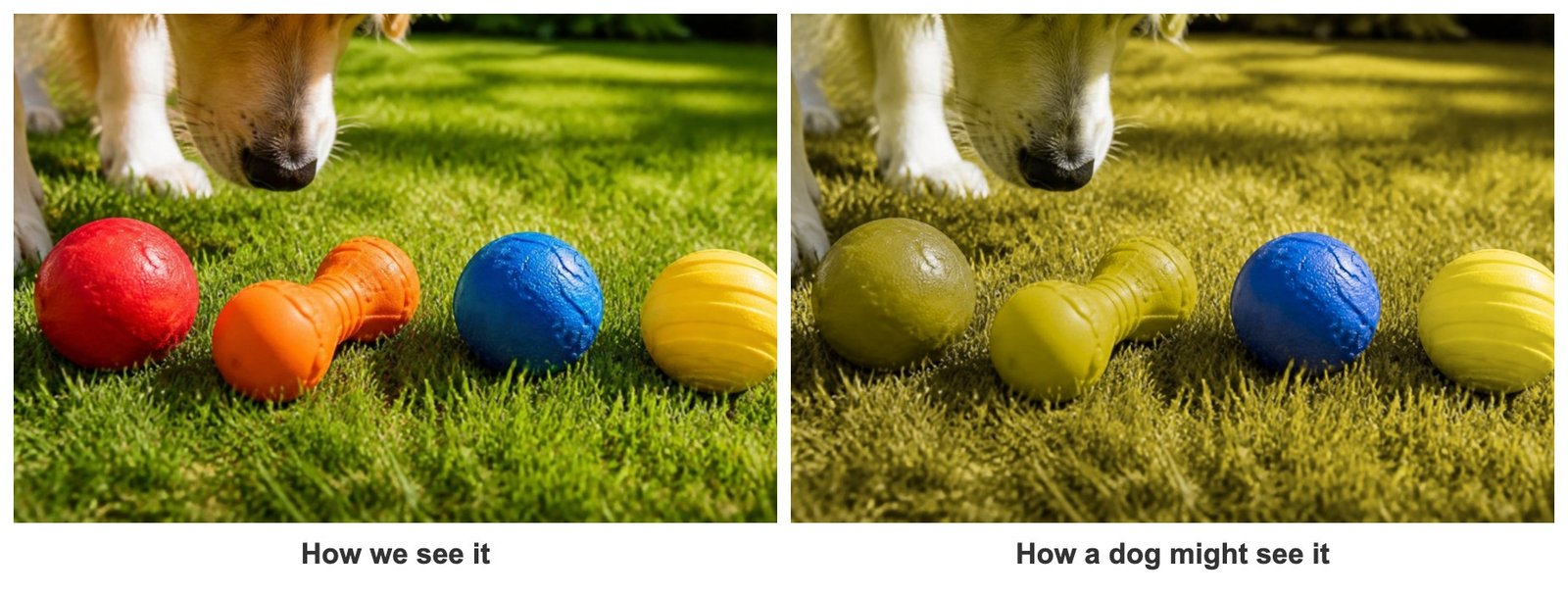
This is where it gets practical. Many dog toys are red or orange because those colors pop for us. But to a dog, a red ball on green grass can look like a dull brownish object on a dull background.
The AKC and VCA both suggest choosing blue or yellow toys, which stand out much more clearly for dogs. If your dog seems to “lose” their ball all the time, the color might be the reason, not their focus.
💡 Good to know: Blue and yellow toys are the easiest for dogs to spot, especially on green grass. It’s a simple way to make playtime a little easier for them.
The picture above is a simulation of red-green color blindness, which researchers say is similar to how dogs see color. Look at how the red ball and orange toy almost melt into the grass, while the blue and yellow balls still stand out.
A few more fun facts
Old TVs looked flickery to dogs. Earth.com explains that dogs need about 70 to 80 flickers per second to see smooth motion, compared with around 60 for people. Old tube TVs refreshed at about 60 times per second, which looked fine to us but likely jittery to dogs. Modern screens are fast enough, which may be why more dogs seem to watch TV today. A 2025 Auburn University study of dog owners even estimated that TV-watching dogs spend about 14 minutes a day looking at the screen.
Dogs “see” with their whole face. Many dogs rely on scent, sound, and even their whiskers to understand what’s around them, especially up close.
When to talk to your vet
It’s normal for dogs to see fewer colors than we do. But changes in how your dog sees are worth checking. Call your vet if you notice your dog bumping into things, hesitating on stairs, seeming nervous in dim light, or if their eyes look cloudy, red, or painful. Vision changes can happen with age and with some health conditions, and early checks help.
Angel Jake Note 🐾
I love learning things like this, because it helps me see the world a little more the way our dogs do. They might not see the bright red of a fall leaf or a birthday ribbon, but they notice movement we miss, see better than us in the dark, and read the world through their noses in ways we can barely imagine.
Next time you pick out a toy, maybe go for blue or yellow. It’s a small thing, but it’s a sweet way of meeting them where they are.
Sources
- American Kennel Club: Can Dogs See Color?
- Scientific American: What Colors Do Dogs See?
- VCA Animal Hospitals: Do Dogs See Color?
- Earth.com: The science behind dogs watching television
- Royal Kennel Club: Colour Vision in the Dog, A Brief Summary (PDF)
Related Reading
- Why Do Dogs Tilt Their Heads When We Talk to Them?
- Why Do Dogs Get the Zoomies?
- Caring for a Senior Dog: Changes You Shouldn’t Ignore as Your Dog Gets Older
Medical Disclaimer
I’m not a vet, and nothing here replaces a real exam. If something about your dog feels off, please trust that feeling and call your veterinarian.