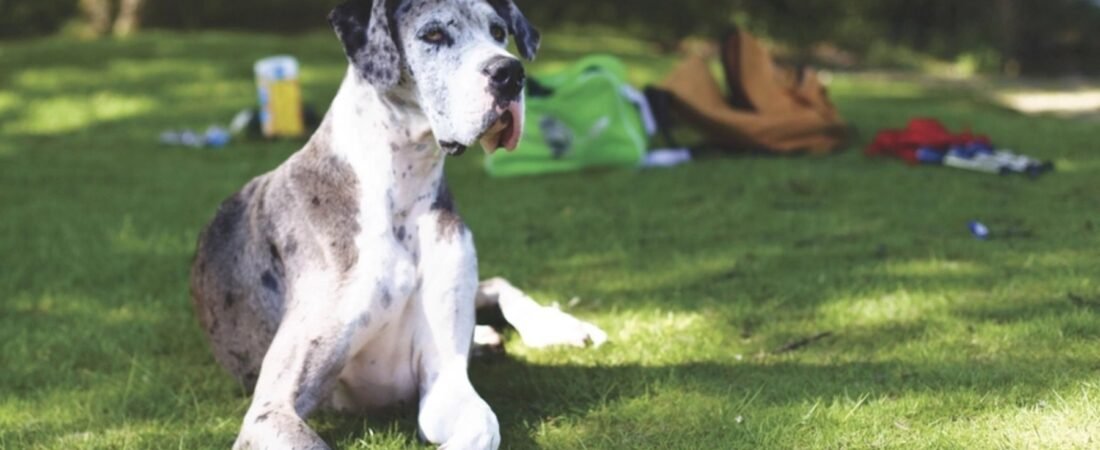
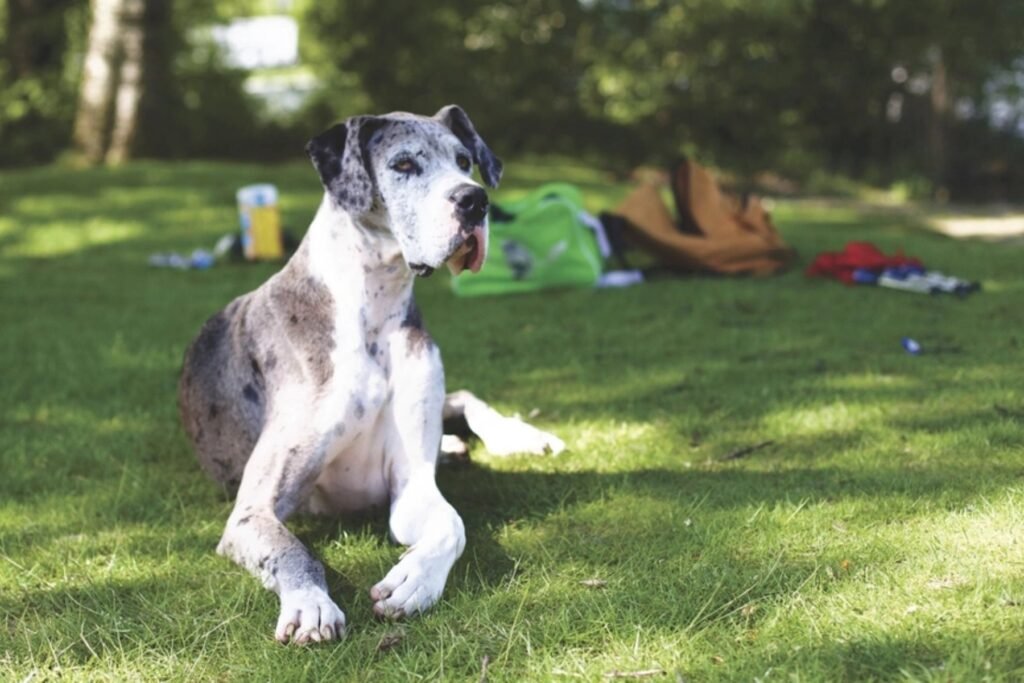
If you’ve ever loved a big dog, you probably know the unfair part already. The Great Dane who seems to go gray almost overnight. The small mixed breed down the street who’s still trotting around at fifteen.
People have noticed this for a long time, and scientists have measured it. What they haven’t had is a clear answer to the question underneath it: why do big dogs grow old so fast? A study published on Oct. 8, 2026, in the journal Science offers what its authors call the first compelling molecular explanation, and it points to something hiding inside the DNA itself.
What the new study looked at
The research comes from a team at Arizona State University, led by Noah Snyder-Mackler, with Blaise Mariner and Brianah McCoy among the scientists who did the work. The paper is titled “Epigenetic aging and transposon dysregulation reflect size-related lifespan compression in dogs.”
The dogs came from the Dog Aging Project, a long-term study of companion dogs based at the University of Washington. These aren’t lab animals. They’re pet dogs living ordinary lives with their families, and their owners sent in blood samples and filled out surveys.
The researchers looked at more than 860 dogs from roughly 120 breeds, according to coverage in Nature. From their blood, the team mapped more than 3 million spots where DNA carries tiny chemical tags called methyl groups.
Those tags are part of what’s called the epigenome. They don’t change the DNA sequence. Instead, they help decide which genes are switched on or off, a bit like sticky notes on a recipe book. The Arizona State release explains that these marks respond to things like diet and stress, and they’re a well-known marker of aging in many animals.
A clock written in DNA
Using those methylation patterns, the team built what scientists call an epigenetic clock. Nature reports that it could predict a dog’s age to within a year.
That’s useful on its own. But the clock also caught something more interesting. Some dogs looked “older” on the inside than their birthdays said they were. And those dogs had a higher risk of dying within the next two years, Nature reported.
Then came the size question. Large dogs tended to pile up these age-related changes faster than small dogs. “Using our biomarker, this epigenetic clock, big dogs were aging a little bit faster per year of life than small dogs,” Snyder-Mackler told Live Science.
The team also saw a difference between the sexes. In the Nature report, male dogs built up these changes faster than females, even males who had been neutered young.

So what are “jumping genes”?
This is where the story gets a little strange, and honestly kind of fascinating.
Scattered through a dog’s genome (and yours) are stretches of DNA called transposable elements, often nicknamed “jumping genes.” One family of them is known as LINE1. According to the university’s release, LINE1s can copy themselves and paste those copies into new places in the genome, sometimes jumping between chromosomes and damaging DNA along the way.
Normally, methyl tags keep them quiet. Think of it as a lid on a pot. The study found that as dogs age, that lid loosens. More than 40 percent of LINE1-related regions lost methylation with age, which made them the most affected group of jumping genes in the study.
And the lid loosened faster in bigger dogs. The release says giant breeds lost about 35 percent more LINE1 methylation per year than small breeds.
Why would that matter? When methylation fades, these elements can become more active. The release notes that higher activity has been linked to genomic instability, cancer, and other age-related diseases. “Faster aging in larger dogs may be driven, at least in part, by reduced control over these ‘jumping genes,’” Mariner said in the release.
The researchers also noticed another change in the blood. As dogs got older, their immune cells seemed to become more alike, a pattern Mariner described to Live Science as a “loss of cell identity.” He called it a key hypothesis for what happens to the body as it ages.
💡 Good to know: Across mammal species, bigger usually means longer-lived. The Arizona State release points out that lifespans range from a couple of years for mice to almost 200 years for some whales. Dogs flip that rule upside down, which is part of why scientists find them so interesting.
Why this has puzzled scientists for so long
The size gap in dog lifespans is real and large. Live Science notes that Great Danes and mastiffs rarely live more than a decade, while Chihuahuas can live twice as long. Nature adds that some of the largest breeds, like Irish wolfhounds, live 10 years or less on average.
Back in 2013, a team led by evolutionary biologist Cornelia Kraus at the University of Göttingen studied the records of more than 50,000 dogs from 74 breeds. Their conclusion, published in The American Naturalist, was that large dogs don’t start aging earlier. They age faster. In the researchers’ words, a big dog’s adult life seems to unwind “in fast motion.”
At the time, one leading idea involved a growth hormone called IGF-1. Small dogs tend to have lower levels of it, and high IGF-1 has been linked to age-related disease in many species.
The new study doesn’t replace that idea. It adds a molecular layer to it. Snyder-Mackler suggested to Live Science that breeding dogs for large size may have come with a cost: “Their bodies have to make this trade-off between really rapid growth and maintenance of that.”
💡 Worth knowing: In that same 2013 coverage, Inside Science reported that veterinarians suggest starting geriatric checkups at about age 11 for small dogs, 9 for medium dogs, and 7 for large dogs. Ask your own vet what timing makes sense for your dog.
A study from Korea found something related
This isn’t the only recent clock study with a surprise in it. In July 2026, a team led by Professor Kim Jaemin at Gyeongsang National University in Korea published a study in PNAS comparing the epigenetic aging of pet dogs in Korea and the United States.
According to Veritas Alpha (베리타스알파), the team studied 824 dogs, working with the university’s veterinary college and the National Institute of Animal Science under the Rural Development Administration. Their clock tracked real age very closely (a correlation of 0.98). When they compared dogs of the same breed, Korean dogs showed significantly faster epigenetic aging than American dogs. The team also found nine methylation sites tied to aging that showed up specifically in the Korean dogs.
The researchers suggested that differences in how dogs are raised, things like diet, exercise, and living environment, could be part of the picture. That’s an idea to test, not a proven cause. Still, it’s a good reminder that a dog’s clock may not be set by genes alone.

What this study can’t tell us yet
It’s an exciting paper, but it’s worth being clear about its limits.
First, it doesn’t prove that jumping genes cause aging. The university’s own release says more research is needed to find out whether LINE1 activity drives aging or is simply a result of it.
Second, the study used blood. Immune cells travel through the whole body, which makes them a reasonable window into aging, but they may not tell the full story for every organ.
Third, size explains only part of the picture. Snyder-Mackler was candid about that: “What we really want to know is, what explains the rest of that variation?”
And the dogs were volunteers. Dog Aging Project families sign up on their own, so the group may not perfectly reflect every dog out there.
There’s also no new treatment here, and nothing for owners to buy or try. The team told Live Science it hopes to build predictive models that might one day help owners anticipate their dogs’ age-related health concerns. That’s a goal, not a product.
Why it still matters
For people who live with big dogs, research like this won’t add years overnight. But it does move the question from “that’s just how it is” toward something scientists can measure and maybe, someday, slow down.
The release also notes that because dogs share our homes, our environments, and even some of our health care, what we learn from them could help people too. Snyder-Mackler went as far as to suggest that jumping genes may be a basic part of aging across mammals.
Angel Jake Note 🐾
I find this study a little bittersweet. It confirms something big-dog families already sense: the years go quickly. But it also shows that scientists are taking that feeling seriously enough to look for its roots in DNA.
If you share your home with a large or giant breed, this isn’t a reason to worry more. It might be a reason to ask your vet about senior checkups a bit earlier, and to notice the small changes that come with each birthday. Whatever size your dog is, the time you get with them counts.
A Note on This Study
This post summarizes a published study for everyday dog lovers. One study can’t tell the whole story, and its findings may not apply to every dog. For the full methods and limitations, please see the original research linked in the Sources section.
Sources
- Science (Mariner et al., Oct. 8, 2026): Epigenetic aging and transposon dysregulation reflect size-related lifespan compression in dogs (DOI: 10.1126/science.aeb2986)
- EurekAlert! (Arizona State University, Oct. 8, 2026): Why big dogs age faster
- Nature (Oct. 8, 2026): Big dogs age faster than little ones — rogue ‘jumping genes’ might be to blame
- Live Science (Oct. 8, 2026): Big dogs age faster at an epigenetic level, new study finds
- Live Science / Inside Science (2013): Large Dogs Age Faster, Die Younger
- Smithsonian Magazine (2013): Why big dogs die younger
- Veritas Alpha (베리타스알파): 경상국립대 연구진 한/미 반려견 후성유전학적 노화 차이 규명
- Gyeongsang National University ScholarWorks: Age-associated epigenetic drift trajectory and cross-national disparities in accelerated aging in domestic dogs (PNAS, 2026)