

Say “Bouba” out loud. Now say “Kiki.” If someone showed you a soft, blobby shape and a sharp, star-like one and asked which is which, you’d almost certainly give the round one to Bouba. Nearly everyone does.
It turns out your dog might, too. A study published on Oct. 14, 2026, in Proceedings of the Royal Society B found that pet dogs looked more at a rounded shape when they heard “Bouba” and more at a spiky shape when they heard “Kiki.” It’s a small study, and the researchers are careful about what it does and doesn’t prove. But it’s a lovely glimpse into how a dog’s brain might connect what they hear with what they see.
Wait, what’s the Bouba-Kiki effect?
It’s one of those odd little quirks of the human mind. People tend to pair made-up words that sound soft and open, like “bouba,” with rounded shapes, and sharp-sounding words, like “kiki,” with pointy ones. Nobody teaches us this. We just seem to feel it.
The idea goes back almost a century. Korea’s Electronic Times (전자신문) traces it to the psychologist Wolfgang Köhler, who described it in 1929. Since then, it has turned up again and again. A 2022 study of 917 people who spoke 25 different languages found that most of them matched bouba to the round shape and kiki to the spiky one. According to Nautilus, it even shows up in cultures without a written language, and in people who have been blind since birth when they’re given 3D versions of the shapes to touch.
💡 Did you know? The Bouba-Kiki effect has also been seen in 4-month-old babies, according to the Electronic Times. But in great apes like chimpanzees and gorillas, it hasn’t been confirmed. That’s part of why a result in dogs is so surprising.
So for a long time, scientists wondered if this was something tied to human language. Then animals started getting in on it.
How do you ask a dog about shapes?

The paper is titled “Hearing shapes: the Bouba-Kiki effect in adult domestic dogs.” It comes from a team at the University of Parma in Italy, with co-first authors Eleonora Biffi, a PhD student in neuroscience, and Giulia Pedretti, supervised by ethology professor Paola Valsecchi. Simona Normando and Maria Loconsole of the University of Padova and Teddy Lazebnik of the University of Haifa and Jönköping University also worked on it, according to Italian outlet Emilia Romagna News 24.
In total, 70 adult pet dogs took part across two experiments.
In the first, 51 dogs came into a room with their owners. There was a screen and a speaker on each side. One screen showed a rounded shape and the other showed a spiky one. For about 15 minutes, a human voice said “Bouba” or “Kiki,” and the shapes swapped sides so a dog’s favorite direction wouldn’t skew the results.
A GoPro filmed every dog. Then an AI tool tracked which way each dog’s head was pointing, as a stand-in for where they were looking. That’s a nice touch, because it keeps a human observer’s expectations out of the scoring.
Dogs matched the sounds to the shapes
Across the study, the pattern held. In the authors’ words, as quoted by ScienceAlert, “dogs looked significantly more at the rounded shape while ‘Bouba’ was played.” When “Kiki” played, the dogs explored the spiky shape more.
The Royal Society summed it up with a pun in its press release headline: “Who’s a good bouba?”
There was a twist, though. In that first experiment, the dogs also showed a general pull toward the spiky shape, no matter which word they heard. Emilia Romagna News 24 reports that dogs tended to glance at the spiky shape first, whatever the sound.
Dogs seem to favor the spiky shape more than chicks and children do, and the authors don’t know why yet. They suggest it could come from something about dogs as a species, from each dog’s own experience, or even from the kinds of objects dogs usually interact with.
One idea they float is a little poetic. Dogs’ faces, especially those of wolves and ancient breeds, are more angular and “spiky” than the round faces of human babies. Maybe that shapes what catches a dog’s eye.
💡 Good to know: This study doesn’t mean your dog understands the words “bouba” and “kiki,” or thinks about shapes the way you do. It measured where dogs pointed their heads. The researchers see it as a sign that dogs may link certain sounds with certain shapes, and they say bigger studies are needed to confirm it.
What if the owners were giving it away?
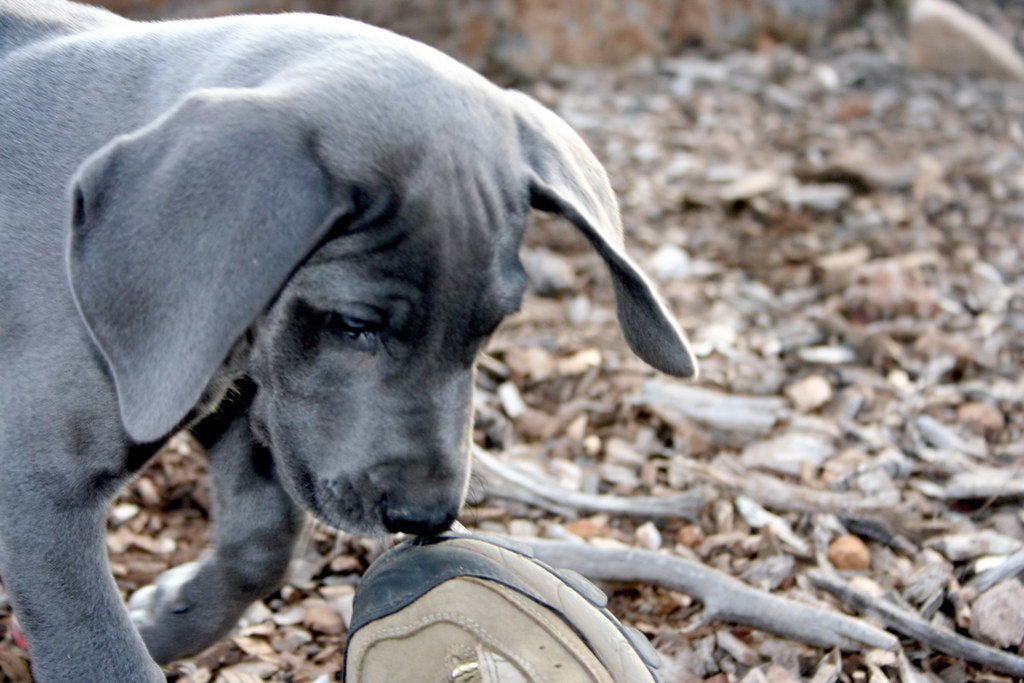
If you’ve ever watched a dog “read” your face before you’ve said a word, you know how sharp they are at picking up human cues. In animal research, an owner accidentally steering their pet toward the “right” answer is known as the Clever Hans effect.
The researchers knew this was a risk. “It could be hypothesized that the dogs were influenced by the owners’ unintentional cues,” they wrote, as quoted by ScienceAlert.
So they ran a second experiment with 19 different dogs. This time, the owners wore headphones playing rock music, so they couldn’t hear which word was coming out of the speakers.
The sound-shape matching was still there. What vanished was the dogs’ general bias toward the spiky shape.
The team thinks owner cues are an unlikely explanation for the main result anyway. As Nautilus points out, people generally prefer rounded shapes, so if dogs were simply copying their humans, you’d expect them to lean round, not spiky.
Dogs, chicks, and maybe monkeys
Dogs aren’t the first animals to show this effect. Earlier in 2026, a study in Science reported that newly hatched chicks made the same link. Korea’s Electronic Times covered it in February, describing chicks as young as one day old moving toward the round picture for “bouba” and the spiky one for “kiki.” Loconsole, one of the chick researchers, explained that the chicks don’t have human language. They seem to have a bridge between the senses, one that humans later put to use for language.
Then, in August, ZDNet Korea reported on a preprint in which nine monkeys in Singapore picked a round lid after hearing “bouba” and a spiky lid after “kiki.” That work hadn’t been peer-reviewed yet, so it’s an early hint, nothing more.
Put together, the picture is intriguing. The press release says the dog findings suggest a broader link between the senses may be at work, not just language. According to Emilia Romagna News 24, the dog study is part of a bigger comparative project that also tests chicks and children at the University of Padova.
The team now wants to know whether the effect shows up early in a dog’s life, how common it is across species, and whether domestication and life alongside people made it stronger.
The fine print
The authors don’t oversell any of this, and their caveats are worth knowing.
Seventy dogs is a modest number, and only 19 were in the headphone experiment. Head direction is only a rough stand-in for where a dog is looking, and looking time is an indirect way to read anything going on inside a dog’s mind. Nature World News notes that results weren’t reported by breed, age, or training history, so we don’t know whether, say, a well-trained working dog would respond differently from a couch-loving pet.
💡 Good to know: The study tested adult dogs only. Whether puppies make the same link, or whether it grows with years of listening to people, is still an open question the researchers want to explore.
So what does this mean for you and your dog?
For owners, there’s no training tip hiding in here. You don’t need to start calling your dog’s round ball a “bouba.”
But it adds to a growing sense that dogs process our voices in richer ways than we often assume. The sounds we make may carry hints about the world for them, not just commands. And it’s another reminder that some of the “human” quirks we take for granted may be much older, and much more widely shared, than we thought.
Angel Jake Note 🐾
Studies like this one are a nice change of pace. There’s nothing to worry about and nothing to fix, just a small window into how a dog might experience the world.
What stays with me is how much effort went into making sure the owners weren’t quietly giving the answers away. That says a lot about how closely our dogs watch us. The next time you’re chatting away to your dog and they tilt their head like they’re really listening, it’s nice to think that some of those sounds might feel round or sharp to them, too.
A Note on This Study
This post summarizes a published study for everyday dog lovers. One study can’t tell the whole story, and its findings may not apply to every dog. For the full methods and limitations, please see the original research linked in the Sources section.
Sources
- Proceedings of the Royal Society B (Biffi, Pedretti et al., Oct. 14, 2026): Hearing shapes: the Bouba-Kiki effect in adult domestic dogs (DOI: 10.1098/rspb.2026.1209)
- Scimex (The Royal Society press release, Oct. 14, 2026): Our dogs might associate sounds with shapes the way we do
- ScienceAlert (Oct. 14, 2026): Dogs Seem to Agree With Humans That ‘Bouba’ Is Round And ‘Kiki’ Is Spiky
- Nautilus (Oct. 15, 2026): Even Dogs Seem to Experience the Mysterious Bouba/Kiki Effect
- Nature World News (Oct. 15, 2026): Dogs Seem to Link the Word Bouba with Round Shapes and Kiki with Spiky Ones, Just Like Humans
- Emilia Romagna News 24 (Oct. 15, 2026): Effetto Bouba-Kiki: anche per i cani i suoni hanno una “forma”
- Electronic Times (전자신문, Feb. 21, 2026): “외국인이 욕 알아듣는 이유”… 병아리도 ‘언어 모양과 소리’ 연결 짓는다
- ZDNet Korea (Aug. 8, 2026): 원숭이도 사람처럼 소리와 모양 연결해 연상했다