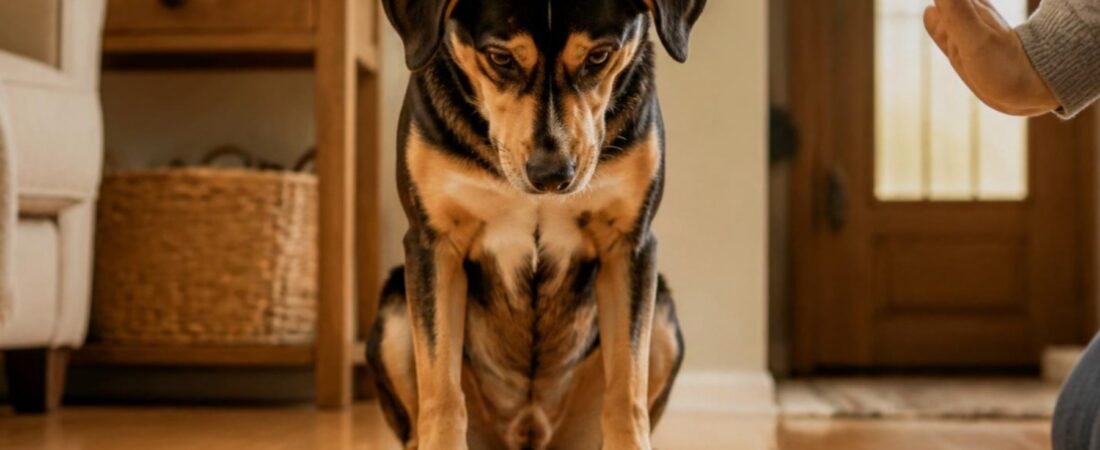
If you’ve ever told your dog to “wait” with a treat sitting right in front of them, you know the look. The stare. The tiny drool. The way their whole body seems to be holding its breath.
It turns out something real is happening inside their head in that moment, and a new study suggests it looks a lot like what happens in ours when we try to resist temptation.
What the researchers did
The study was published in September 2026 in the journal Animal Cognition by Márta Gácsi, Ivaylo Iotchev, and Anna Kis from Eötvös Loránd University (ELTE) in Budapest and the HUN-REN Research Centre for Natural Sciences in Hungary.
They worked with 14 dogs who already knew how to wait for a reward. Each dog wore small EEG sensors, a gentle, non-invasive way of recording brain waves from the surface of the head. Then their owners placed a treat within reach and asked the dogs to wait for about 30 seconds before they were allowed to take it.
The team collected 226 short brain recordings and compared the dogs’ brain activity while they were waiting with their activity while they were simply resting.
What they found
While the dogs were holding back, the researchers saw an increase in theta waves, a type of brain rhythm that cycles about 4 to 8 times per second, at the front of the head. They also saw a drop in broader background brain activity.
Here’s why that matters. In people, that same combination is often linked to cognitive control, the mental effort we use to stop ourselves from doing something we really want to do. Think of skipping dessert, not checking your phone, or biting your tongue in an argument.
In other words, your dog may not be waiting on autopilot. Their brain seems to be working at it.
Automatic or effortful?
Iotchev explained the question behind the study with a comparison I really liked. A mouse freezing in fear is an ancient, automatic reaction. A person trying to quit smoking has to use conscious effort and willpower. The researchers wanted to know which one a waiting dog looks more like, and their results point toward the second.
💡 Did you know? In people, this kind of brain pattern often shows up when we’re working hard to stop ourselves from doing something we really want. So when your dog holds a “wait,” it may be taking real effort.
Don’t take it too far
The researchers were careful about the limits of their work, and I think it’s worth sharing them:
- Only 14 dogs were tested, and all of them were already trained to wait.
- EEG sensors on the scalp can only record from a few spots.
- Theta waves show up in other mental processes too, like attention and anticipation, so the team can’t say for sure that they measured self-control alone.
So this isn’t proof that dogs think exactly like us. But it’s a fascinating clue.
A little background: the famous marshmallow test
This study reminded me of the well-known “marshmallow test” from Stanford in the late 1960s and early 1970s, when psychologist Walter Mischel offered young children one treat now or two treats if they could wait. It became one of the most famous experiments about self-control ever done.
Dogs can’t be offered a better deal in words, of course, but a “wait” cue is a lot like a canine version of that same challenge.
Why this could matter for people too
The researchers also noted that EEG is cheaper and easier to use than an MRI scanner, which means studies like this could be done with more dogs in the future. And because dogs live alongside us and age faster than we do, the team suggested this kind of research might someday help scientists understand self-control problems in people too, such as ADHD or overeating.
What this means for you and your dog
A few gentle takeaways I’m keeping in mind:
- Waiting is hard work. If your dog breaks a “wait,” they may simply be tired, overexcited, or asked to hold on too long. Start with a few seconds and build up slowly.
- Keep practice sessions short. Mental effort is tiring for dogs too. Several quick sessions usually work better than one long one.
- Reward the effort. When your dog manages to hold back, that deserves a real “good job” and a well-earned treat.
💡 Good to know: Start with just two or three seconds of waiting, then reward. Add time slowly. Lots of small wins build a dog’s confidence much faster than a few long, hard tries.
Angel Jake Note 🐾
I love that science is starting to show what so many of us already feel: that our dogs are really trying. When your dog sits there trembling beside a treat because you asked them to, they’re not just following a rule. They’re choosing to trust you and hold on a little longer.
That’s worth celebrating every single time.
Sources
- Animal Cognition: A human-like EEG signature of cognitive control in the domestic dog (2026)
- Earth.com: Dogs show a surprisingly human-like brain response while resisting temptation
- Talker News: What happens in a dog’s brain when it’s told to wait?
Related Reading
- Your Dog Is Listening to Your Consonants
- How to Tell If Your Dog Is Stressed
- Why Does My Dog Follow Me Everywhere?
Medical Disclaimer
I’m not a vet, and nothing here replaces a real exam. If something about your dog feels off, please trust that feeling and call your veterinarian.