

You come home after a long day, and before you can even put your bag down, your dog is there. Tail going, whole body wiggling, and then the licks start. Your hands, your chin, maybe your ankles if that’s all they can reach.
Most of us take it as a kiss. Sometimes that’s exactly what it is. But licking is one of the most useful tools a dog has, and it can mean a handful of different things depending on the moment.
It started with puppies and their mothers
Dr. Alexandra Horowitz, who runs the Horowitz Dog Cognition Lab at Barnard College, explained to the American Kennel Club that puppies lick their mother’s face and muzzle when she returns from a hunt, to get her to regurgitate food for them.
Not the most romantic origin story, I know.
Over time, though, that begging behavior changed shape. Horowitz says licking “has now become a ritualized greeting for many dogs.” So those licks at the door may carry a little of that ancient “welcome home, what did you bring?” along with the joy of seeing you.
Yes, a lot of it is love
PetMD notes that dogs commonly lick one another’s faces as part of social bonding, grooming, affection, and appeasement. It makes sense that they’d offer the same gesture to the people they live with.
Certified applied animal behaviorist Dr. Mary Burch told the AKC that licking can be a sign of affection, and that it may give a dog a sense of security and comfort, “just as the dog had when licked by its mother.”
There’s something for the dog in it, too. Both the AKC and PetMD point out that licking releases endorphins in a dog’s brain, which can help them feel calm and relaxed.
You might just taste interesting
Human skin is slightly salty, especially after a workout, and Burch told the AKC that some licks may be more about the salt than the affection.
Feet are a big target for this reason. According to PetMD, the soles of your feet have a high concentration of sweat glands, and as sweat dries, it leaves behind salt and other compounds many dogs find appealing. Lotion, shampoo, body wash, and shaving products can draw a curious tongue as well.
Licking helps dogs gather information about scents and tastes, so your freshly moisturized hands are basically a fascinating news report.
Licking gets results (and dogs notice)
If every lick earns a laugh, a “good girl,” a scratch behind the ears, or a snack, your dog is going to keep doing it. The AKC describes this as positive reinforcement, and PetMD adds that foot licking in particular can turn into a game when a dog finds the reaction rewarding. That’s not a bad thing. It just means licking has become one of the ways your dog asks for attention.
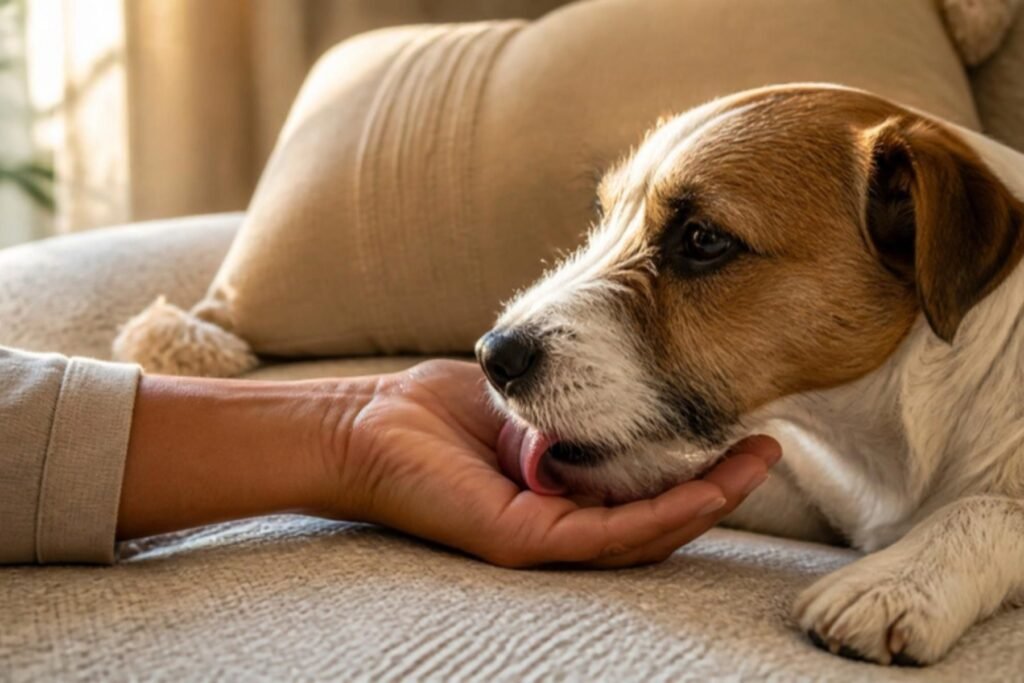
Sometimes a lick means “I need a little space”
Licking can also be a way for a dog to cope with feeling overwhelmed. PetMD describes it as a possible calming signal or displacement behavior.
Ellen Furlong, a psychology and neuroscience professor at Transylvania University, told Popular Science that some dogs “lick to dismiss.” In those moments, the licks are a polite way of asking you to back off, and it’s a meaning owners can easily miss.
💡 Did you know? In a study published in the journal Behavioural Processes, researchers from the University of Lincoln and the University of São Paulo found that dogs licked their lips when they saw angry human faces, but not when they only heard angry voices. The researchers linked this behavior to the dogs’ perception of negative emotions.
When licking might be a sign of a problem
Most licking is perfectly normal. Still, PetMD notes that excessive or persistent licking can sometimes point to a behavioral or medical issue, including anxiety, allergies, skin infections, pain, or digestive trouble.
It’s worth a closer look if your dog:
- licks you, themselves, or objects so much it’s hard to interrupt them
- keeps licking their own paws or one spot on their body
- starts licking much more than usual, seemingly out of nowhere
⚠️ Please don’t wait. If the licking is constant, hard to stop, or comes with irritated skin, signs of pain, or an upset stomach, call your vet. The AKC notes a vet may recommend medical treatment or a visit with a behavior specialist.
Is it safe to let your dog lick you?
Dog saliva does carry germs. The CDC explains that many kinds of bacteria live in the mouths of dogs and cats, including a common group called Capnocytophaga.
These germs can make people sick if a dog bites them or if the dog’s saliva gets into an open wound or sore. The CDC calls this infection rare but potentially serious, and notes that most people who have contact with dogs and cats do not get sick.
💡 Good to know: According to the CDC, people with weakened immune systems are at higher risk for serious illness, including people with cancer, diabetes, or HIV; people taking medicines that weaken the immune system; and people without a spleen. If that’s you or someone in your home, it’s a good idea to keep licks away from any cuts or scrapes.
The simple rule: don’t let your dog lick open wounds, and wash your hands after a slobbery greeting, especially before you eat.
How to gently redirect the licking
If you’d like a little less licking, there’s no need to scold your dog, who is usually just trying to connect with you. Burch suggests redirecting them to something that can’t happen at the same time as licking, like an interactive puzzle, a game of fetch, or some trick training.
The AKC also mentions lick mats topped with a dog-safe spread, which give all that licking energy a better place to go. Extra enrichment and exercise can also help when the licking comes from boredom.
Angel Jake Note 🐾
It’s easy to feel a little guilty about wanting fewer licks, as if we’re turning down a gift. Setting a gentle boundary is okay, and our dogs have plenty of other ways to show us they care.
What I love about this topic is how much a lick can say. “Hello.” “I missed you.” “You taste like lotion.” “I’m a bit worried.” “Please give me some space.” Once you start watching the rest of your dog’s body along with that tongue, you’ll understand them a little better every day.
Medical Disclaimer
I’m not a vet, and nothing here replaces a real exam. If something about your dog feels off, please trust that feeling and call your veterinarian.
Sources
- American Kennel Club: Why Does My Dog Lick Me? Why Do Dogs Lick People?
- American Kennel Club: Why Do Dogs Lick?
- PetMD: Why Do Dogs Lick You? Common Reasons Explained
- Popular Science: Why do dogs lick humans? It could be a sign of affection.
- ScienceDaily: Dogs mouth-lick to communicate with angry humans (2017)
- CDC: About Capnocytophaga