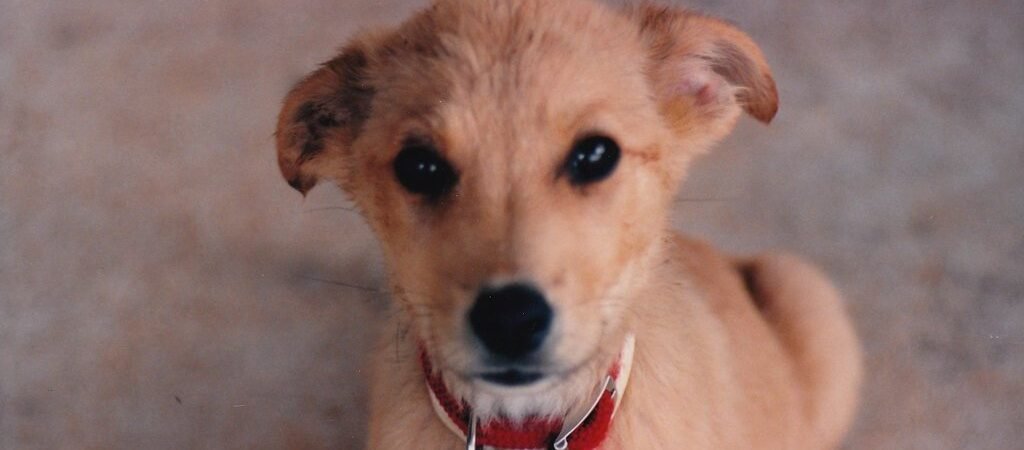

You’re on the couch, eating dinner or scrolling your phone, and you can feel it. Two eyes, locked on you. You look over, and sure enough, your dog is staring right at you without blinking.
It can feel sweet one minute and a little unnerving the next. Is it love? Hunger? Something you’re supposed to understand? Usually it’s one of a handful of ordinary things, and once you know what to look for, that stare starts to make a lot more sense.
Sometimes it really is just love
The American Kennel Club (AKC) puts it simply: “a lot of dog staring is exactly what it seems — an expression of love.”
There’s even some chemistry behind it. In 2015, a team led by Miho Nagasawa at Azabu University in Japan published a study in Science showing that when dogs gazed at their owners, the owners’ oxytocin went up, and then the dogs’ did too. The researchers described it as “an interspecies oxytocin-mediated positive loop,” and wolves didn’t show the same response. I went into that study in more detail in Why Does My Dog Lean on Me?, so I’ll keep it short here. Put simply, a soft, lingering look from your dog can be good for both of you.
“Hey. It’s dinnertime.” (The asking stare)
A lot of staring is far more practical. The AKC calls it “the canine equivalent of a tap on the shoulder.” If your dog stares at you while you eat, sits by their empty bowl and looks back at you, or watches you the moment you go near the leash, they’re asking for something.
Dogs also stare because they’re watching for what’s coming. According to the AKC, they’re often waiting for us to do something that will affect them, like picking up the leash for a walk. Dogs who’ve been trained with treats and praise tend to keep an eye out for the next chance to earn one.
And yes, some of it is a bit of strategy. The AKC notes that “some dogs stare to manipulate their owners and get something they want.” If a long stare at the dinner table has paid off before, your dog has learned that it works. The AKC’s advice is to stop giving in to the begging and reward a different behavior instead.
Your dog is reading your face
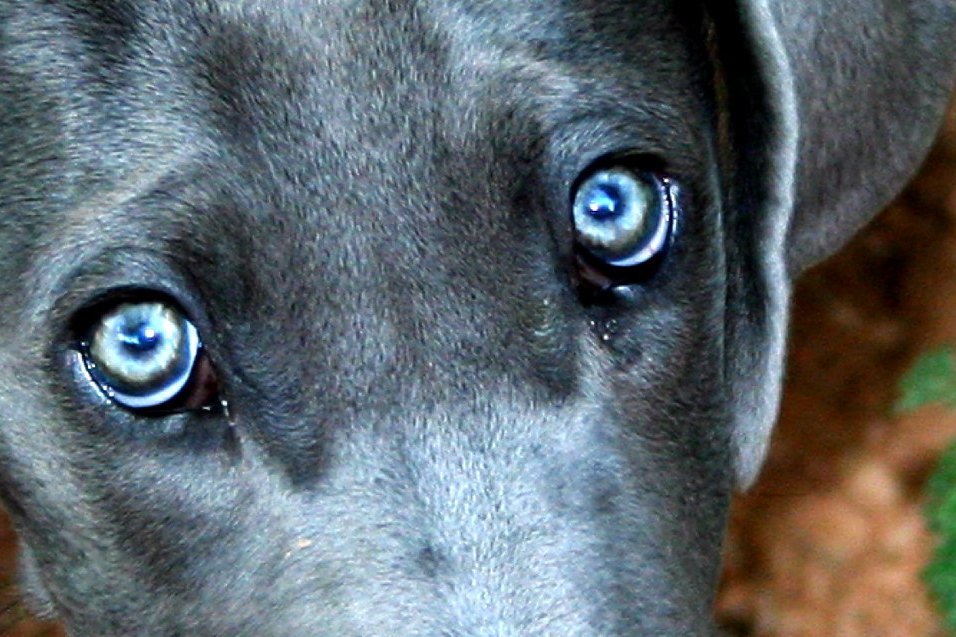
This is the part I find most fascinating. Your dog isn’t only looking at you. They’re reading you.
In a 2003 study published in Current Biology, a team of Hungarian researchers including Ádám Miklósi gave dogs and wolves a simple food task and then quietly made it impossible to solve. The dogs turned and looked at the nearby person. The wolves didn’t, even though they’d been raised around people. The authors concluded that a dog’s readiness to look at a human’s face is one of the key differences between the two.
Dogs are also good at following where we point and look. A 2010 review in Biological Reviews by Monique Udell, Nicole Dorey, and Clive Wynne describes a 2002 study by Brian Hare and colleagues that tested seven pet dogs and seven wolves. As a group, the dogs could find hidden food using every kind of human cue tested, including a tap or a point toward the right container. The wolves only managed it when a person pointed and looked at the same time, and no single wolf beat chance on any cue. Socialized wolves can learn to follow a simple point when the hand nearly touches the object, the review notes, but chimpanzees, our close relatives, are “much less sensitive to these kinds of cues” than dogs.
It even seems to matter how you get their attention. In a 2012 eye-tracking study in Current Biology, Ernő Téglás, József Topál, and colleagues showed dogs videos of a person turning toward one of two pots. Dogs were more likely to follow the person’s gaze when the person first made eye contact and said “Hi dog!” in a high-pitched voice. Topál compared dogs’ social skills to those of a child between 6 months and 2 years old.
Korean media have covered this kind of research too. In 2009, 코메디닷컴 (Kormedi) reported on a study led by Gabriella Lakatos, also at Eötvös Loránd University, that compared 15 adult dogs with two- and three-year-old children on understanding pointing. The dogs did about as well as the two-year-olds, while the three-year-olds were the only ones who could follow the trickiest gesture, a point made with the knee.
💡 Did you know? Dogs seem to know when you’re not watching them. According to the Udell review, dogs in a 2003 study by Josep Call and colleagues avoided food they’d been told not to eat while their owner was watching, but most of them readily ate it when the owner wasn’t looking or couldn’t see them.
The “puppy dog eyes” are real (and they evolved)
You know the look. The inner brows lift, the eyes go wide, and suddenly you’re sharing your toast.
In 2019, a team led by Juliane Kaminski at the University of Portsmouth published a study in PNAS that compared the facial muscles of six domestic dogs and four wild wolves. They found that a small muscle called the levator anguli oculi medialis, which raises the inner eyebrow, was present in the dogs. In the wolves, there were only scant fibers or a small tendon where it would be.
According to the paper, this movement makes the eyes appear bigger, hence more infant-like, and it resembles a facial movement humans make when they’re sad. That combination may trigger a nurturing response in us. When the researchers filmed 27 shelter dogs and nine wolves for two minutes each, the dogs made the eyebrow movement far more often.
“To see this kind of soft tissue change in the timespan of [dog domestication] is remarkable,” co-author Bridget Waller told PBS NOVA. The paper puts domestication at over 33,000 years ago, which is a short stretch in evolutionary terms.
Soft eyes vs. a hard stare
Not every stare is friendly, and this is the one worth learning to recognize.
The ASPCA describes a happy, relaxed dog’s eyes as “soft and open.” Sometimes they’re even a little squinty and almond-shaped with no white showing. That’s the gaze you usually get on the couch.
A warning stare looks very different. The ASPCA describes “hard, staring eyes” with a tense forehead, and a still body with an intense stare and tight facial muscles as a threatening display. Watch for “whale eye,” too, when a tense dog shows a lot of white around the outside of the eye. The AKC says a hard stare comes with “unblinking eyes and a stiff posture,” and that “resource guarding is often accompanied by a hard stare and other aggressive body language.”
If you see that, the AKC recommends avoiding eye contact and calmly backing away to give the dog some space. If it happens often with your own dog, a professional trainer or behaviorist can help you figure out what’s behind it. With a shy or newly adopted dog, the AKC suggests not staring into their eyes and giving them time to get used to you.
Why does my dog stare at me while they poop?
It’s a slightly awkward question, but a fair one. VCA Animal Hospitals explains that a dog doing their business is in a vulnerable position, so they may be looking to you for protection and watching your body language for any sign of danger.
VCA offers a couple of other ideas. Many puppies were praised or given treats for going outside, and dogs don’t forget that. Your dog may also be checking that they picked the right spot. On the other hand, some dogs prefer privacy and will tuck themselves behind a bush. VCA says that just means they feel safer that way.
The AKC adds a related one: a dog who sits by the door and stares at you may simply need to go out.
💡 Good to know: If the “I need to go out” stare is easy to miss in your house, the AKC suggests teaching your dog a clearer signal, like ringing a bell by the door.
When an older dog stares at the wall
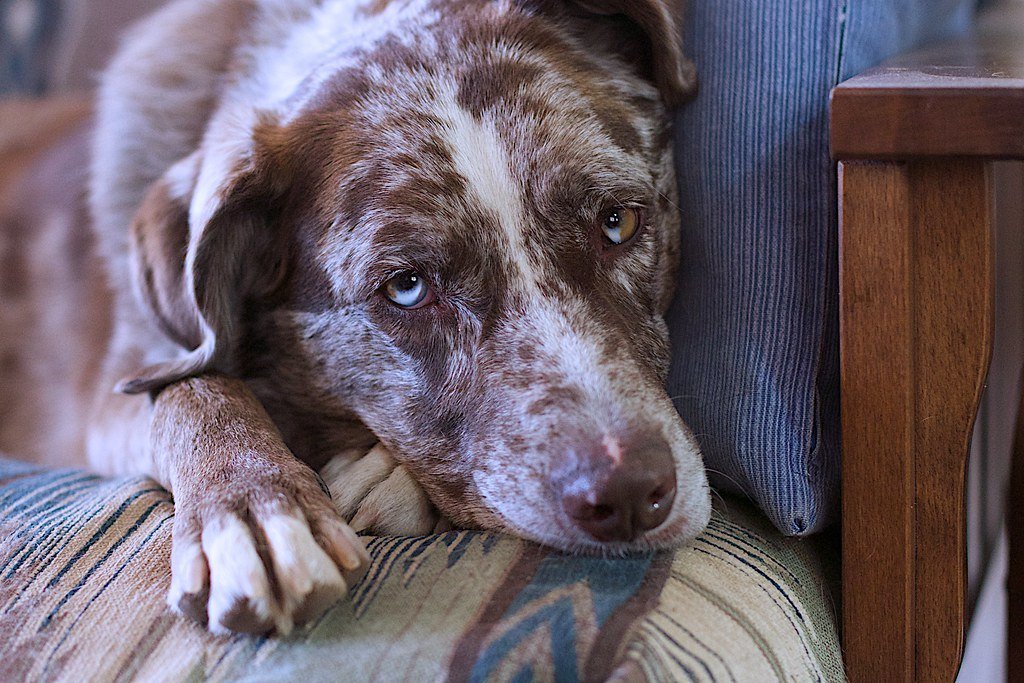
A senior dog who stands and stares at a wall or into space is a different situation, and it’s worth paying attention to.
The AKC lists a few possible reasons, including a dog hearing pests inside the wall that you can’t hear. But in older dogs, one of the big ones is canine cognitive dysfunction syndrome (CDS), which the AKC describes as “similar to Alzheimer’s disease in people.” According to the AKC, as many as 28 percent of dogs aged 11 to 12 have CDS, and the number rises with age. Many cases go undiagnosed because the signs tend to show up one or two at a time.
The AKC groups the signs of CDS under the acronym DISH: disorientation (like wandering aimlessly, getting stuck in corners, or staring at walls), changes in how your dog interacts with people, changes in sleep, and lapses in house-training.
Staring can also be a sign of something else. The AKC explains that staring at a wall or into space can be a symptom of a focal (partial) seizure, which can have causes ranging from epilepsy to cancer, and poisoning should be ruled out. The good news is that in most cases, these seizures can be managed with medication.
⚠️ Please don’t brush it off as just “getting old.” If your dog stares at walls repeatedly, or the staring comes with other changes in behavior, call your vet. The AKC recommends writing down the date, time, and how long each episode lasts, and taking a video to show your vet.
Fun facts 🐾
The puppy eyes may help dogs get adopted. The 2019 PNAS paper points to earlier research by Waller and colleagues, published in 2013, that found shelter dogs who raised their inner eyebrows more often were rehomed faster.
Huskies are a little more wolf-like here. In the same study, the Siberian Husky was the only dog that lacked one of the eye muscles the researchers looked at. The authors note that the breed is one of the more ancient breeds, more closely related to wolves than many others.
Dogs make that face more when you’re looking. The PNAS paper also cites a separate study finding that dogs produce the inner-eyebrow raise more often when a human is looking at them.
Angel Jake Note 🐾
Most of the time, when your dog stares at you, they’re asking for something, watching to see what you’ll do next, or just enjoying being near you. That’s a pretty lovely thing to be on the receiving end of.
What helps most is reading the whole dog, not just the eyes. Soft eyes and a loose body usually mean all is well. A frozen, hard stare deserves a little space. And if an older dog starts staring at walls or seems lost in familiar rooms, trust that nagging feeling and talk to your vet. Your dog spends so much time reading you. It’s worth learning to read them back.
Medical Disclaimer
I’m not a vet, and nothing here replaces a real exam. If something about your dog feels off, please trust that feeling and call your veterinarian.
Sources
- American Kennel Club: Why Does My Dog Stare at Me?
- Asian Scientist: Can’t Ignore Those Puppy Dog Eyes? Oxytocin Explains Why (on Nagasawa et al., *Science*, 2015)
- Current Biology (Miklósi et al., 2003): A simple reason for a big difference: wolves do not look back at humans, but dogs do
- Biological Reviews (Udell, Dorey, and Wynne, 2010): What did domestication do to dogs?
- ScienceDaily: Dogs’ gaze following is tuned to human communicative signals (on Téglás et al., *Current Biology*, 2012)
- PNAS (Kaminski et al., 2019): Evolution of facial muscle anatomy in dogs
- PBS NOVA: Canines evolved puppy dog eyes to woo human companions
- ASPCApro: Canine Body Language Tips
- American Kennel Club: Why You Shouldn’t Stare Down a Dog
- VCA Animal Hospitals: Why Do Dogs Stare at You While They Poop?
- American Kennel Club: Why Is My Dog Staring at the Wall?
- 코메디닷컴 (Kormedi): 개와 두살아기, 인지능력 비슷