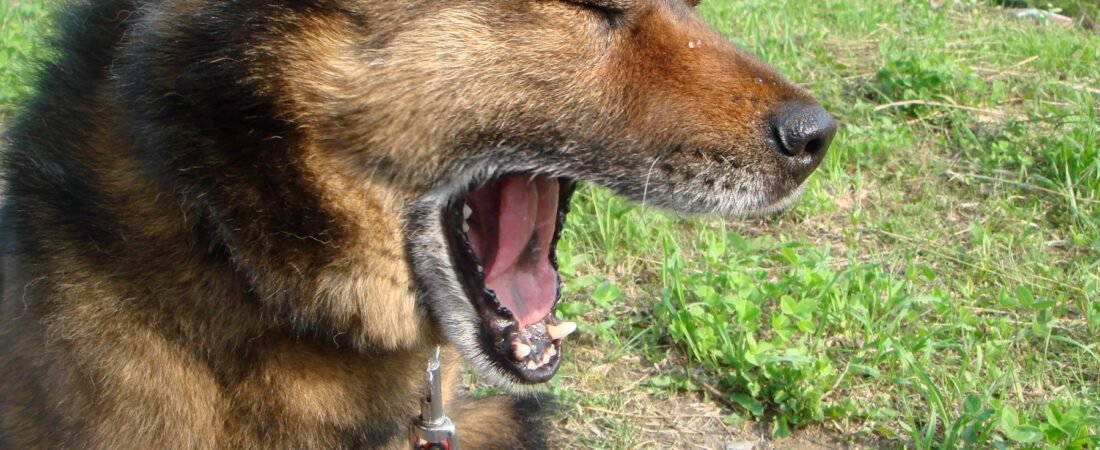
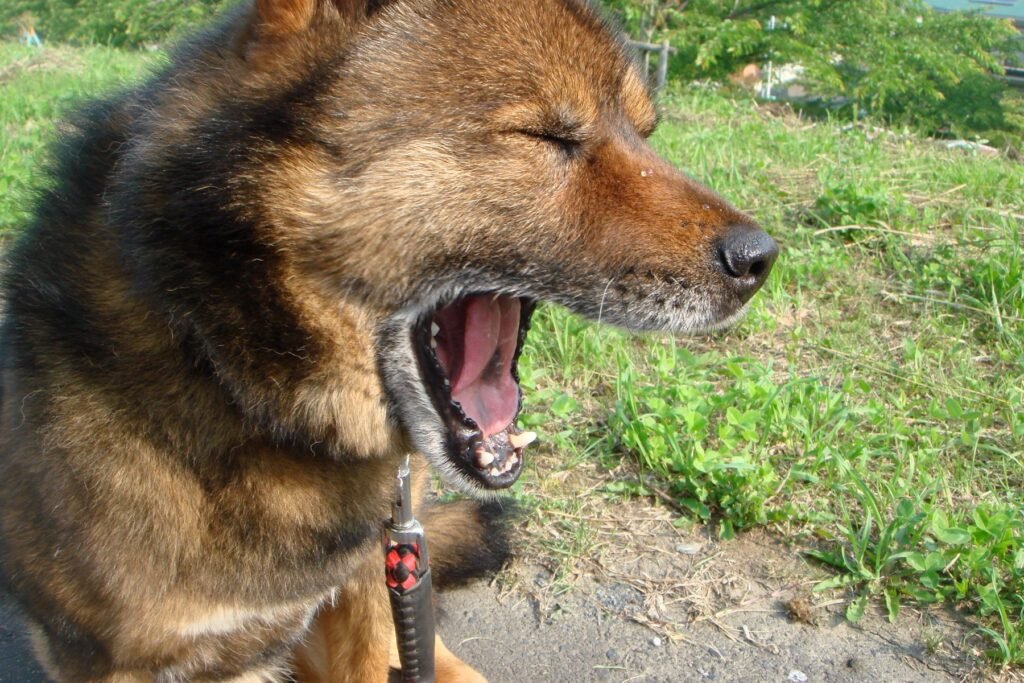
You’re on the couch, it’s getting late, and you let out a big, unguarded yawn. A few seconds later, your dog stretches their jaw wide and yawns right back at you.
Coincidence? Maybe. But scientists have spent almost two decades trying to answer that exact question, and they don’t all agree. Along the way, they’ve also learned that a dog’s yawn can mean a lot more than “I’m sleepy.”
Sometimes a yawn really is just a yawn
Dogs yawn when they’re tired, just like we do. PetMD lists sleepiness, and the shift between sleeping and waking, among the everyday reasons. A yawn while curling up at night usually means exactly what it looks like.
Yawns can also come from good feelings. PetMD notes that some dogs yawn out of excitement or anticipation, like before playtime or when a treat is coming. Norwegian dog trainer Turid Rugaas describes the same thing on her website: a dog may yawn “by the door when you are about to go for a walk.”
So if your dog yawns while you grab the leash, they’re probably not bored. They may just be very, very ready.
The yawn as a “calming signal”
Rugaas is known for the idea of “calming signals,” a set of small body movements she believes dogs use to ease tension in themselves and in others. Her book On Talking Terms with Dogs: Calming Signals describes around 30 of these signals, and yawning is on the list, along with lip licking.
On her website, she lists moments when a dog might yawn: when someone bends over them, when you sound angry, when there’s yelling in the family, when someone walks straight at them, and when the dog is at the vet’s office.
It’s a lovely idea, and many trainers use it. But Rugaas built it from watching dogs, and researchers are still testing how well it holds up. A pilot study by Mariti and colleagues, described by psychologist Stanley Coren in Psychology Today, filmed 24 dogs interacting in pairs and recorded 2,130 calming signals. The most common ones were head turning, lip licking, freezing, and turning away. Coren also notes that yawning is known as a sign of stress, and it may not always be a message to anyone. Some veterinary behavior professionals agree, reading many yawns as stress rather than deliberate calming. Either way, a yawn in a tense moment is worth noticing.
💡 Good to know: A Korean dog adoption center, Peace Winds Korea in Gwangju, explains in its guide that a dog yawning while being scolded isn’t ignoring you. The center describes it as the opposite, a signal that means something like “please don’t be angry” and “I don’t want to fight.”
What yawning looks like at the vet
Rugaas isn’t the only one to connect yawns with vet visits. In a study published in the Journal of the American Veterinary Medical Association and summarized by Fear Free, researchers watched 32 dogs during standard exams, with owners either present or absent. Yawning was one of the fear behaviors they scored, along with lip licking, body shaking, avoidance, and trying to escape.
Oddly, dogs with their owners in the room yawned more than expected, and the researchers weren’t sure why. Still, having their people nearby helped in other ways, with less vocalizing and lower body temperatures.
Can your dog really catch your yawn?
The first big study came in 2008, when Ramiro Joly-Mascheroni, Atsushi Senju, and Alex Shepherd published “Dogs catch human yawns” in Biology Letters. Twenty-nine dogs watched a person either yawn or make other mouth movements. Of the 29 dogs, 21 yawned after watching the real yawn. None of them yawned at the fake mouth movements.

Not everyone got the same result, though. In 2009, a team led by Aimee Harr showed 15 dogs videos of yawns and videos of mouths simply opening. Only one dog yawned significantly more after the yawning videos.
Then came studies suggesting that who yawns matters. In 2012, Silva, Bessa, and de Sousa tested whether the sound of a human yawn alone could set dogs off. It could, and the dogs yawned more to a familiar person’s yawn than to a stranger’s.
A 2013 PLOS ONE study by Romero, Konno, and Hasegawa pointed the same way. Its 25 dogs yawned more often when their owner yawned than when an unfamiliar person did. The dogs’ heart rates didn’t change between conditions, which suggested the yawns weren’t simply stress.
💡 Did you know? Puppies don’t seem to catch yawns right away. A Lund University study of 35 dogs aged 4 to 14 months found that only dogs older than seven months caught human yawns. The researchers say that, like humans, dogs seem to grow into it over their first year.
But the story isn’t settled. In 2020, Patrick Neilands and colleagues at the University of Auckland looked back at earlier research covering 257 dogs and ran their own experiment with 32 more. They found that dogs do catch yawns. However, the dogs were no more likely to yawn for someone they knew, and female dogs didn’t yawn more than males. Neilands concluded: contagious yawning “does not appear to be a reliable signal of empathy in dogs or other mammals.”
So yes, your dog may catch your yawn. Whether it proves a deep emotional bond is still an open question.
When yawning plus other signs means stress
The American Kennel Club says “a yawn by itself rarely tells the whole story,” and that the meaning depends on the situation and your dog’s body language.
Pay closer attention if your dog yawns a lot in a short time along with any of these:
- lip licking, or turning their head or body away
- trying to look smaller, or hiding
- whining or whimpering
- body shaking
If you see that cluster, give your dog a little space, slow things down, or move somewhere quieter.
⚠️ Please don’t wait. PetMD advises calling your vet if frequent yawning comes with lethargy, loss of appetite, behavior changes, signs of pain, or breathing trouble like coughing. Those can point to a health problem rather than a mood.
Angel Jake Note 🐾
I think yawns are one of the easiest dog signals to overlook. We see them every day and assume they mean “bedtime.” But a yawn can be a sleepy one, a happy one before a walk, or a quiet little “I’m not comfortable” in a crowded room.
And if your dog yawns right after you do, science can’t promise it’s love. It’s still a pretty sweet moment to share.
Medical Disclaimer
I’m not a vet, and nothing here replaces a real exam. If something about your dog feels off, please trust that feeling and call your veterinarian.
Sources
- Biology Letters (Joly-Mascheroni, Senju, Shepherd, 2008): Dogs catch human yawns
- Animal Cognition (Harr, Gilbert, Phillips, 2009): Do dogs (Canis familiaris) show contagious yawning?
- Animal Cognition (Silva, Bessa, de Sousa, 2012): Auditory contagious yawning in domestic dogs
- PLOS ONE (Romero, Konno, Hasegawa, 2013): Familiarity bias and physiological responses in contagious yawning by dogs support link to empathy
- ScienceDaily: Puppies don’t pick up on yawns (Lund University, 2012)
- University of Auckland: Yawning difference between us and dogs (2020)
- Turid Rugaas: Calming Signals, the Art of Survival
- Dogwise: On Talking Terms With Dogs: Calming Signals, 2nd Edition
- Psychology Today (Stanley Coren): What Are Canine Calming Signals and Do They Work?
- Synergy Veterinary Behavior: Calming Signals or Stress Signs?
- Fear Free: Dogs Less Stressed With Owners Present at Exams, Study Shows
- PetMD: Why Do Dogs Yawn?
- American Kennel Club: Why Do Dogs Yawn?
- Peace Winds Korea (피스윈즈코리아): 강아지가 ‘졸리지도 않은데’ 하품하는 이유