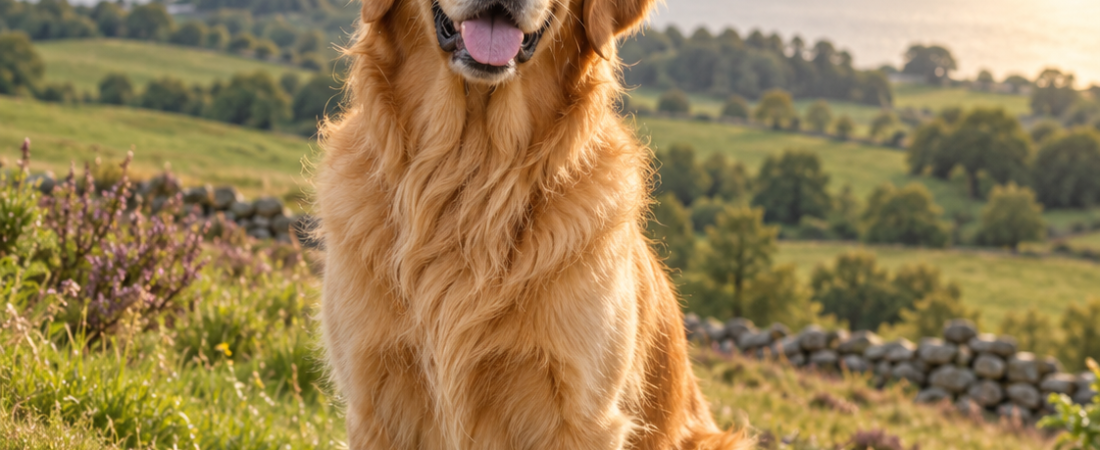

There’s a reason people call Golden Retrievers “the family dog.” That soft face, the wagging tail that never seems to stop, the way they greet everyone like an old friend. Goldens have a gift for making people feel loved.
They’ve been one of America’s most popular breeds for decades, and it’s easy to see why. But most people who love Goldens have no idea how carefully this breed was planned, how one man’s handwritten notebook rewrote its history, or why so many Goldens today are helping scientists fight cancer.
Born on a Scottish estate, planned in a notebook
In the mid-1800s, a Scottish businessman and politician named Dudley Marjoribanks, later the first Lord Tweedmouth, wanted the perfect hunting dog for his estate, Guisachan, in the Scottish Highlands. The land there was wet, rugged, and full of rivers and marshes. He needed a dog that could handle cold water, rough ground, and long days, and that would still bring birds back gently.
The Golden Retriever Club of America (GRCA) says that in 1865 he bought a yellow retriever named Nous from a cobbler in Brighton. In 1868, Nous was bred to Belle, a Tweed Water Spaniel, a tough, curly-coated water dog from the Scottish borders that no longer exists today.
That first litter produced the puppies that became the foundation of every Golden Retriever alive today. The Friends of Guisachan records their names: Crocus, Cowslip, and Primrose, with a later puppy named Ada starting another important line. Lord Tweedmouth kept careful notes on every breeding from 1865 to 1890.

The Russian circus dog myth
Most Golden lovers have never heard this one.
For decades, many people believed Goldens descended from a troupe of Russian circus dogs that Lord Tweedmouth supposedly saw performing and bought on the spot. It was a charming tale, and the GRCA notes that it was accepted as the breed’s origin until the early 1950s. It was even officially supported by Golden Retriever clubs in Britain and America.
Then, in 1952, Lord Tweedmouth’s handwritten studbooks were made public. They told a completely different story: no circus, no Russian dogs, just Nous, Belle, and years of careful planning. The romantic legend quietly disappeared, and the real history took its place.
💡 Did you know? The Russian circus story was repeated for decades, even by official breed clubs. It took one man’s private notebooks to set the record straight.
The Kennel Club in Britain officially recognized the breed in 1901, per the GRCA, and the Friends of Guisachan notes that the first Golden Retrievers were registered with the AKC in 1925.
Why Goldens are built the way they are
Almost everything about a Golden makes sense once you picture those cold Scottish rivers.
That beautiful coat. The AKC breed standard calls for a coat that is “dense and water repellent with good undercoat.” The outer coat sheds water, and the soft undercoat keeps them warm. That’s why Goldens can swim in chilly water, and also why they shed so much.
The “soft mouth.” Goldens were bred to carry birds back without damaging them. That gentle grip is why so many Goldens love carrying things around the house, from toys to socks to your shoes. Many greet you at the door with something in their mouth, almost like a gift.
That famous temperament. The breed standard describes the ideal Golden as “friendly, reliable and trustworthy.” A hunting dog had to work closely with people, stay calm, and take direction. Those same traits are exactly why Goldens are now some of the most common guide dogs, therapy dogs, and search-and-rescue dogs in the world.
Size and appearance
Goldens are sturdy, athletic dogs. The AKC standard has males at 23 to 24 inches tall and females at 21½ to 22½ inches. Males usually weigh around 65 to 75 pounds, and females around 55 to 65 pounds.
Their coats range from light cream to deep, rich gold. And yes, they shed year-round, with heavier shedding a couple of times a year. Brushing a few times a week helps a lot, and a good vacuum becomes your new best friend.

Personality: sunshine in dog form
Goldens are usually gentle, playful, and deeply people-oriented. They tend to get along with kids, other dogs, and strangers. Like Labs, most Goldens make terrible guard dogs, because they’re far more likely to welcome a stranger than warn you about one.
They also stay puppy-like for a long time. Many Goldens keep their playful, goofy side well into adulthood, which is part of their charm, and part of why early training matters.
Exercise and training
Goldens were bred to work all day, so they need real daily exercise. Long walks, fetch, swimming, and games that use their brains all help. A bored Golden may start chewing, digging, or finding their own fun.
The good news is that they’re wonderfully trainable. They’re eager to please and food-motivated, and they respond beautifully to kind, reward-based training.

The hard part: Goldens and cancer
I want to be gentle but honest here, because this matters so much for anyone who loves a Golden.
Goldens are known for having a high rate of cancer. In a 1998–1999 health survey by the Golden Retriever Club of America, which included 1,444 Goldens, cancer accounted for about 61.8% of veterinary-confirmed deaths. The most common serious cancers included hemangiosarcoma, a cancer of the blood vessels, and lymphoma.
That’s heartbreaking. But it’s also why Golden Retrievers are now helping every dog.
3,000 Goldens helping all dogs
In 2012, the Morris Animal Foundation started the Golden Retriever Lifetime Study, one of the largest and most detailed dog health studies ever done in the United States. More than 3,000 Golden Retrievers were enrolled as young dogs, and their owners and vets have shared health, lifestyle, and environmental information every single year.
So far, the Morris Animal Foundation says the study has collected more than 650,000 biological samples, 1.6 million lab results, and over 1,700 confirmed cancer diagnoses. Researchers have already found chromosome regions linked to hemangiosarcoma, and they found that dogs with lymphoma were significantly more likely to have been exposed to secondhand smoke.
💡 Good to know: One simple takeaway from the study: keep your dog away from cigarette smoke. It’s a small change that could really help.
Every one of those dogs had a family who said yes to years of vet visits and paperwork, not just for their own dog, but for dogs they’ll never meet. I find that so moving.

Other health issues to know
Besides cancer, Goldens can be prone to:
- hip and elbow dysplasia
- skin allergies and hot spots
- ear infections, since those floppy ears trap moisture
- certain eye conditions
- heart problems, including a narrowing of the heart valve called subvalvular aortic stenosis
If you’re getting a puppy, ask the breeder about health testing for hips, elbows, eyes, and heart in both parents.
⚠️ Please don’t wait. If your Golden suddenly seems weak, has pale gums, or has a swollen belly, treat it as an emergency and call your vet now. These can be signs of internal bleeding, a known risk with hemangiosarcoma.
Fun facts and true stories 🐾
A Golden holds the world record for the loudest bark. According to Guinness World Records, a Golden Retriever named Charlie from Adelaide, Australia, barked at 113.1 decibels in 2012. Not bad for one of the sweetest-looking breeds in the world.
Goldens are still gathering at their “birthplace.” Golden Retriever lovers from around the world have traveled to the ruins of Guisachan House in Scotland for special gatherings, bringing their dogs back to the place where the breed began.
They were exported around the world early. The Friends of Guisachan notes that Goldens were being sent abroad starting in 1882, reaching places like Canada, India, and New Zealand.
Their ancestor is extinct. The Tweed Water Spaniel, the curly water dog that gave Goldens part of their love of water, no longer exists. In a way, every Golden carries a little piece of it.
Is a Golden right for you?
A Golden might be a wonderful fit if you want an affectionate, social dog, have time for daily exercise and training, don’t mind a lot of dog hair, and are prepared for possible health costs as your dog gets older.
It might be harder if you’re away most of the day, want a low-shedding dog, or would struggle with unexpected vet bills. Pet insurance is worth looking into early with this breed.

Angel Jake Note 🐾
Goldens have a way of loving people with their whole hearts. Learning their history made me love them even more: a breed carefully planned on a rainy Scottish estate, a romantic myth that turned out not to be true, and now thousands of Goldens quietly helping science understand cancer.
If you share your life with a Golden, cherish those soft-mouthed gifts at the door and the tail that never stops wagging. And please keep up with regular vet visits, because catching problems early can mean more time together.
They give us so much sunshine. They deserve every bit of care we can give back.
Sources
- Golden Retriever Club of America: The Origins of the Golden Retriever Revisited
- Golden Retriever Club of America: AKC Breed Standard
- Golden Retriever Club of America: National Health Survey 1998–1999 (PDF)
- Friends of Guisachan: Guisachan Dogs
- Morris Animal Foundation: Golden Retriever Lifetime Study
- Morris Animal Foundation: What the Golden Retriever Lifetime Study tells us about dog health
- Guinness World Records: Loudest bark by a dog
- American Kennel Club: Golden Retriever
Related Reading
- Labrador Retriever: History, Personality, Health & Surprising Facts
- Pet Insurance: Is It Really Worth It?
- Caring for a Senior Dog: Changes You Shouldn’t Ignore as Your Dog Gets Older
Medical Disclaimer
I’m not a vet, and nothing here replaces a real exam. If something about your dog feels off, please trust that feeling and call your veterinarian.