
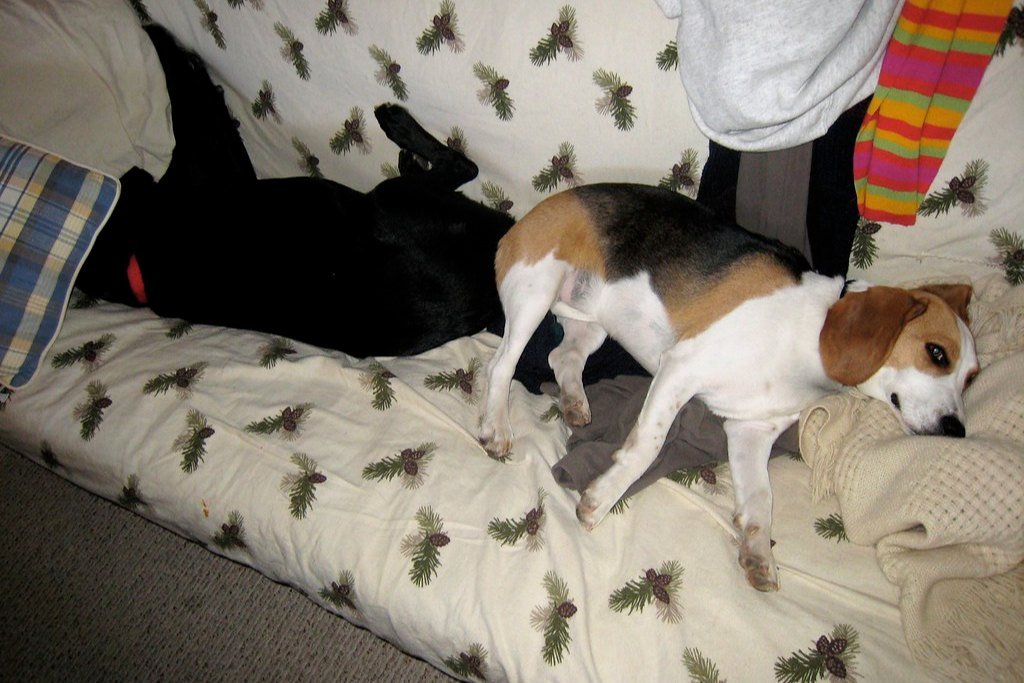
If your dog sleeps in your bed, you’ve probably heard the warnings. They’ll wake you up. They’ll steal your spot. You’ll never get a good night’s rest again.
And maybe you’ve felt a little guilty about it, lying there at 3 a.m. and wondering if the warm body pressed against your legs is the reason you’re tired. A study published on Oct. 7, 2026, in the journal PLOS One suggests you can probably let some of that guilt go. When researchers tracked owners and their dogs through the night, sharing a bed didn’t measurably hurt people’s sleep. And when someone did start moving in the dark, it was more often the human.
What the researchers actually did
The paper is called “Who is disrupting whom? Examining the nighttime activity patterns of humans and their dogs.” It was led by Ming Fei Li (University of Toronto and Duke University) and Lavania Nagendran (University of Toronto Mississauga), working with C. Kiru, L. Schroeder, and D. R. Samson.
The team recruited 25 people and their 38 dogs in southern Ontario, Canada. For about four weeks, from early November to early December 2021, everyone wore a small activity monitor. People wore theirs on the wrist. Dogs wore theirs on a collar. The devices logged movement every minute, all night long.
Owners also filled out a standard sleep questionnaire, the Pittsburgh Sleep Quality Index, plus a set of questions about their dogs.
The sleeping arrangements varied. According to the paper, 4 people always slept with their dog, 10 sometimes did, and 11 never did. More than half the households (13 of 25) had more than one dog.
💡 Did you know? Every dog in this study was a husky or a malamute, aged 2 to 12. The researchers chose just those two breeds on purpose, to keep breed differences in activity from muddying the results. It’s a smart design choice, but it also means the findings may not apply to, say, a restless terrier.
Sharing a bed didn’t change the numbers
Here’s the part bed-sharing owners will like. When the team compared people who slept with their dogs to those who didn’t, co-sleeping had no significant effect on how long people slept or how efficiently they slept. It didn’t change the dogs’ nighttime activity either.
That doesn’t mean everyone in the study slept like a baby. On average, owners got about 6.2 hours of sleep a night, with a sleep efficiency of about 79 percent. Their average questionnaire score was 6.84, and the paper notes that a score of 5 or higher points to poor sleep. So these were fairly typical, slightly tired adults. The dogs just didn’t seem to be what made the difference.
The only factor that stood out was the number of dogs. People with more than one dog rated their own sleep as worse. Even that link was weak, though, and it showed up only in what people reported, not in what the monitors measured.
What owners believed about their dogs was interesting too. About half thought their dogs interrupted their sleep. Yet 88 percent said barking didn’t wake them, and 84 percent said the sound of their dog moving around didn’t either. Fourteen of the 25 owners said their dog never woke them at all.
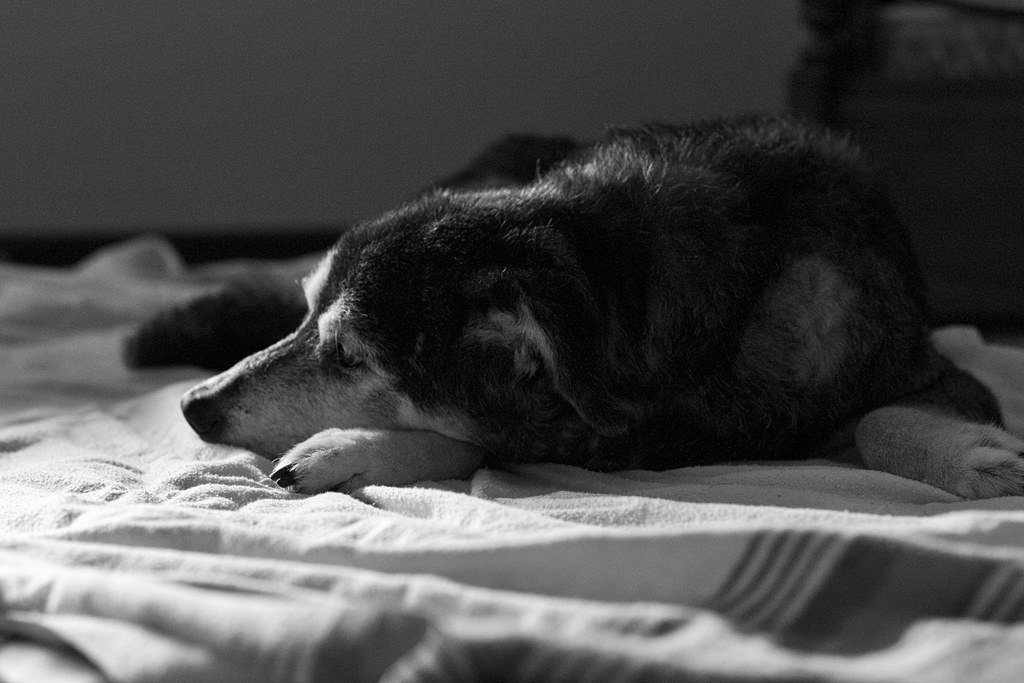
So who’s waking whom?
This is the part that made headlines.
The monitors showed that human and dog activity at night was closely linked. “Our findings suggest that nighttime activity in humans and dogs is closely coupled,” the authors wrote, as quoted in the PLOS press release. When one stirred, the other often did too.
The team then looked at timing, minute by minute, to see who tended to move first. Of the 36 owner-dog pairs they could analyze, 22 showed a clear link within five minutes. And in those 22 pairs, the owner moved first in 10 pairs, compared with just 4 where the dog moved first. The remaining 8 moved within the same minute.
“Human movement actually preceded dog movement more frequently in our study group,” Li and Nagendran said, as quoted by Earth.com.
There’s a small twist, too. In the four pairs where the dog moved first, the dogs weren’t sleeping on the bed. The authors suggest that dogs sleeping farther away might be more likely to wake their people, while dogs on the bed tend to react to their owners instead. With only four pairs, though, they treat that as an idea worth testing, not a finding.
Why would people be the restless ones? The data were collected during COVID-19 lockdowns, and the authors suggest that stress and disrupted routines may have made owners’ sleep lighter than usual.
💡 Good to know: Sleeping close to your dog may come with an emotional upside. Earth.com reported that 18 of the 25 owners in this study said they felt safer with their dog. Korean health outlet Kormedi has also pointed to a 2018 study of 962 American women, in which those who slept with a dog reported feeling more protected than those who slept alone or with a cat or a partner.
How this fits with earlier research
This isn’t the first time scientists have strapped sensors on dogs to study sleep, and the results haven’t always agreed.
Back in 2017, a Mayo Clinic team published a study in Mayo Clinic Proceedings that followed 40 healthy adults and their dogs for seven nights. They found that a single dog in the bedroom didn’t seem to disrupt human sleep. But people’s sleep efficiency was lower when the dog was on the bed rather than just in the room.
Earth.com also notes that a 2020 sensor study found the opposite pattern to this new one: dog movement was more likely to come before human movement.
So the picture is mixed. The new study adds a careful, minute-by-minute look, and its message is less “dogs are fine” than “it goes both ways.” The authors put it warmly in the paper: “We emphasize that both parties impact the nighttime activity of one another, demonstrating our species’ close bond.”
A Korean outlet picked it up, too
The study traveled fast. On Oct. 8, the Korean magazine Eyesmag (아이즈매거진) ran a story on it, asking whether sharing a bed with a dog really lowers sleep quality. It walked readers through the same numbers, including the 10 pairs where people moved first and the 4 where dogs did.
Eyesmag was careful about the limits, too. It pointed out that the sample was small, that only huskies and malamutes were included, and that sleep stages weren’t measured directly, so the order of movements can’t be read as proof of cause.
What this study can’t tell us yet
It’s a fun result, but it’s a small study, and the authors are upfront about that.
The sample was 25 people, 21 of them women, all from southern Ontario. Every dog was a husky or a malamute. There was no direct observation of what happened in the bedroom, so the researchers couldn’t tell whether a burst of movement came from a noise, a partner, or a dream.
The dog monitors had another quirk. Any movement at all counted as “active,” which means a dreaming dog’s twitching paws may have been scored the same as a dog getting up. The devices also haven’t been validated for telling sleep from wakefulness in dogs, so the team talked about “activity” rather than “sleep.”
And the timing data had its limits. Movements were logged in one-minute blocks, which can’t sort out who moved first when both stirred within the same minute.
There’s also nothing here to suggest that everyone should start sharing a bed with their dog. If you sleep badly with your dog beside you, that’s real, whatever a study of other people says.
💡 Good to know: Kormedi notes that about 6 percent of dog bites happen when a dog is sleeping or resting, and that even gentle dogs may bite when startled. Young children often miss a dog’s warning signs, so it’s worth thinking twice before letting kids share a bed with a dog who has ever shown aggression.
Why it still matters
For a lot of people, the dog on the bed isn’t a habit to break. It’s part of what makes home feel like home. This study won’t settle the debate, but it does push back on the idea that the dog is always the problem.
It’s also a quiet reminder of how tuned in our dogs are to us. If you toss and turn, your dog probably notices. Maybe a calmer night for you means a calmer night for them, too.
Angel Jake Note 🐾
I love that the researchers asked the question both ways. So much advice about dogs in bed assumes the dog is the troublemaker, and this study gently suggests we might be keeping them up just as often.
If your dog sleeps beside you and you both wake up rested, this study gives you one more reason not to feel guilty. If you’re not sleeping well, it’s okay to try a dog bed next to yours and see what changes. And if the sleepiness doesn’t go away, talk to your doctor. Wherever your dog ends up sleeping, they’ll probably still be listening for you.
A Note on This Study
This post summarizes a published study for everyday dog lovers. One study can’t tell the whole story, and its findings may not apply to every dog. For the full methods and limitations, please see the original research linked in the Sources section.
Sources
- PLOS One (Li et al., Oct. 7, 2026): Who is disrupting whom? Examining the nighttime activity patterns of humans and their dogs (DOI: 10.1371/journal.pone.0358453)
- EurekAlert! (PLOS, Oct. 7, 2026): Dogs and owners disturb each other in the night, but still get pretty good sleep
- Earth.com (Oct. 8, 2026): Study finds little evidence that sharing a bed with dogs worsens sleep
- Denver7 (Oct. 8, 2026): Think your dog is ruining your sleep? Science says it might be you
- Mayo Clinic Proceedings (Patel et al., 2017): The Effect of Dogs on Human Sleep in the Home Sleep Environment
- Eyesmag (아이즈매거진, Oct. 8, 2026): 반려견과 같이 자면 수면의 질이 떨어진다?
- Kormedi (코메디닷컴, 2023): 반려견과 같이 잔다면? 좋은 점 vs 나쁜 점