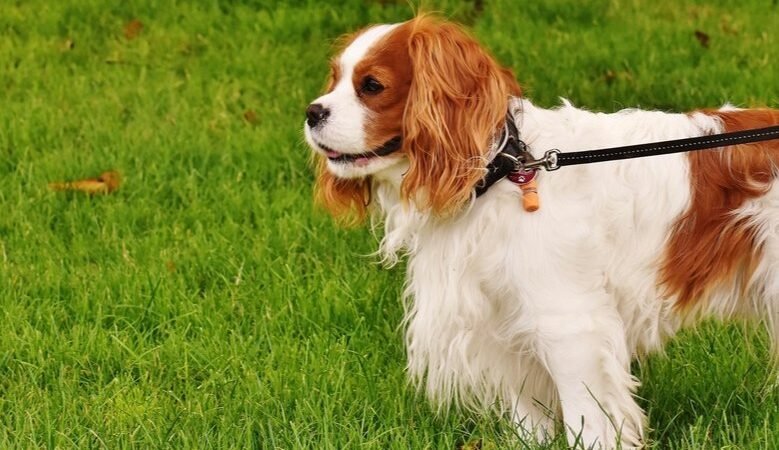
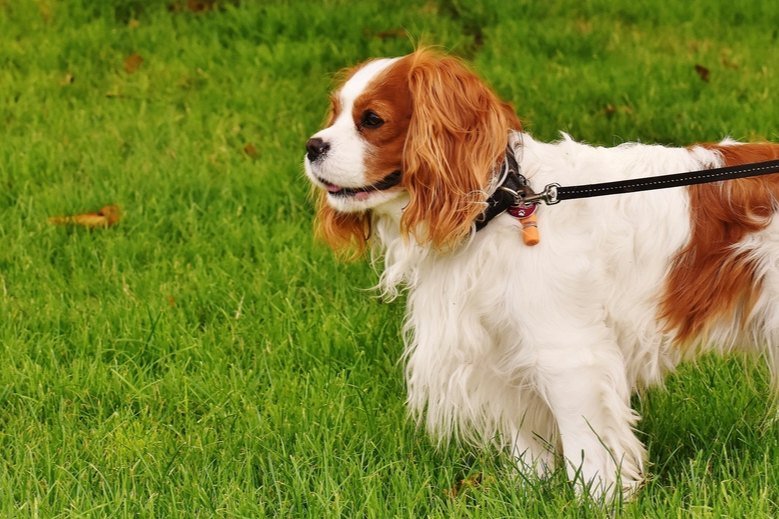
Some dogs walk into a room. A Cavalier King Charles Spaniel drifts in, finds the nearest lap, and settles there like they’ve been invited. Those round, dark eyes and long feathered ears have been melting hearts for centuries.
The breed’s story is stranger than you’d guess, though. It involves a king whose spaniels reportedly followed him everywhere, a duchess’s thumbprint, and an American who placed an ad in a dog show catalog and changed dog history. And that sweet face comes with a heart that needs a little extra watching.
A king and his spaniels
The AKC’s history of the breed says Charles II, who took the English throne in 1661, was a prolific dog breeder, and his little spaniels reportedly followed him everywhere, even to bed. The Cavalier King Charles Spaniel Club USA quotes the old description of him as “seldom seen without two or three spaniels at his heels.” Under the Stuart kings, these toy spaniels got their royal title: King Charles Spaniels. And “Cavalier”? Wikipedia explains that supporters of Charles II during the English Civil War era were known as Cavaliers.
After Charles died in 1685, fashion moved on. By the 1800s, according to the AKC, the craze for flat-faced breeds from Asia, such as the Pug and the Japanese Chin, had nearly erased the longer-muzzled spaniels from view. Today, the AKC notes, those flat-faced dogs are still called King Charles Spaniels in the UK and English Toy Spaniels in the US. They’re a separate breed from the Cavalier.
The American who brought the old spaniel back
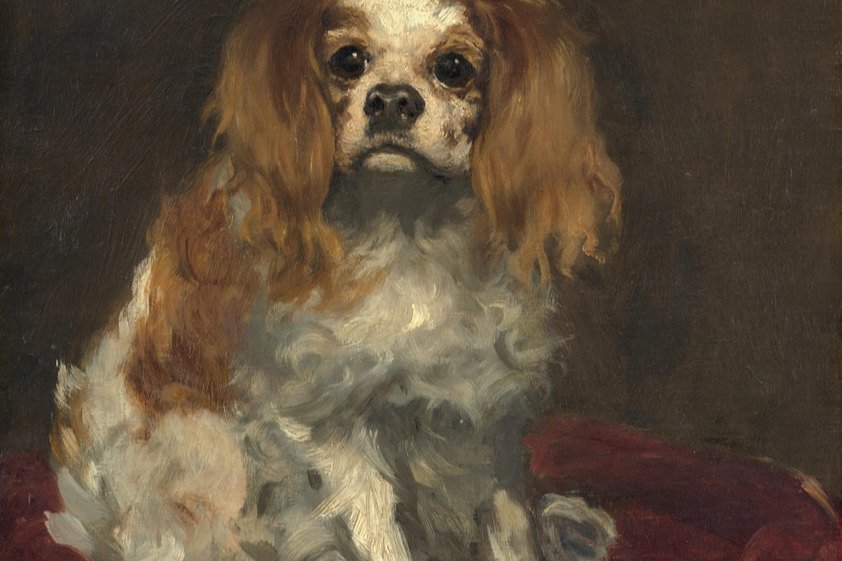
In 1926, an American named Roswell Eldridge went looking in England for the longer-nosed spaniels he’d seen in old paintings. He found only short-faced dogs. So, the AKC says, he placed an ad in the Crufts catalog calling for “Blenheim Spaniels of the Old Type,” with a “long face, no stop, flat skull.” He offered 25 pounds sterling to the best dog and the best bitch, every year for five years. The AKC estimates that first prize at roughly $2,000 in today’s money.
Breeders weren’t impressed. The AKC reports that only four dogs entered the special classes at Crufts in 1926. A few kept at it anyway, sometimes using long-faced puppies that turned up in short-faced litters.
In 1928, a dog named Ann’s Son, owned by Miss Mostyn Walker, won the prize. According to the breed club, Eldridge had died about a month before that Crufts, at 70, so he never saw the dogs he’d asked for. That same year, breeders founded the Cavalier King Charles Spaniel Club and drew up a standard with Ann’s Son standing on the table as the live model. The AKC adds that Ann’s Son won Best of Breed three years running and ended his show career undefeated.
One more lovely detail from the club’s history: the founders agreed the Cavalier should be a natural dog, with no trimming, not one “carved into shape.” The Kennel Club granted the breed separate registration in 1945, and the AKC admitted the Cavalier in 1996 as its 140th breed.
💡 Did you know? The breed nearly ran out of dogs during World War II. Wikipedia reports that 53 of the 60 Cavaliers born during the war were sired by a single dog, Plantation Banjo, which severely narrowed the gene pool. That bottleneck is part of why some inherited health problems are so common in Cavaliers today.
Size, coat, and that famous “Blenheim spot”
Wikipedia gives an average weight of 13 to 18 pounds, and Hill’s lists a height of about 12 to 13 inches at the shoulder. One easy way to tell them from the English Toy Spaniel: the Cavalier’s skull is flat, while the English Toy’s is domed.
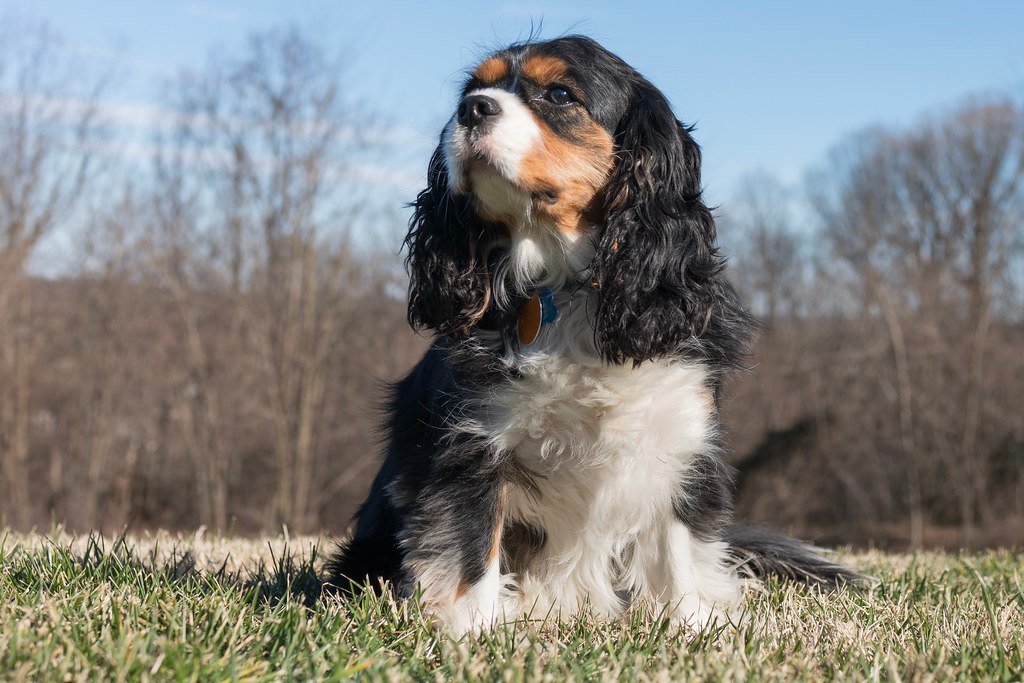
There are four colors, and the AKC says all four are equally correct: Blenheim (chestnut on pearly white), tricolor, black and tan, and ruby, which is solid rich chestnut.
The Blenheim name has a story of its own. It comes from Blenheim Palace, home of John Churchill, the first Duke of Marlborough, who kept red-and-white spaniels. According to legend, his anxious duchess pressed her thumb onto the head of a pregnant spaniel while she waited for news from the 1704 Battle of Blenheim. The puppies were born with a thumb-shaped chestnut mark on their heads. That mark is still called the Blenheim spot, and Wikipedia says it’s also known as the “Duchess Thumb Print.” It’s a legend, of course — but a sweet one.
The coat is medium length, silky, and flat. Hill’s recommends a thorough brushing once a week and says shedding is light, mostly in spring and fall. Check those long ears regularly, too. Ear infections are among the breed’s common problems.
Why are Cavaliers such lap dogs?
Because that’s what people asked them to be, for hundreds of years. Hill’s shares an old prescription for a Queen of England that recommended keeping a “comforte dog” on her lap to treat a cold. These spaniels were bred to sit close and keep people warm.
There’s a little sporting dog in there, too. The AKC notes that the Marlborough spaniels were bred for both lap-warming and bird hunting.
Hill’s describes the breed as affectionate, playful, and intelligent, not usually shy or aggressive, good with children, and generally not protective. So don’t count on a Cavalier as a guard dog, though Hill’s does mention their “noisy greetings.” Exercise needs are modest, too: under 20 minutes a day, by Hill’s count.
The heart of the matter: mitral valve disease
This is the hard part. No one who loves a Cavalier wants to read it, so I’ll go gently.
Mitral valve disease, or MVD, is the most common heart disease in dogs. PDSA explains what happens: the mitral valve, one of the heart’s four valves, thickens and doesn’t close fully, so blood leaks backward. The heart has to work harder, and that backward flow can cause a heart murmur a vet can hear.
In Cavaliers, MVD is far more common, and it starts earlier. NC State’s College of Veterinary Medicine says the disease is about 20 times more frequent in Cavaliers and that they often develop it young, while most dogs get it in old age. Statistically, Wikipedia notes, more than half of Cavaliers have it by age five, and nearly all eventually develop it. A UK Kennel Club survey found that 42.8% of Cavalier deaths were heart-related.
A 2015 Royal Veterinary College VetCompass study looked at the clinical records of 1,749 Cavaliers seen at primary-care practices in England. A heart murmur was the single most common problem, recorded in 30.9% of dogs. The authors wrote that cardiac diseases, especially mitral valve disease, “continue to be of particular concern in this breed.”
Now for some reassurance: a murmur isn’t a death sentence. PDSA says many dogs show no signs at first, and mild MVD often needs only monitoring and regular checkups. NC State describes the drug pimobendan as a big breakthrough that delays the onset of heart failure by about 15 months. PDSA also suggests counting your dog’s breaths while they sleep, so ask your vet what number is normal for your Cavalier.
⚠️ Please don’t brush off a cough. PDSA lists coughing (often after lying down or at night), tiring on walks, faster or heavier breathing, weight loss, and fainting as signs that MVD may be progressing. If your Cavalier is struggling to breathe, see a vet immediately.
Syringomyelia: when the skull is too small
The second big health worry in Cavaliers is harder to see. VCA explains that Chiari-like malformation (CM) is a size mismatch: the brain is “too big” for a skull space that’s “too small.” That crowds the back of the brain and blocks the normal flow of cerebrospinal fluid. Over time, fluid-filled cavities can form inside the spinal cord. That’s syringomyelia, or SM.
How common is it? Wikipedia reports that over 90% of Cavaliers in international samples have the malformation, and 30% to 70% have fluid pockets in the spinal cord. Not every dog with these changes shows signs, but Wikipedia adds that among Cavaliers who do, 85% start showing them between six months and four years of age.
Research has started to explain why. ScienceDaily reported in 2017 that a University of Surrey-led study in PLOS ONE found early fusion of bones in the Cavalier skull was compressing the brain. Professor Clare Rusbridge, who helped first describe the condition, received a Petplan Charitable Trust award in 2023 for her life’s work on it and used the moment to call for “an end to cruel breeding practices solely based on human desires.”
💡 Good to know: VCA lists signs of SM that are easy to mistake for an itch: scratching while walking (often with no obvious trigger), rubbing the face, crying out when picked up, and sensitivity around the ear, shoulder, or neck. Wearing a collar can set off scratching, so VCA says removing it may help. An MRI is what shows the malformation, so tell your vet what you’re seeing.
Treatment focuses on pain relief, usually with nerve-pain medication such as gabapentin. VCA adds that some dogs stay stable for years.
How long do Cavaliers live?
Hill’s gives a lifespan of 9 to 14 years. Wikipedia cites a 2022 UK study that found an average life expectancy of 10.45 years for Cavaliers, compared with 11.82 years for crossbreeds. VetCompass also recorded diarrhea, dental disease, ear infections, conjunctivitis, and anal sac infections among the most common issues. Averages can’t predict your own dog’s life, but they’re worth knowing.
Fun facts and true stories 🐾
That “royal decree” might be a myth. The US breed club says Charles II decreed that King Charles Spaniels should be welcome in public places, even Parliament. Wikipedia disagrees: the UK Parliament says no Act refers to the dogs, and the Kennel Club couldn’t trace any such decree.
A president’s Cavalier. Ronald Reagan had a Blenheim Cavalier named Rex, according to Wikipedia. Margaret Thatcher owned Cavaliers too.
A painter’s daughter saved the breed. The AKC says Amice Pitt, daughter of the painter Sir Everett Millais, helped write the 1928 standard and championed the breed through decades of declining interest.
One country stopped breeding them. In 2022, in a case brought by Animal Protection Norway, the Oslo District Court banned Cavalier breeding, ruling that no dog of the breed could be considered healthy, according to Wikipedia. DogWellNet reports that in 2023 Norway’s Supreme Court upheld the ban on breeding Cavaliers under the Animal Welfare Act, while allowing English Bulldogs to be bred with health screening.
In Korea, they go by “Cavi.” Namuwiki notes that in Korea the name is sometimes shortened to “캐비” (Cavi), and that even the spelling isn’t settled: 캐벌리어 and 카발리에 are both used. It also points out that pet shops often call them “킹찰스 스패니얼,” which is really the name of a different breed.
A TV star, too. Namuwiki mentions that Charlotte’s dog in Sex and the City, Elizabeth Taylor, was a Cavalier.
Is a Cavalier right for you?
A Cavalier could be a wonderful match if you want a gentle, affectionate companion who loves people, gets along with kids, and is happy with short walks and long cuddles. Hill’s even calls them well suited to families or empty nesters.
Please think carefully about the health side, though. Ask any breeder for heart and MRI screening results on both parents, and budget for regular vet checks and possibly lifelong medication. A vet who knows the breed is worth a lot.
Angel Jake Note 🐾
Ever since Charles II’s day, these spaniels have done one job: staying close. A king and a president loved them for the same reason families do today. They’re just happy to be near you.
Loving a Cavalier means listening a little more carefully. A cough at night, a scratch that doesn’t look quite right, a walk that ends earlier than usual — these small things matter. Catch them early, and you give that soft, loyal heart the best chance to keep going.
Medical Disclaimer
I’m not a vet, and nothing here replaces a real exam. If something about your dog feels off, please trust that feeling and call your veterinarian.
Sources
- American Kennel Club: Cavalier King Charles Spaniel History
- Cavalier King Charles Spaniel Club USA: General History
- Wikipedia: Cavalier King Charles Spaniel
- Hill’s Pet Nutrition: Cavalier King Charles Spaniel
- PDSA: Mitral valve disease (MVD) in dogs
- NC State College of Veterinary Medicine: What You Need to Know About MVD
- Summers et al. (2015): Prevalence of disorders recorded in Cavalier King Charles Spaniels attending primary-care veterinary practices in England
- Royal Veterinary College: New VetCompass paper: Common disorders in Cavalier King Charles spaniels
- VCA Animal Hospitals: Syringomyelia and Chiari-Like Malformation
- ScienceDaily: Studies offer new hope for diagnosis of Chiari-malformation in toy dog breeds
- University of Surrey: Award winning vet calls for end to poor dog breeding practices
- 10News: Norway bans breeding of English bulldogs, Cavalier King Charles spaniels
- DogWellNet: The Supreme Court in Norway: It is allowed to breed English Bulldogs but not Cavalier King Charles Spaniels
- 나무위키: 카발리에 킹 찰스 스파니엘