

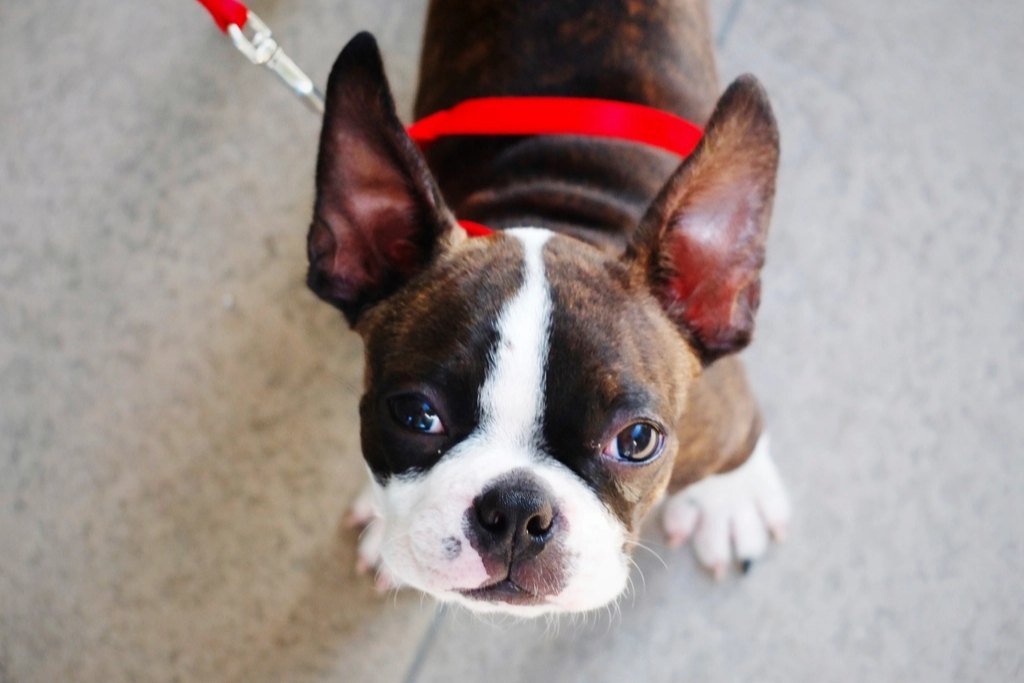
A Boston Terrier always looks a little dressed up. The crisp white chest, the dark coat, the big round eyes that seem to follow every word you say. It’s no wonder people call them “the American Gentleman.”
This tidy little dog has surprisingly tough ancestors, though, and a story that reaches all the way to a World War I battlefield. If you share your home with one (or you’re thinking about it), you’ll also want to know what that flat face and those famous eyes mean for their health.
A Boston original, from Judge to “Round Heads”
Almost every Boston Terrier alive today traces back to one dog. Around 1870, William O’Brien of Boston bought a Bulldog-and-terrier-type dog from England and sold him to Robert C. Hooper, who lived in the same city. The dog became known as “Hooper’s Judge.” The AKC describes him as a dark brindle dog of about 32 pounds with a white stripe down half his face, a cross between an English Bulldog and the now-extinct White English Terrier.
Judge was bred to a 20-pound white female named Gyp, owned by Edward Burnett of Southborough, Massachusetts. They had one puppy, Well’s Eph, and Eph’s offspring with a golden brindle female called Tobin’s Kate laid the foundation for the breed.
Those early bulldog-and-terrier crosses were bigger and tougher than the Bostons we know. As breeders made the dogs smaller, their temperament softened too. Today, Royal Canin Korea describes the Boston as one of the gentlest breeds around.
The name took a while to settle. Some people called them American Bull Terriers, and about 30 local breeders exhibited them as “Round Heads.” Hill’s says that name was dropped in 1891 after Bulldog and Bull Terrier fans objected. The AKC recognized the breed in 1893 and calls the Boston “the first of only a few made-in-the-USA breeds.”

The tuxedo, the state title, and a soldier dog
The “American Gentleman” nickname comes straight from the coat, since those markings look a lot like formal wear. Massachusetts honored the breed in 1979, when the Boston Terrier became the state dog of Massachusetts. The push started decades earlier: Boston.com reports that in 1959, a Newton trainer named Bessie Edna Colp lobbied for state recognition. “The Boston Terrier is a gentleman,” she said, adding that the breed had “the disposition of a Bay Stater.” Boston University has had a Boston Terrier mascot, Rhett, since 1922.
Then there’s Stubby. In 1917, a stray brindle puppy with a short tail wandered into camp while the 102nd Infantry was training at Yale, and Private J. Robert Conroy later smuggled him aboard the SS Minnesota when the division shipped out to France. The Smithsonian doesn’t name a breed for Stubby, so nobody can say for sure what he was. Boston fans have claimed him anyway.
💡 Did you know? Stubby warned his unit about gas attacks, helped find wounded soldiers, and caught a German soldier near the Allied trenches. Connecticut’s state history site says he was promoted to sergeant for it. General John J. Pershing later presented him with a medal from the Humane Society, and his remains are kept at the Smithsonian’s National Museum of American History.
Size, coat, and that little screw tail
Bostons are compact and square-built, with plenty of muscle. VCA lists a weight of 12 to 25 pounds, and the AKC show ring divides them into three weight classes: under 15 pounds, 15 to under 20, and 20 to 25. The UKC standard accepts brindle, seal (black with a reddish cast), or black, always with white markings.
Grooming is about as easy as it gets. Hill’s says an occasional bath plus a rub with a grooming mitt is all the short coat needs, and shedding is minimal. VCA recommends wiping around the eyes and facial folds regularly, since that’s where irritation tends to start.
The tail is short, often no more than 2 inches, and it can be straight or twisted like a corkscrew. Why the twist? A 2019 UC Davis study traced the “screw tail” to a variant in a gene called DVL2. It turned up in every Bulldog and French Bulldog the team sampled and was very common in Boston Terriers. The same variant is linked to the shape of the head, so the tail and the short face are, in a sense, a package deal.

Why they’re such good company
Hill’s describes Bostons as good-natured and playful, and their sturdy build means they tend to handle children better than many small dogs. They usually get along with other pets, cats included, especially if they grow up together. They’re bright and trainable, with a stubborn streak, and VCA says they respond well to positive reinforcement and routine.
They’re also fairly quiet and tend to bark only when they have a reason, which suits apartment life. Just don’t count on one as a guard dog. Hill’s points out that most Bostons will cheerfully welcome anyone through the door.
The flip side of all that affection? VCA says Bostons don’t handle being alone well. They’d much rather be in your lap than waiting by the window. For exercise, Hill’s suggests roughly 20 to 40 minutes a day, ideally short games of fetch or moderate walks rather than one long, hard outing.
Breathing: better news, but still a flat face
Bostons are brachycephalic, meaning their skull is short and wide. Less room in the muzzle means less room for the soft tissue of the nose and throat, and that can narrow the airway. When it’s bad enough to cause problems, vets call it brachycephalic obstructive airway syndrome, or BOAS.
The latest research is encouraging. In 2024, the University of Cambridge BOAS Research Group published a study of 107 Boston Terriers in the UK, led by Dr. Fran Tomlinson. Of the dogs graded, 37.5% showed no signs of BOAS, compared with 10% of French Bulldogs and 15.2% of Bulldogs in earlier data. “They are less severely impacted than some of the more popular flat-faced breeds,” said Dr. Jane Ladlow, part of the research group.
That doesn’t mean Bostons are in the clear. Another 26% of the dogs had moderate BOAS, the level the researchers consider clinically significant, and one dog was graded severe. The dogs most at risk tended to have tighter nostrils, shorter faces, more white showing around the eyes, and a thicker neck compared with their chest. Still, measurements overlapped a lot between affected and unaffected dogs, so you can’t reliably judge a Boston’s breathing just by looking at them.
Heat makes everything harder for a short-nosed dog. Hill’s warns that Bostons overheat easily, and VCA says their airway shape limits how hard they can exercise in warm weather. Oddly enough, they don’t love the cold either. Hill’s calls them house dogs who chill easily.
💡 Good to know: If you’re looking for a puppy, ask the breeder whether the parents have had a formal breathing assessment. The Cambridge team found that grading how a dog actually breathes was more useful than judging their face shape, and the Kennel Club says breeders can use these risk factors to breed away from BOAS.
Those big eyes need looking after
A Boston’s eyes are their trademark, and VCA says those large, prominent eyes also raise the risk of injury and irritation. It lists dry eye and corneal ulcers as concerns in adults, and cataracts and glaucoma in seniors. Royal Canin Korea adds that some cataracts in the breed are hereditary, and suggests keeping saline eye drops on hand.
A 2017 Royal Veterinary College VetCompass study of more than 104,000 dogs in England found that flat-faced breeds had over 11 times the risk of corneal ulcers compared with other dogs, and Bostons were among the breeds counted as brachycephalic. The authors had a possible explanation: flat-faced dogs tend to have a wider eye opening and a shallower socket, so more of the eye’s surface is exposed. Their corneas also have fewer nerve endings, which may mean they don’t feel a small scratch right away.
⚠️ Please don’t brush off a squinting eye. If your Boston is blinking hard, tearing, pawing at an eye, or keeping it half closed, call your vet the same day. Because their corneas may be less sensitive, a dog can look only mildly bothered by an injury that needs prompt treatment.

Other health facts worth knowing
A 2024 UK study of more than 580,000 dogs, published in Scientific Reports, estimated a life expectancy of 11.8 years for Boston Terriers, a little below the 12.7 years for purebreds overall. VCA gives a typical range of 11 to 13 years.
Pregnancy can be risky. A 2017 RVC study of nearly 20,000 female dogs seen at emergency clinics found Boston Terriers were 12.9 times more likely to have trouble giving birth. Hill’s notes that their litters are small and C-sections are common.
VCA also mentions heart valve disease, kneecap problems, skin allergies, and back disc disease. Royal Canin Korea notes that Bostons may be prone to mast cell tumors, a type of skin cancer, so any new lump is worth showing your vet. Regular checkups really matter for this breed.
Fun facts and true stories 🐾
A Boston once held a world record for eye size. In 2012, Guinness World Records named a Boston Terrier called Bruschi the dog with the largest eyes. A vet measured each one at 28 mm (about 1.1 inches) across.
A president’s dog with a famous grin. Lennu, the Boston Terrier of Finnish President Sauli Niinistö and his wife Jenni Haukio, won fans around the world. Yle reports that Tonight Show host Jimmy Fallon was one of them, and a Helsinki café even named a dog-faced pastry after him. Lennu died in May 2021, at age 10.
A Boston sold shoes. Tige, the dog in the comic strips used to advertise Buster Brown shoes, was a Boston Terrier, says the AKC. Helen Keller, Louis Armstrong, and Robin Williams all owned the breed too.
Korea knows them as an American first. Royal Canin Korea calls the Boston “미국에서 최초로 만들어진 공식 견종,” the first official breed made in America, and points out that they’ve been the state dog of Massachusetts since 1979.
Is a Boston Terrier right for you?
A Boston might be a wonderful fit if you want a small, sturdy, cheerful dog who’s happy in an apartment, good with kids, and easy to groom. They do best with people who are home a lot, or who can bring them along, since they really don’t like being left alone.
Think it over carefully if your summers are hot and you don’t have reliable air conditioning, or if you’d struggle with the cost of eye care or airway treatment. Look for a breeder who can show you breathing assessments, watch those eyes closely, and keep walks gentle when the weather’s warm.

Angel Jake Note 🐾
It’s a little funny that a breed with fighting dogs in its family tree ended up as the gentleman of the dog world. Boston breeders spent decades making them smaller and gentler, and what they got was a dog whose favorite place is right next to you.
What they need from us is pretty simple. Keep them cool in summer and cozy in winter, check those big eyes every day, and pay attention to how they breathe. A gentleman this devoted deserves that much.
Medical Disclaimer
I’m not a vet, and nothing here replaces a real exam. If something about your dog feels off, please trust that feeling and call your veterinarian.
Sources
- American Kennel Club: Boston Terrier History: From First American Breed to All-Around Companion
- Smithsonian Institution: Stubby
- ConnecticutHistory.org: A True Dog of War, Sergeant Stubby
- National WWI Museum and Memorial: The Price of Freedom, Stubby
- Boston.com: How the Boston Terrier became the most beloved breed in Massachusetts
- United Kennel Club: Boston Terrier Breed Standard
- Hill’s Pet Nutrition: Boston Terrier
- VCA Animal Hospitals: Boston Terrier
- UC Davis: Bulldogs’ Screw Tails Linked to Human Genetic Disease
- Tomlinson et al. (2024): BOAS in the Boston Terrier: A healthier screw-tailed breed?
- Canine Chronicle: New research explores respiratory health of Boston Terriers
- O’Neill et al. (2017): Corneal ulcerative disease in dogs under primary veterinary care in England: epidemiology and clinical management
- Royal Veterinary College: New research reveals brachycephalic dogs are most susceptible to corneal ulcerative disease
- Royal Veterinary College: New study reveals flat-faced dogs have the highest risk when giving birth
- Anglia Ruskin University: New research calculates a dog’s life expectancy
- Guinness World Records: 10 facts about Bruschi, the dog with the largest eyes
- Yle News: Finland’s “First Dog” Lennu dies
- 로얄캐닌 코리아: 보스턴 테리어