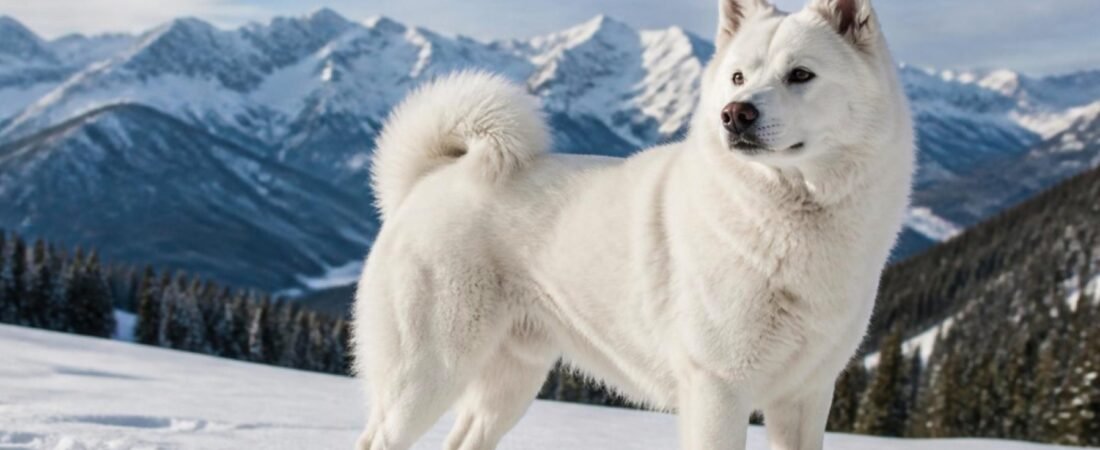
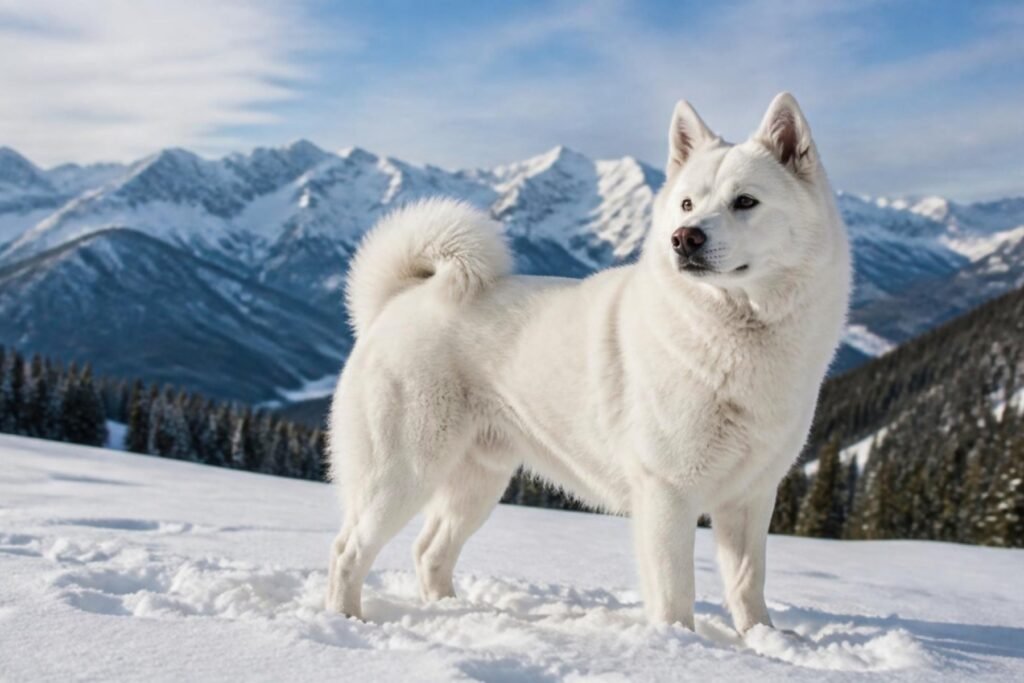
Think of the Pungsan dog as the Korean Jindo’s bigger, fluffier cousin. It has a white coat, pointed ears that stand straight up, and a curled tail. But this dog comes from the other side of the border.
In North Korea, the Pungsan is the national dog. In South Korea, a few of them became famous as gifts passed between leaders at summits. And very few people outside Korea have ever met one in person. That’s what makes their story so interesting to me, so here it is, from the mountains to the zoo.
A hunting dog from the cold northern highlands
The Pungsan dog is named after Pungsan County in what used to be South Hamgyong Province. According to Korean Wikipedia and Namuwiki, that area is now Kimhyonggwon County in Ryanggang Province, North Korea. English Wikipedia says the dogs were bred in the Kaema Highlands.
Tongil News describes the Pungsan as a traditional hunting dog adapted to mountains and forests. Korean Wikipedia adds that the royal family is said to have raised them for hunting during the Joseon era.

Three dogs and a tiger?
Here’s the legend you’ll hear about Pungsan dogs again and again. Namuwiki says an old story has been passed down for generations: if hunters release three Pungsan dogs, they’ll bring back a tiger.
It’s a great story, but it’s still a story. Namuwiki suggests it more likely means the dogs helped hunters, not that they took down a tiger on their own, and it adds that leopards, which also lived on the Korean Peninsula, may be a more realistic target. English Wikipedia tells the same story and says it most likely left people with a strong impression of how resilient and brave these dogs were.
What people seem to agree on is the “why.” Namuwiki’s view is that what made the Pungsan such a good hunting dog was grit, more than fighting power. Wikipedia also describes the breed’s “remarkable perseverance and patience.” A dog like that doesn’t give up on a long, cold trail.
A national symbol in the North, but not in the South
In North Korea, this dog is protected. It has been listed as Natural Monument No. 368 since 1956, according to Tongil News, and Kim Jong-un made it the country’s national dog in November 2014. In 2022, North Korea went one step further and registered “Pungsan dog culture” as national intangible cultural heritage. That covers raising and training the dogs, hunting customs, and even novels, films, and art about them.
The South Korean side of the story is quieter. Korean Wikipedia explains that Pungsan dogs from that region were designated Natural Monument No. 128 in 1942, under Japanese colonial rule, and that the designation was lifted in South Korea in 1962. Namuwiki is clear on this: the Pungsan is not a natural monument of South Korea today. The Jindo, of course, is.
Big, white, and built for the cold
Pungsan dogs are larger than Jindos. English Wikipedia lists males at 60 to 65 cm (about 24 to 26 inches) and females at 50 to 60 cm (about 20 to 24 inches), with a weight of 20 to 30 kg (about 44 to 66 pounds).
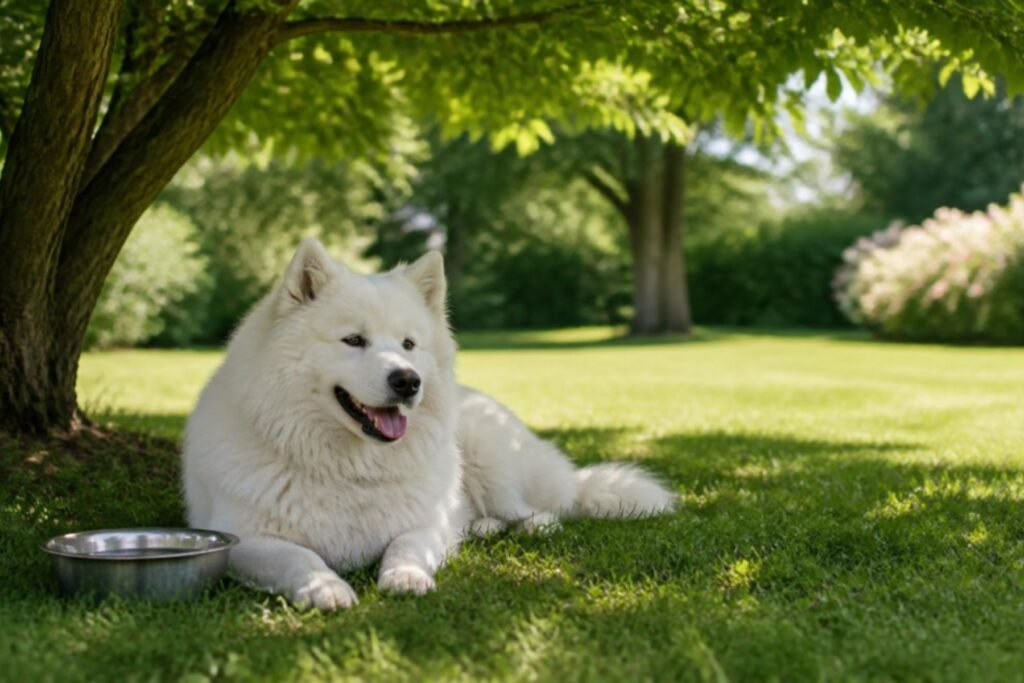
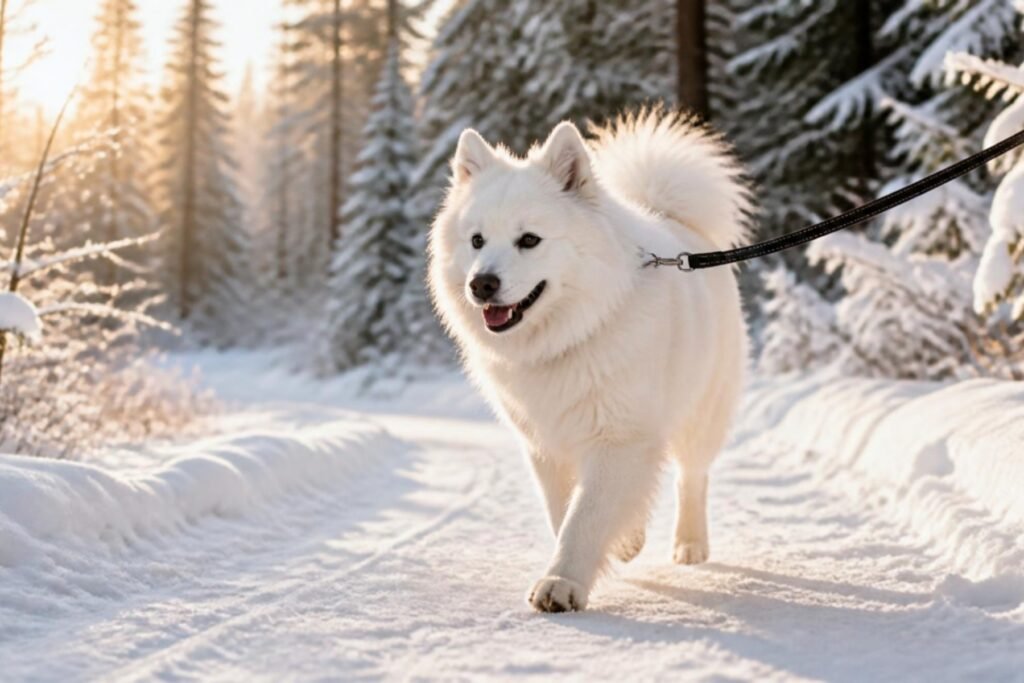
Korean Wikipedia describes a thick coat that’s usually white, sometimes with some brown mixed in, plus a curled tail and pointed, upright ears. The Korean pet site Bemypet Life calls it a thick double coat and says Pungsans are sturdier than Jindos, with even thicker fur.
White wasn’t always the main color, though. Namuwiki says that up until the Japanese colonial period, many Pungsan dogs were black or gray. Breeding later focused on white dogs, and today white is by far the most common.
That coat makes sense for a dog from the Kaema Highlands. Wikipedia notes the breed’s strong endurance and high resistance to cold. Heat is another story. Bemypet Life says Pungsans don’t handle it well and do best in cold climates.
What is a Pungsan dog like at home?
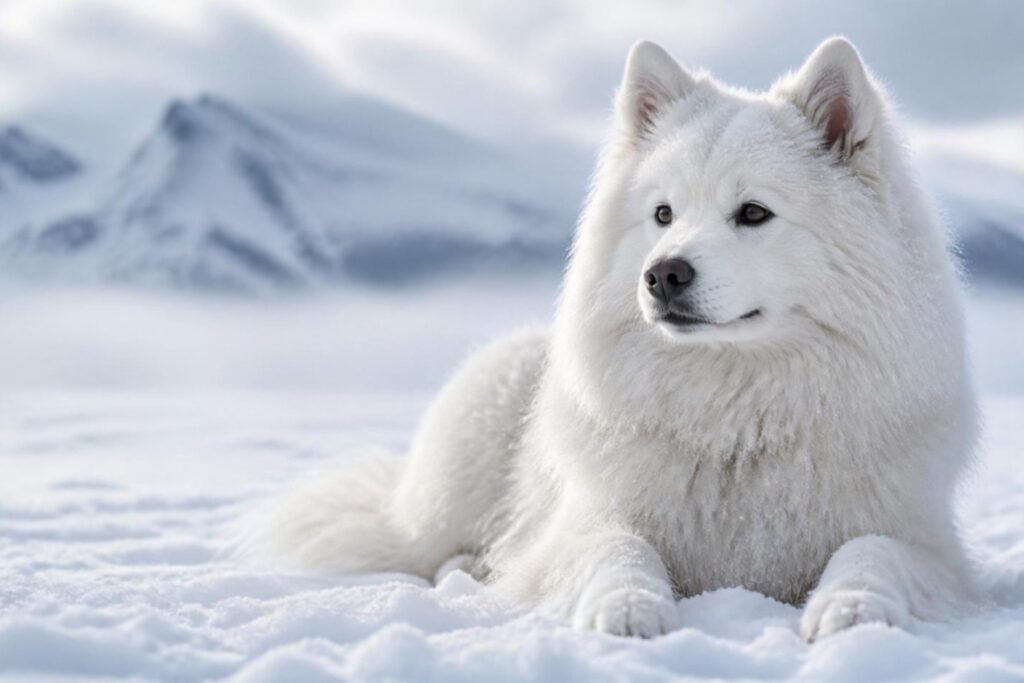
Descriptions of the Pungsan’s personality are a mix of gentle and fierce, and that contrast is part of their charm. The Korea Herald has described the breed as “agile, clever and ferocious to beasts, but friendly and loyal to their human masters.”
English Wikipedia says they’re generally very gentle, and that they rarely bark or get into fights without a reason. Korean Wikipedia agrees they’re mild-mannered, but says that when they’re hunting or facing an enemy, they fight to the end.
Bemypet Life describes them as very loyal to one owner, protective, independent, and a little stubborn. It recommends early socialization and consistent training, plus one to two hours of hard exercise a day. That’s a lot of dog. A hunter bred to keep going through the mountains isn’t going to be satisfied with a quick walk around the block.
Why you almost never see one outside Korea
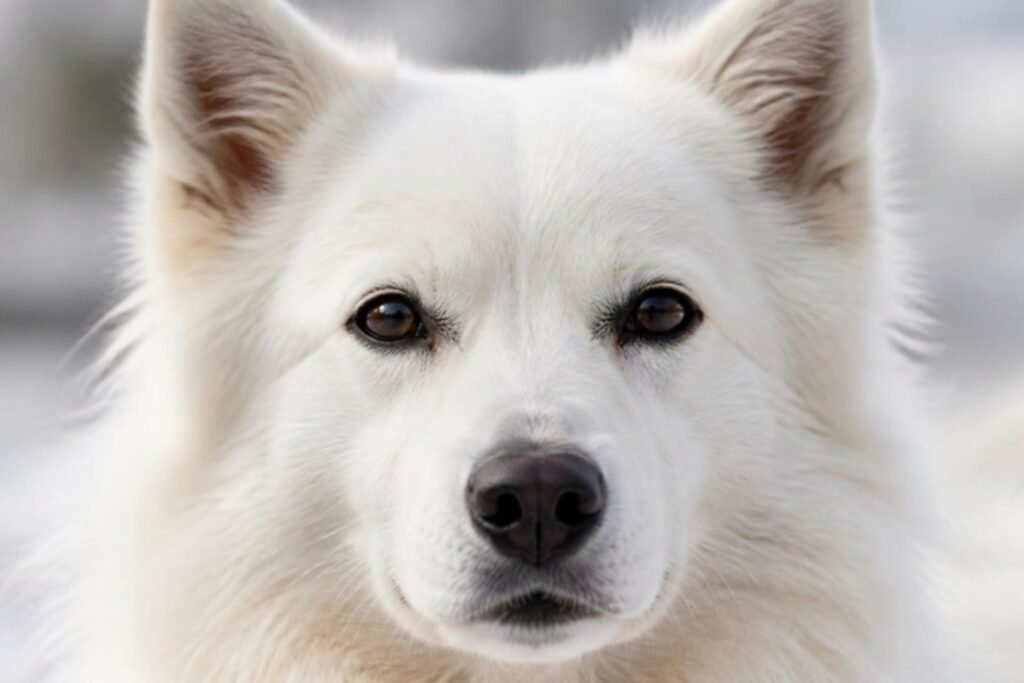
If you’re hoping to spot a Pungsan at your local dog park, I’m afraid the odds are low. Wikipedia calls it a rare breed and says it’s not recognized by any major kennel club. Bemypet Life specifically notes that neither the AKC nor the FCI recognizes it.
Even in South Korea, real Pungsan dogs are hard to find. Namuwiki says the genuine ones there mostly trace back to pairs that came from the North as gifts, and to their offspring kept by zoos and public institutions.
💡 Good to know: Many dogs sold as “Pungsan” in South Korea aren’t the real thing. Namuwiki traces one well-known case to 1992, when a man from Pohang bought a pair of white dogs in China’s Jilin Province and sold them as Pungsan dogs.
Health: what we know (and what we don’t)
I want to be honest here. There isn’t much breed-specific health research on Pungsan dogs, at least not that I could find in English or Korean.
A 2013 Seoul Shinmun report said the average lifespan of Pungsan dogs is 10 to 12 years. Bemypet Life mentions hip dysplasia, bloat, and inward-rolling eyelids (entropion) as concerns, but I couldn’t find studies to back that up for this breed specifically.
What we can lean on is general care advice for large, double-coated dogs:
- Don’t shave that coat. Dr. Jerry Klein, the AKC’s chief veterinary officer, warns that shaving a double coat removes an insulating layer and “makes the dog susceptible to heat stroke.” Regular brushing, shade, water, and exercise during cooler hours help much more.
- Know the signs of bloat. Veterinarian Dr. Jeff Grognet, writing for the AKC, says large dogs with deep chests are most at risk. Watch for a swollen belly, retching, drooling, restlessness, and pain when the belly is touched.
⚠️ Please don’t wait. If you think your dog might have bloat, call your vet or an emergency vet right away. Dr. Grognet notes that shock can set in within one to two hours without treatment.
Fun facts and true stories 🐾
Uri and Duri, a summit gift. At the 2000 inter-Korean summit, Kim Jong-il gave President Kim Dae-jung a pair of Pungsan dogs. (I wrote about the Jindos that went north that same year in my Korean Jindo guide.) According to Seoul Shinmun, the male was originally named Jaju and the female Dangyeol, and Kim Dae-jung renamed them Uri and Duri. They lived at Seoul Grand Park from November 2000, had 21 puppies together, and saw their family line reach three generations. Both died in 2013 at 14 years old, which is longer than the average the paper reported.
Gomi arrived with a surprise. After the September 2018 summit in Pyongyang, Kim Jong-un gave President Moon Jae-in two Pungsan dogs, a male named Songkang and a female named Gomi. Gomi was already pregnant. On November 9, 2018, she gave birth to six puppies, three males and three females, ITV reported. Moon said, “I hope inter-Korean ties will also be like this.” In August 2019, the Korea Herald reported that the puppies took one last stroll at Cheong Wa Dae before moving to four local governments: Seoul, Incheon, Daejeon, and Gwangju.
Seven more followed. In 2021, the Korea Times reported that Gomi had seven white puppies with Maru, a Pungsan who was already Moon’s own dog.
A custody question that made headlines. Under South Korea’s Presidential Records Act, gifts like these belong to the state, so they can’t simply go home with a president. When Moon left office in May 2022, an agreement let him keep caring for the dogs. In November 2022, he returned Songkang and Gomi to the government, with his side citing a lack of support and an enforcement ordinance that hadn’t been revised, the Korea Herald reported. The dispute turned into a political argument, but the dogs themselves ended up in a good place. After a vet stay where they were treated for ear and bladder inflammation and kidney stones, they moved to Uchi Park Zoo in Gwangju in December 2022, where one of their pups, Byul, already lived. A few weeks later, Seoul Shinmun reported they’d gained weight and were busy marking spots all over the park on their daily walks.
💡 Did you know? In November 2022, while the custody story was in the news, North Korea’s party newspaper Rodong Sinmun praised the Pungsan as clever and usually gentle, and said it follows the owner who raises it well.
Is a Pungsan dog right for you?
Realistically, most of us will never have the chance. These dogs are very rare, not recognized by major kennel clubs, and even in Korea it’s hard to know if a dog is truly a Pungsan.
Still, the traits are worth knowing if you love this type of dog. Based on everything above, a Pungsan would need plenty of hard exercise, patient and consistent training, early socialization, and a real plan for hot summers. It’s a lot to ask of a family. If that sounds like your kind of dog, a Jindo or Jindo mix might be a lovely fit, and as I shared in my Jindo guide, many of them are waiting in US rescues.
Angel Jake Note 🐾
It still amazes me that one breed can hold so many stories at once. A hunting dog from the snowy north, a legend about tigers, and a litter of summit puppies.
Politics came and went around them. The dogs just did what dogs do. They had puppies, went on walks, and left their mark all over a new park. Maybe that’s the part worth remembering most.
Medical Disclaimer
I’m not a vet, and nothing here replaces a real exam. If something about your dog feels off, please trust that feeling and call your veterinarian.
Sources
- Wikipedia: Pungsan dog
- 위키백과: 풍산개
- 나무위키: 풍산개
- 비마이펫 라이프: 풍산개 성격 및 특징, 북한 출신의 용맹한 토종개
- 통일뉴스: 북, 풍산개 국가비물질문화유산으로 지정
- 이데일리: 北, 또 풍산개 거론 “영리하고 온순…길러준 주인 잘 따라”
- 서울신문: 김정일 선물한 풍산개 암수, 노환으로 모두 숨져
- ITV News: Kim Jong-un’s pregnant dog gifted to South Korea gives birth to six “peace puppies”
- The Korea Herald: Moon distributes puppies of Pungsan dogs gifted by N.K. leader
- The Korea Times: President Moon Jae-in’s dog gifted from Kim Jong-un delivers 7 puppies
- The Korea Herald: Moon returns to state two dogs gifted by N. Korea’s Kim
- The Korea Times: NK dogs gifted to Moon find new home in Gwangju zoo
- 서울신문: 병원비 1110만원 나왔던 ‘풍산개들’…공원 곳곳에 마킹中
- American Kennel Club: Should You Shave Your Dog in the Summer?
- American Kennel Club: Bloat in Dogs