

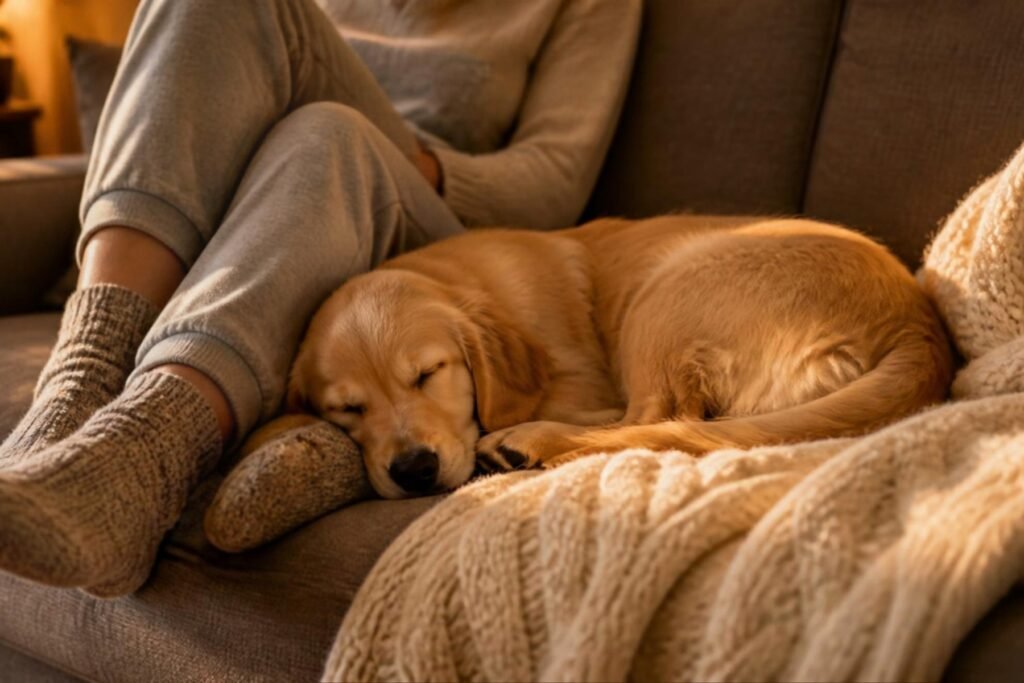
You’re relaxing on the couch, and your dog is fast asleep beside you. Then it starts. A little paw twitch. Then another. Their legs begin to paddle like they’re running, their whiskers flicker, and a tiny muffled “woof” slips out.
It’s hard not to wonder what’s happening in there. Are they chasing a squirrel? Playing fetch? Dreaming about you? Science can’t read a dog’s mind yet, but it can tell us a surprising amount.
So, do dogs dream?
Most scientists who study sleep think the answer is yes.
Psychologist Stanley Coren, who has written many books on dog behavior, explains in Psychology Today that dogs’ brains go through the same stages of sleep as ours, with similar patterns of electrical activity. That includes REM sleep, short for “rapid eye movement,” the stage when people have most of their vivid dreams.
During REM sleep, you might notice your dog’s eyes moving behind their eyelids, their breathing becoming a little uneven, and those famous twitches and paddles.
What do dogs dream about?
Here’s where it gets really interesting.
Researchers at MIT once recorded the brain activity of rats while they ran through a maze, and then again while they slept. The patterns during REM sleep matched the patterns from the maze so closely that the scientists could tell the rats were replaying their day in their sleep.
Dogs have more complex brains than rats, so scientists suspect they do the same thing.
And there’s even more evidence. Coren describes earlier experiments in which researchers switched off a part of the brain called the pons, which normally keeps the body still during dreams. Without it, sleeping dogs started acting out what looked like their dreams. Pointers seemed to search for game, spaniels flushed imaginary birds, and Doberman pinschers acted like they were chasing off intruders.
In other words, dogs seem to dream about very doggy things.
💡 Did you know? A dog who spends the day chasing balls may be more likely to dream about fetch. The AKC points out that your Lab may dream about tennis balls more often than a Pug does, because dreams tend to reflect what a dog loves to do while awake.
Do dogs dream about us?
Many of us secretly hope so, and there’s a good reason to think it’s possible.
Harvard psychologist Dr. Deirdre Barrett, who studies dreams, told People magazine in 2016, as reported by CBS News, that “since dogs are generally extremely attached to their human owners, it’s likely your dog is dreaming of your face, your smell and of pleasing or annoying you.”
We can’t prove it. But if dogs dream about their days, and we’re a huge part of those days, it makes a lot of sense.
Big dogs and small dogs dream differently
This is one of my favorite details. According to the AKC, small dogs tend to dream more often, but for shorter stretches, while large dogs dream less often but for longer.
Coren notes that an average-sized dog usually starts dreaming about 20 minutes after falling asleep.
Puppies and senior dogs also tend to twitch more in their sleep. The AKC explains that in puppies, the part of the brain that keeps the body still during dreams is still developing, and in older dogs it may not work quite as well as it used to.
Dreams may help dogs learn
Scientists in Hungary have been studying what happens in dogs’ brains while they sleep. In a 2017 study published in Scientific Reports, they found that certain patterns of brain activity during sleep after learning were linked to how well the dogs learned.
It’s a reminder that a good nap isn’t just rest. For dogs, as for us, sleep may help turn the day’s experiences into memories.
Should you wake a dreaming dog?
It’s tempting, especially if it looks like a scary dream. But the AKC recommends letting them wake up on their own. A dog who’s startled out of a deep dream can feel confused for a moment and might snap by accident. That’s especially important to teach children.
If you feel your dog is upset, you can softly say their name from a short distance instead of touching them.
Dreaming or a seizure?
Most sleep twitches are completely normal. But it’s worth knowing the difference, because seizures can look a little like dreaming at first.
According to the AKC:
- Dreaming usually looks like short twitches or gentle paddling that lasts less than 30 seconds, and the dog wakes up easily when you call them.
- A seizure is often stiff, rigid, or violent. The dog can’t be woken up, and afterward they may seem confused, drool, or pant. Some dogs also lose control of their bladder or bowels.
⚠️ Please don’t wait. If you think your dog is having a seizure, keep them away from stairs and sharp furniture, don’t put your hand near their mouth, and call your vet. If a seizure lasts longer than 3 to 4 minutes, or your dog has more than one in 24 hours, it’s an emergency.
The AKC also suggests filming the episode on your phone if you safely can. It can help your vet understand what happened.
Angel Jake Note 🐾
I think there’s something so tender about watching a dog dream. Those little paws running, that tiny muffled bark, the way they sigh and settle back down. Whatever they’re dreaming about, it’s a peek into a world we’ll never fully see.
And if Dr. Barrett is right, some of those dreams might be about us. So let them sleep, keep them safe and cozy, and maybe, just maybe, be the person they dream about.
Medical Disclaimer
I’m not a vet, and nothing here replaces a real exam. If something about your dog feels off, please trust that feeling and call your veterinarian.
Sources
- Psychology Today (Stanley Coren): Do Dogs Dream?
- American Kennel Club: What Do Dogs Dream About?
- American Kennel Club: Dog Dreaming vs. Seizures, How to Tell the Difference
- CBS News: Chances are, your dog dreams about you, says Harvard psychologist (2016)
- BBC Science Focus: Your dog loves you so much, they even dream about you
- Scientific Reports: EEG transients in the sigma range during non-REM sleep predict learning in dogs (2017)