
That bright white coat, those dark, curious eyes, and a little carrot-shaped tail held proudly in the air — the West Highland White Terrier looks almost like a dog who walked straight out of a storybook.
But please don’t let the teddy-bear look fool you. Inside that small, fluffy body is a true terrier: confident, clever, independent, curious, and full of personality. Before Westies became cozy family companions, they had a much tougher job in the rocky hills of Scotland. And honestly, the more I learned about them, the more I fell for this breed. Here’s everything I think is worth knowing.
West Highland White Terrier at a glance 🐾
- Nickname: Westie
- Origin: Scotland
- Breed group: Terrier
- Height: about 10–11 inches at the shoulder
- Weight: usually around 15–20 pounds
- Life expectancy: about 13–15 years (AKC)
- Coat: white double coat — a harsh outer coat and a soft undercoat
- Energy: moderate to high
- Grooming needs: moderate to high
- Trainability: smart, but independent
- Prey drive: high
- Apartment friendly: often yes, with enough exercise
- Good with kids: often, when children are gentle and respectful
- Best for: people who want a small, sturdy dog with a very big personality
Where Westies come from
Westies come from the Scottish Highlands, where small, tough terriers were kept to hunt foxes, badgers, and rats. They had to be brave enough to follow animals into rocky crevices and underground dens, yet small and agile enough to move through rough ground. The Westie shares its roots with other Scottish terriers, including the Cairn Terrier and the Scottish Terrier.
One story is told again and again in Westie history. According to breed legend, Colonel Edward Donald Malcolm of Poltalloch lost one of his reddish terriers during a hunt when it was mistaken for a fox and shot. After that heartbreak, his family is said to have favored white terriers, because they were so much easier to tell apart from wildlife. Whether every detail is exactly true is hard to prove, but it became a treasured part of the breed’s story.
The breed was officially recognized at England’s Crufts dog show in 1907, the American Kennel Club recognized it in 1908, and the West Highland White Terrier Club of America was founded in 1910.

Small, but surprisingly sturdy
Westies are small, but they are definitely not fragile. The AKC breed standard describes them as compact, well-boned, hardy little terriers. The ideal height is about 11 inches at the shoulder for males and 10 inches for females, and most adults weigh somewhere around 15 to 20 pounds.
Their strong legs, deep chest, and proud posture make them seem bigger than they really are. They’re the classic “big dog in a small body.”
Here’s a sweet little detail most people don’t know: Westie puppies are often born with pink on their noses and paw pads, and it slowly darkens to black as they grow up.
Westie personality
Westies are usually confident, curious, playful, alert, independent, and deeply affectionate with their families. Many have a wonderful sense of humor, too. A Westie might follow you from room to room all day and then decide that whatever you just asked is more of a suggestion than a request.
That independence comes from generations of terriers who worked ahead of their people and had to make decisions on their own. So training usually works best when it’s short, upbeat, and fun. Treats, praise, games, and variety go a lot further than repetition or harsh corrections — a Westie who’s bored will simply stop playing along.

Are Westies good with children?
Many Westies love their kids, especially when they’re raised together and well socialized. But they’re still terriers, and most of them value their personal space. Grabbing, squeezing, chasing, or rough play usually isn’t their idea of fun.
Teaching children to be gentle — letting the dog come to them, petting softly, and leaving the dog alone while eating or sleeping — makes such a difference. And young children and dogs should always be supervised together, whatever the breed.

Prey drive: why Westies chase everything
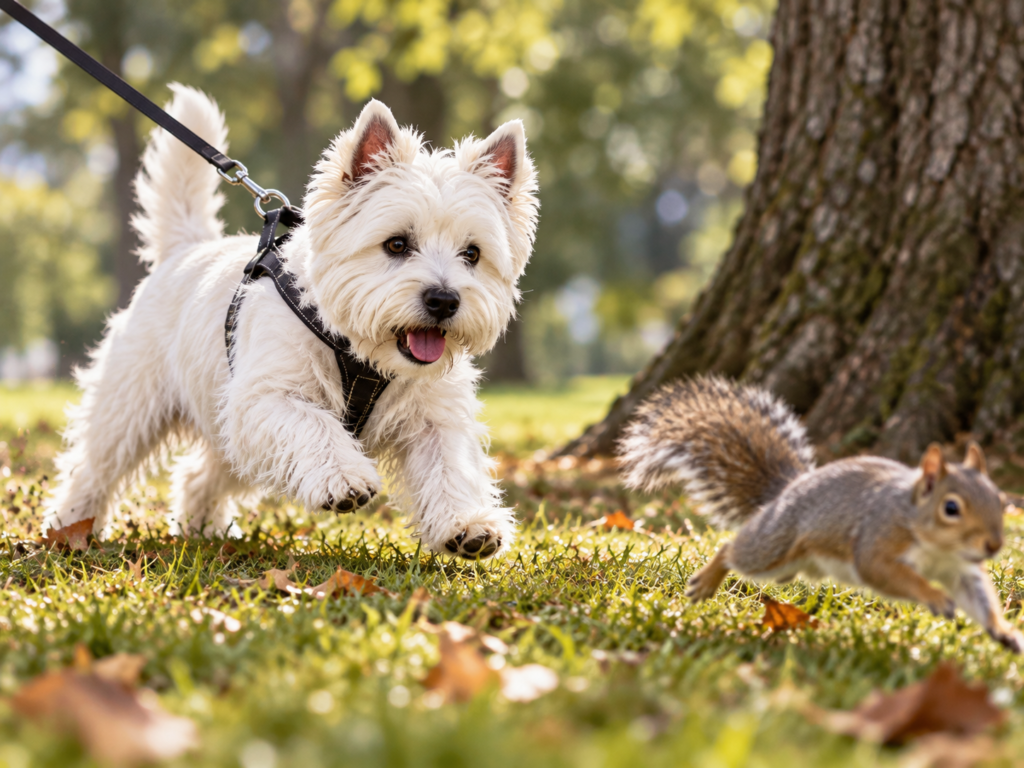
This is one of the most important things for a future Westie parent to understand. These dogs were bred to pursue small animals, and that instinct is still very much alive. A squirrel dashing across the sidewalk can be almost impossible for some Westies to ignore, and rabbits, rodents, and birds can switch on that chase instinct in a heartbeat.
That’s why many Westies shouldn’t be off-leash in unfenced areas. A secure fence, a well-fitted harness, and a reliable leash keep them safe. And if you have small pets like hamsters, guinea pigs, or rabbits, please think carefully and never leave them unsupervised together.
💡 Good to know: A Westie who spots a squirrel may not hear a single word you say. A secure fence and a well-fitted harness are much more reliable than recall alone.
Why do Westies love to dig?
If your Westie starts digging up the backyard, they’re not trying to ruin your garden. They’re following centuries of instinct. Terriers were bred to find animals that lived underground, so digging was literally part of the job. In fact, the word “terrier” comes from the Latin word terra, meaning earth, and working terriers like the Westie are sometimes called “earthdogs.”
For many modern Westies, digging still feels amazing. A designated digging spot (a sandbox works well), sniffing games, and puzzle toys can give that energy somewhere to go.

How much exercise do Westies need?
Westies may be small, but they’re not couch potatoes. Most enjoy a mix of daily walks, sniffing adventures, fetch, backyard play, puzzle toys, and short training games. Around 45 to 60 minutes of activity spread through the day is a good starting point for many healthy adults, though age, health, and personality all matter.
Mental exercise is just as important as physical exercise. A bored terrier can become a surprisingly creative interior designer.

Grooming that famous white coat
The Westie has a double coat: a harsh, straight outer coat and a softer undercoat. The breed standard allows only one color — white. Brushing a few times a week helps prevent tangles and keeps loose hair under control.
How often a Westie needs professional grooming depends on the style. According to the AKC, Westies kept in a clipped style are usually groomed every 4 to 6 weeks, while show dogs that are “hand-stripped” — where dead hairs are pulled out by hand instead of clipped — may be groomed as often as every 1 to 3 weeks. Most family Westies are clipped because it’s much easier to maintain.
Don’t forget the little things, either. Overgrown nails are one of the most common problems vets see in Westies, so regular nail trims matter. And please go easy on the baths — Westie skin can be sensitive, and too much bathing or harsh shampoo can cause irritation. Your vet or groomer can help you find the right routine.

What the research says about Westie health
One thing I really wanted to know was what actually goes wrong most often in Westies — not just the scary rare conditions, but everyday problems. A large study by the Royal Veterinary College’s VetCompass program looked at the vet records of 2,058 Westies in the UK, and the findings surprised me.
The most common problems were:
- dental (periodontal) disease — about 15.7% of Westies
- ear infections (otitis externa) — about 10.6%
- overgrown nails — about 7.2%
- allergic skin disease — about 6.5%
- obesity — about 6.1%
When the researchers grouped conditions together, skin problems were the most common category of all, affecting about 22.7% of the dogs. The same study found a median lifespan of 13.4 years, with males living a little longer than females (13.8 vs. 12.9 years). The most common causes of death were lower respiratory (lung) disease and cancer.
What I take from this is simple and hopeful: many of the most common Westie problems — teeth, ears, nails, skin, and weight — are things we can watch for and help with at home, together with our vet.
Westie skin deserves special attention
If there’s one area every Westie parent should watch closely, it’s the skin. Westies are well known for allergic skin disease (atopic dermatitis), and researchers have even studied the genetics behind it in this breed.
Signs of skin trouble can include frequent scratching, paw licking, chewing at the skin, ear infections that keep coming back, redness, hair loss, and a greasy or unpleasant smell. Please don’t brush these off as “just a Westie thing.” Your vet can help figure out whether allergies, infection, parasites, food reactions, or something else is going on — and the earlier it’s managed, the more comfortable your dog will be.
⚠️ Please don’t wait. If your Westie keeps scratching, licking their paws, or getting ear infections, book a vet visit sooner rather than later. Skin trouble is much easier to calm down when it’s caught early.
Other health conditions seen in Westies
Like every breed, Westies can be prone to certain conditions:
Craniomandibular osteopathy (“Westie jaw”). An inherited condition that causes abnormal bone growth in the jaw, usually in young puppies. It can make chewing and opening the mouth painful. There is a DNA test for it.
Legg-Calvé-Perthes disease. A hip condition that can cause pain and limping, usually in young small-breed dogs.
Patellar luxation. A kneecap that slips out of place, which is common in many small breeds.
Liver disease. Chronic liver problems, including chronic hepatitis, have been reported more often in Westies.
Dry eye (keratoconjunctivitis sicca). A condition where the eyes don’t make enough tears, leading to irritation and thick discharge. It’s very manageable when caught early.
Pulmonary fibrosis (“Westie lung disease”). A progressive scarring of the lungs seen mostly in middle-aged and older Westies. Signs can include coughing, faster breathing, and getting tired easily on walks. Since lung disease was one of the top causes of death in the VetCompass study, any lasting change in your Westie’s breathing deserves a vet visit.

Health testing: questions to ask a breeder
If you’re thinking about a Westie puppy from a breeder, please ask about health testing. For Westies, the Canine Health Information Center (CHIC) program, supported by the West Highland White Terrier Club of America, lists these tests for breeding dogs:
- eye exams by a board-certified veterinary ophthalmologist (repeated regularly)
- hip evaluation
- patella (kneecap) evaluation
- a DNA test for craniomandibular osteopathy
Health testing can’t guarantee a puppy will never get sick, but it helps reduce avoidable inherited problems. A good breeder will be happy to show you the results.
Food and weight
Westies love their food, and extra weight sneaks up quickly on a small dog — about 6% of Westies in the VetCompass study were recorded as obese. A little extra weight puts more strain on their joints and can make other health problems harder to manage. Measure meals, count treats, and ask your vet what a healthy body condition looks like for your dog. If your Westie has skin allergies, your vet may also recommend a specific diet as part of their care.
How long do Westies live?
Westies are often long-lived little dogs, and many reach their early or mid-teens. The AKC lists a typical lifespan of 13 to 15 years, and the VetCompass study found a median of 13.4 years. Genetics, weight, dental care, regular checkups, and catching problems early all make a real difference.
Fun facts about Westies 🐾
Their tail really is supposed to look like a carrot. The breed standard describes the tail as fairly short, sturdy, and carrot-shaped, carried upright — not curled over the back. According to the AKC, it’s said to be strong enough that a Westie stuck in a burrow could be pulled out by it.
That white coat had a job. Besides the famous legend, a white dog was simply easier for hunters to spot against the Scottish landscape.
They were working dogs before they were lap dogs. Westies helped farmers and estate owners control rats and other vermin, which explains why they can be fearless around animals far bigger than they are.
Their bark had a purpose. When a terrier went underground, a loud, persistent bark helped hunters find where the dog had gone. That alert voice still shows up whenever someone walks past the window.
You’ve probably seen one on TV. A Westie has long been the face of Cesar dog food, and a black-and-white pair of a Scottie and a Westie appears on the label of Black & White Scotch whisky.
Small dog, serious confidence. The breed standard even mentions a Westie’s “self-esteem.” Anyone who’s met one knows exactly what that means.
Is a Westie right for you?
A Westie might be a wonderful match if you want a dog who’s small but sturdy, playful and entertaining, active without being extreme, and affectionate without needing constant attention.
A Westie might be harder if you want a dog you can trust off-leash, you have small pets at home, you don’t enjoy grooming, or you want a dog who obeys every command instantly. (A Westie may hear you perfectly well — they’re just considering their options.) And please be ready to keep an eye on their skin, ears, and teeth throughout their life.
If you’re open to an adult dog, Westie breed rescues often have wonderful dogs looking for homes, including seniors who are already past the digging-everything stage.
Angel Jake Note 🐾
There’s something about a Westie that makes people smile. Maybe it’s that little white face, or the carrot tail standing proudly in the air, or the way they trot down the street like the whole neighborhood belongs to them.
But under all that cuteness is something I find even more special. Westies were built to be brave. For generations, these tiny terriers worked in the rough Scottish countryside, following prey underground and making decisions without waiting for anyone to tell them what to do. And somehow, that spirit is still there.
A modern Westie might spend the afternoon chasing a squirrel, digging a completely unnecessary hole in your yard, and ignoring you when you call… and then curl up beside you that evening like the sweetest little dog in the world.
That’s the Westie. Cute enough to look like a stuffed animal, and confident enough to believe they’re ten times their size. If you can love the stubbornness, the grooming, the terrier instincts, and the occasional attitude, you’ll find a dog who is funny, loyal, brave, and completely unforgettable.
That big personality might just steal your heart.
Sources
- American Kennel Club: West Highland White Terrier breed information
- American Kennel Club: West Highland White Terrier facts you may not know
- O’Neill et al. (2019), West Highland White Terriers under primary veterinary care in the UK (VetCompass)
- West Highland White Terrier Club of America: CHIC health screening
- Westie Foundation of America: Westie health issues
- Idiopathic pulmonary fibrosis in West Highland white terriers: an update (The Veterinary Journal)
- American Kennel Club: Terrier group health testing requirements
Related Reading
- Why Is My Dog Licking Their Paws?
- Dental Disease in Dogs: Signs, Stages, Treatment, and How to Prevent It
- Caring for a Senior Dog: Changes You Shouldn’t Ignore as Your Dog Gets Older
Medical Disclaimer
I’m not a vet, and nothing here replaces a real exam. If something about your dog feels off, please trust that feeling and call your veterinarian.