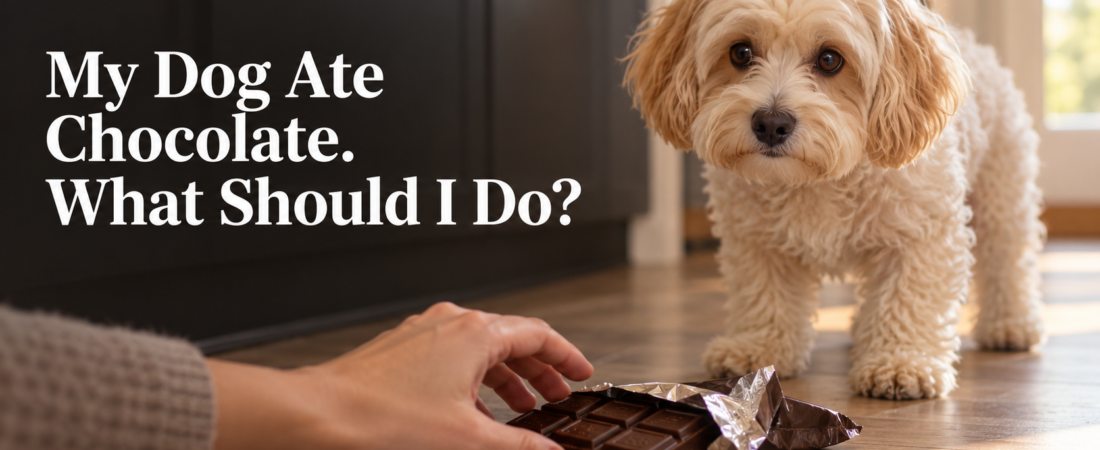
You turn around for one minute, and the brownie on the counter is just… gone. Or you walk into the living room and the Halloween candy bag is torn open, and your dog is looking at you like they have no idea what happened.
If that’s where you are right now, first — breathe. I know your heart is pounding. Chocolate can be dangerous for dogs, but not every chocolate moment turns into an emergency. What really matters is what kind of chocolate it was, how much your dog ate, and how big your dog is.
And if you only read one line of this post, let it be this one: if you’re not sure, call your vet or a pet poison hotline now. Nobody will think you overreacted. Calling and hearing “they’ll be fine” is so much better than waiting and wondering.
What to do right now
Move your dog away from whatever is left and pick up the wrappers. Then look at the packaging and try to figure out what kind of chocolate it was — milk, dark, baking chocolate, cocoa powder — and roughly how much is missing. It also helps to know about how much your dog weighs.
Then call. Your regular vet, an emergency vet, or one of these 24/7 hotlines:
- ASPCA Animal Poison Control Center: (888) 426-4435
- Pet Poison Helpline: (855) 764-7661
Both charge a consultation fee, but honestly, the peace of mind is worth it — and sometimes it saves you an emergency visit you didn’t need.
💡 Good to know: Please don’t try to make your dog throw up on your own. Pet Poison Helpline specifically warns against doing that without talking to a professional first.
Why chocolate is hard on dogs
Chocolate has two stimulants in it: theobromine and caffeine. Our bodies break them down pretty quickly. Dogs’ bodies don’t, so the effects hit them harder and stay with them longer.
Theobromine is the bigger worry. According to the Merck Veterinary Manual, chocolate contains several times more theobromine than caffeine.
Dark chocolate is a different story than milk chocolate
This part surprised me the first time I read it. The darker and more bitter the chocolate, the more dangerous it is for dogs. Here’s roughly how much theobromine is in different kinds, based on the Merck Veterinary Manual:
- Cocoa powder: about 800 mg per ounce
- Unsweetened baking chocolate: about 440 mg per ounce
- Dark or semisweet chocolate: about 150 to 160 mg per ounce
- Milk chocolate: about 64 mg per ounce
- White chocolate: about 1 mg per ounce
💡 Did you know? So a spoonful of cocoa powder or a bit of baking chocolate can be far more serious than a whole milk chocolate bar. White chocolate barely has any theobromine at all, though all that sugar and fat can still leave your dog with an upset stomach.
How much is too much?
The Merck Veterinary Manual says mild signs can start around 20 mg of theobromine per kilogram of body weight. Heart-related effects can show up around 40 to 50 mg/kg, and seizures at 60 mg/kg or more.
To make that a little more real, here’s roughly what 20 mg/kg looks like:
- For a 10-pound dog: about 1.4 ounces of milk chocolate, about half an ounce of dark chocolate, or about a fifth of an ounce of baking chocolate
- For a 50-pound dog: about 7 ounces of milk chocolate, about 3 ounces of dark chocolate, or about 1 ounce of baking chocolate
Please treat these as a rough guide, not a green light. Every chocolate product is a little different, it’s hard to know exactly how much a dog really ate, and some dogs are just more sensitive. Let your vet or the hotline do the math with you.
Signs to watch for
Symptoms usually show up within 6 to 12 hours. That’s the tricky part — your dog can seem completely fine at first and then start feeling sick later. Keep an eye out for:
- Vomiting or diarrhea
- Drinking or peeing a lot more than usual
- Restlessness, pacing, or acting wired
- Heavy panting or a racing heart
- Shaking or muscle tremors
- Seizures or collapse
In serious cases, chocolate can cause heart rhythm problems, a high body temperature, and trouble breathing, and Merck notes that signs can last up to 72 hours. If you see tremors, a seizure, or collapse, please don’t wait. Go straight to an emergency vet.
What the vet might do
If your dog ate the chocolate recently — often within about two hours — the vet may give medication to make them vomit safely. Depending on how much they ate and how they’re doing, they might also give IV fluids, medicine to calm the heart rate or stop seizures, and keep an eye on them until the stimulants are out of their system.
The good news, and I want you to hear this part: most dogs recover well, especially when they get help early.
Halloween makes this so much easier to happen
October is a hard month for this. Candy bowls sit out, trick-or-treat bags end up on the floor, and dogs are really, really good at finding them.
A few small things help. Keep candy up high or behind a closed door. Gently remind the kids not to share with the dog and to keep their bags off the floor. Watch out for sugar-free candy and gum too, since many contain xylitol, which is also very dangerous for dogs. And pick up wrappers — swallowing those can cause problems of their own.
Angel Jake Note 🐾
I think almost every dog parent knows that sinking feeling. You see the empty wrapper, and your mind jumps straight to the worst.
In that moment, you don’t need to have all the answers. You just need to grab the wrapper, pick up the phone, and let someone help you figure it out. That’s enough. That’s being a good dog parent.
And maybe, after everyone’s okay, move the chocolate one shelf higher.
Veterinary Sources
I leaned on the Merck Veterinary Manual for the theobromine amounts and dose ranges, and on the ASPCA Animal Poison Control Center and Pet Poison Helpline for the hotline numbers and the advice not to make your dog vomit without talking to a professional first.
- Merck Veterinary Manual: Chocolate Toxicosis in Animals
- ASPCA Animal Poison Control Center
- Cornell University: What should I do if my dog eats chocolate?
Related Reading
- When Should You Take Your Dog to the Emergency Vet? Signs You Shouldn’t Ignore
- Dog Not Eating? When to Worry and When to Call the Vet
- 7 Subtle Changes That May Mean Your Dog Isn’t Feeling Well
Medical Disclaimer
I’m not a vet, and nothing here replaces a real exam. If something about your dog feels off, please trust that feeling and call your veterinarian.