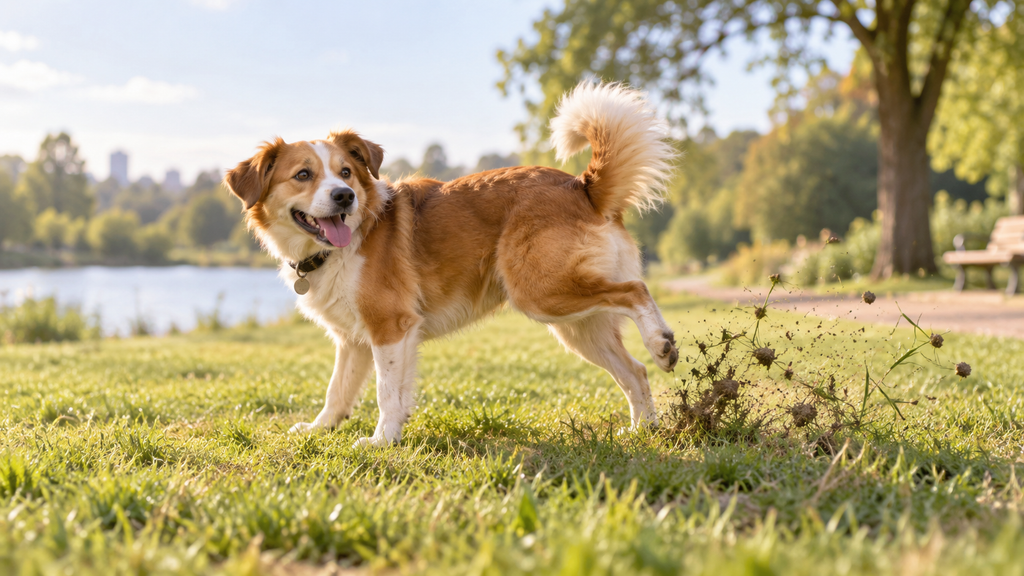
You know the moment.
Your dog finishes pooping, takes one or two steps forward, and suddenly starts kicking the ground like they are trying to destroy the lawn.
Grass flies.
Dirt goes everywhere.
And if you are standing in the wrong place, sometimes it comes straight at you.
It can look like your dog is trying to cover their poop.
But that is probably not what is happening.
In fact, this strange little habit is part of the way dogs communicate.
Your Dog Is Leaving More Than Poop Behind
Dogs communicate with scent much more than we do.
According to the Merck Veterinary Manual, dogs use body language, sounds, touch, scents, and pheromones to communicate with one another. Scent marking is an important part of that system.
When a dog scratches or kicks the ground after eliminating, they are not simply moving dirt around.
VCA Animal Hospitals explains that dogs have scent-producing glands around their paw pads and between their toes.
As their paws scrape against the ground, they can leave scent behind.
At the same time, the scratches in the grass or dirt create a visible mark.
So another dog passing by may find both:
a smell and a physical sign that another dog was there.
It Is Basically a Doggy Message Board
We tend to experience a walk visually.
Dogs experience much more of it through their noses.
A patch of grass that looks completely ordinary to us may contain all kinds of interesting scent information for a dog.
Another dog urinated there.
Another dog walked through.
Someone marked the tree.
And now your dog may decide to add their own scent to the area.
VCA notes that scientists still do not fully understand exactly what every scent signal communicates.
It may sometimes relate to territory, but it could also simply advertise that a particular dog passed through the area.
So rather than thinking of it only as:
“This is mine.”
It may sometimes be closer to:
“I was here.”
Why Do They Do It After Pooping?
Poop itself already carries scent.
Dogs also have anal sacs that release strongly scented material associated with bowel movements, which can contribute to chemical communication between dogs.
Then some dogs add another layer by scraping the ground afterward.
That creates a combination of scent from the elimination area, scent from the paws, and visible scratches.
To us, it may look completely unnecessary.
To another dog, it may be much more noticeable.
Why Do Some Dogs Kick Much More Than Others?
Not every dog does this.
Some dogs give the ground two gentle scratches and walk away.
Others kick so hard that chunks of grass go flying several feet behind them.
Individual dogs simply vary in how much marking behavior they show.
The environment can matter too.
AKC notes that some dogs may perform ground scratching more often in places where other dogs are present, such as dog parks or frequently traveled walking areas.
That makes sense if part of the behavior is communication.
The more dogs passing through an area, the more smells there are to investigate—and potentially respond to.
Is My Dog Trying to Cover the Poop?
Probably not.
That is one of the most common misunderstandings about this behavior.
Cats often bury waste.
Dogs generally are not doing the same thing when they kick backward after pooping.
In fact, the kicking can make the area more noticeable rather than less noticeable.
They may spread scent and leave visible scratch marks on the ground.
So if your dog sends grass flying everywhere after using the bathroom, they are probably not trying to hide the evidence.
Why Does My Dog Sniff Forever Before Pooping?
This behavior makes a little more sense once you realize how important scent is to dogs.
Your dog may walk back and forth, sniff one patch of grass, reject it, sniff another, turn in a circle, and finally choose a spot.
To us it can feel like:
“Please just pick a place.”
But your dog may be gathering information before deciding where to leave their own scent.
Dogs often investigate scent left by other animals and then add their own mark afterward. Merck describes scent marking as a normal part of canine social communication.
So your dog may be doing much more than simply looking for a bathroom.
They may be checking the neighborhood.
Should You Stop Your Dog From Kicking?
Usually, no.
For most dogs, occasional ground scratching after pooping or urinating is normal behavior.
If they are outside and not damaging anything or hurting themselves, there is usually no reason to stop them.
But there are a few situations where you may want to interrupt or redirect it.
For example, if your dog kicks very aggressively on concrete or another rough surface, they could irritate their paw pads or damage a nail.
VCA notes that vigorous scratching can occasionally cause paw or nail injuries.
You may also want to redirect the behavior if your dog starts scratching carpets, furniture, or other surfaces inside the house.
When Should You Look at Their Paws?
Take a quick look if your dog suddenly starts kicking much harder or more often than usual.
Check for:
- cracked paw pads
- bleeding
- broken nails
- redness
- swelling
- limping
- persistent licking of the paws
The kicking itself is usually normal.
But damaged paws are not.
If your dog seems painful or you notice an injury, contact your veterinarian.
One More Reason to Let Your Dog Sniff on Walks
There is another lesson hidden in this funny behavior.
Walks are not only exercise for dogs.
They are also a chance to investigate the world.
A dog stopping to sniff a tree for thirty seconds may look like they are doing nothing.
But from the dog’s perspective, that spot may contain information left by several other animals.
Allowing some time for sniffing can be an important part of a dog’s walk.
You do not have to let your dog inspect every blade of grass for ten minutes.
But giving them some time to sniff and explore lets them experience the world in the way dogs naturally do.
Angel Jake Note 🐾
I used to think the little kick after pooping was just one of those weird things dogs do.
And honestly, it still makes me laugh when a dog kicks the grass so hard that the person standing behind them has to move.
But once you understand how much dogs rely on smell, the behavior starts to make a lot more sense.
We walk down a street and see houses, cars, trees, and people.
Our dogs may be experiencing an entirely different version of that same street.
Who walked here?
Which dog stopped at this tree?
Who left a scent here earlier?
And apparently, sometimes they decide they need to leave a little message of their own.
So the next time your dog finishes pooping and starts launching grass into the air, maybe they are not ruining the lawn just for fun.
They might simply be saying:
“Yep. I was here too.”
Sources
This article was prepared using veterinary and canine behavior information from the Merck Veterinary Manual, VCA Animal Hospitals, and the American Kennel Club.
Current veterinary behavior references support the role of scent marking in canine communication and describe ground scratching after elimination as a way dogs can leave both scent and visible signals. Scientists still do not know precisely what every scent signal communicates.
Disclaimer
This article is for general educational purposes only.
Ground scratching after elimination is usually normal canine behavior. If your dog suddenly develops unusual repetitive behavior, appears painful, limps, or damages their paws or nails, contact your veterinarian.