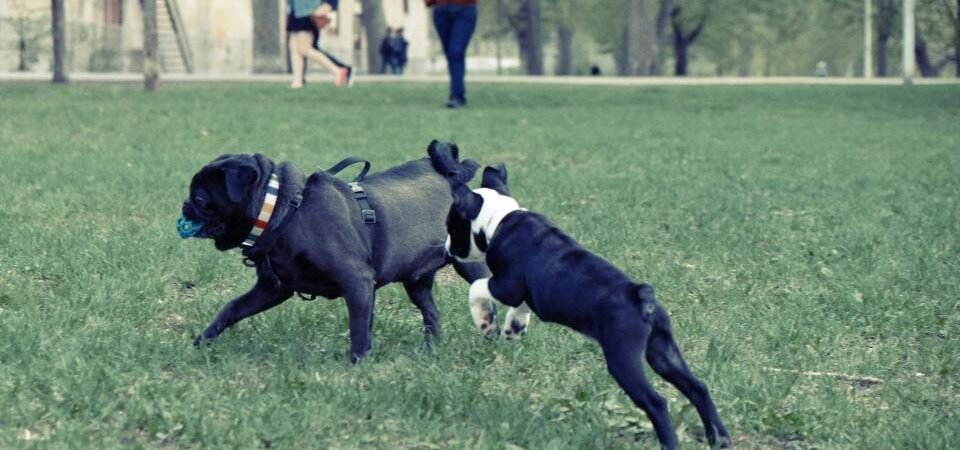

Two dogs are wrestling on the grass, bowing, chasing, rolling over. Then one of them stops and lets out a quick little sneeze. A few seconds later, they’re right back at it.
If you’ve seen this and wondered whether your dog is coming down with something, you’re not alone. Most of the time, that tiny sneeze is part of the conversation. Sometimes, though, a sneeze is your dog’s nose telling you something isn’t right, and the strange honking “backward sneeze” can be downright alarming the first time you hear it. Here’s how to tell them apart.
So what is a play sneeze, exactly?
The American Kennel Club (AKC) puts it simply: sneezing can be a way of communicating playfulness. PetMD calls it a sign of happiness that also signals play behavior, and with no other symptoms, it’s usually nothing to worry about.
Emergency veterinarian Jennifer Bailey, writing for Whole Dog Journal, adds an interesting twist. She describes the play sneeze as a social cue that can ask a playmate to dial the energy down a notch. Her translation of the message is lovely: “I’m enjoying this playtime with you but you’re getting a little too rambunctious for me right now.”
She also explains how a social sneeze looks different from a “real” one. A sneeze caused by nasal irritation is usually forceful, and it may come with discharge or a jerk of the head. A social sneeze is small and delicate, with no discharge and very little head movement. Some dogs even sneeze at people to get attention, Dr. Bailey says, often followed by barking, pawing, or pointing their nose at whatever they want.
Wild dogs that “vote” by sneezing

Dogs aren’t the only canids who sneeze with a purpose. In 2017, a team led by Reena Walker, with Andrew King, J. Weldon McNutt, and Neil Jordan, published a study in Proceedings of the Royal Society B about African wild dogs in the Okavango Delta of Botswana. They recorded 68 “social rallies” across five packs. These are the excited greeting sessions where the pack decides whether to get up and go hunting.
The researchers defined a sneeze as an “audible, abrupt exhalation of air through the nose,” and they noticed that the more the dogs sneezed, the more likely the pack was to leave. Successful rallies averaged about 7.5 sneezes, while rallies that fizzled averaged just over one.
Who started the rally mattered. When a dominant dog kicked things off, the rally never failed once it reached at least three sneezes. When a lower-ranking dog started it, it took at least ten sneezes to get the same result. “The sneeze acts like a type of voting,” Jordan said in a post on the Royal Society’s blog.
The Korean daily 한국일보 (Hankook Ilbo) covered the study that same year under the headline “African wild dogs vote by the number of their sneezes.” The authors themselves were careful, though. They couldn’t rule out that the sneezes were a response to a decision the pack had already reached in ways the researchers couldn’t see. Still, it’s a wonderful reminder that a sneeze can mean a lot more than a tickle.
💡 Did you know? According to the study’s authors, sneezing had never been documented as a communication signal in African wild dogs before this research, although other canids make similar sounds described as a “huff,” “sneeze,” or “snuff.”
When a sneeze is just a sneeze
“Sneezing is a normal response to stimulation of irritant receptors in the nasal passage,” says AKC chief veterinarian Dr. Jerry Klein. Dust, pollen, smoke, air fresheners, and cleaning products are common culprits, and the sneezing usually stops once your dog is away from the irritant. The AKC also points out that dogs who sniff intensely often sneeze to clear their noses.
Allergies can cause sneezing too, though the AKC says they’re less common in dogs than in people, and the Merck Veterinary Manual calls allergic rhinitis “uncommon.” When it does happen, it may follow the seasons (pollen) or last year-round (house dust and molds). PetMD says allergic dogs often have watery eyes or itchy skin, with a lot of scratching and licking.
One helpful clue from the AKC: sneezing that starts suddenly is generally less worrying than sneezing that creeps in over weeks, which can point to an infection or a mass.
Grass awns and other things that go up the nose
Sometimes a dog breathes in something that doesn’t belong there. Foxtails and other grass awns are notorious. The UC Davis School of Veterinary Medicine says these seed heads are shaped to burrow into soil. Once one gets inside a body, it can’t back out on its own, and it can keep migrating, in some cases all the way to the brain or lungs.
Signs of a foxtail in the nose include persistent sneezing and snorting, nasal discharge, head shaking, and pawing at the face. UC Davis notes that foxtails are most dangerous in summer, once they’ve dried out and hardened. Merck adds a telling detail: a sudden discharge from just one nostril, possibly with pawing at the face, suggests a foreign body. Getting it out usually means a vet visit and anesthesia, according to the AKC, so please don’t try digging around in your dog’s nose yourself.
Nasal mites
These are tiny white parasites, about 1 to 1.5 mm long, that live in a dog’s nasal passages. PetMD says dogs can pick them up while digging or rubbing their noses in dirt. The AKC lists sneezing, bloody discharge from both nostrils, an itchy face, head shaking, and reverse sneezing among the signs. Finding them takes a scope under anesthesia or a nasal flush, and they’re treated with antiparasitic medication.
The tooth connection
This one surprises a lot of people. Merck explains that an abscess at the root of a tooth can spread upward into the nasal area and cause rhinitis or sinusitis. The AKC says an infected upper tooth can lead to sneezing, along with tooth pain and swelling just below the eye. Treatment usually involves antibiotics and removing the affected tooth.
Nasal tumors in older dogs
Nasal tumors aren’t common. Merck says nasal and sinus tumors make up only 1 to 2 percent of all tumors in dogs and cats. But when they do happen in dogs, they’re almost always malignant, and the average age at diagnosis is about 9.5 to 10 years.
Interestingly, flat-faced dogs aren’t the ones most at risk. Merck says long-nosed and medium-nosed breeds appear to be at higher risk than brachycephalic breeds, and the AKC says these tumors show up more often in older, longer-nosed male dogs. VCA Animal Hospitals lists cigarette smoke and city living as possible risk factors.
The signs tend to build slowly: sneezing that comes on gradually, a chronic discharge that usually starts in one nostril, nosebleeds, and in later stages a change in the shape of the face or a bulging eye. That slow, one-sided pattern is exactly why a new nose problem in a senior dog deserves a vet visit.
That scary snorting sound: reverse sneezing
The first time you hear a reverse sneeze, it can sound like your dog is choking. They suddenly stand still, stretch out their head and neck, and pull air in through the nose in quick, loud snorts. PetMD compares the sound to a goose honking.
VCA explains that it’s also called paroxysmal respiration. In a regular sneeze, air is pushed out. In a reverse sneeze, it’s pulled in rapidly. PetMD says the soft palate at the back of the mouth gets irritated and the muscles spasm, which briefly narrows the airway. Episodes usually last 30 seconds or less and end on their own within a minute, and dogs act completely normal before and after.
Any dog can do it, but the AKC says it’s more common in small dogs, including miniatures, terriers, and flat-faced (brachycephalic) breeds. PetMD notes that an elongated soft palate, a common trait in brachycephalic dogs, is one trigger. Others include pollen, dust, perfume, cleaning products, pulling on a leash attached to a collar, eating or drinking, and plain old overexcitement. Yes, the same excitement that brings on a play sneeze can set off its noisy cousin.
💡 Good to know: The AKC suggests briefly holding your dog’s nostrils closed and then lightly massaging their throat, which should make them swallow a couple of times and usually stops the spasm. Gently blowing in their face or stepping outside for fresh air can help too, and VCA suggests offering something to lick or drink. And if you do nothing at all, PetMD says the episode will end on its own.
Reverse sneezing is usually harmless, but it isn’t always meaningless. In a 2022 study in Veterinary Sciences that looked at 30 dogs brought in for reverse sneezing, 60 percent had been having episodes for more than three months. Most turned out to have an underlying problem: inflammatory airway disease in 57 percent, anatomical issues in 27 percent, and a foreign body in the nose or throat in 10 percent. The authors concluded that even infrequent reverse sneezing can be a sign of irritation worth looking into.
It’s also worth knowing what it isn’t. The AKC says tracheal collapse, which is often seen in toy breeds, produces a loud honking cough, and it’s more serious than reverse sneezing. If the sound seems more like a cough than a snort, let your vet know.
When to see the vet

A happy little sneeze in the middle of a game is nothing to fuss over. “Sneezing can present as an emergency if it’s severe and persistent, or if sneezing results in blood from the nose,” Dr. Klein says. Call your vet if you notice:
- A nosebleed, or blood mixed with sneezes
- Discharge from only one nostril, especially if it’s thick, yellow-green, or bloody
- Pawing at the face or nose, or a lot of head shaking
- Sneezing that started after time in tall or dry grass
- Swelling on the face or just below the eye, or a bulging eye
- Sneezing that has slowly gotten worse over weeks, especially in an older dog
- Reverse sneezing that happens often, or a first episode you’re not sure about
⚠️ Please don’t wait. If your dog has a nosebleed along with pale gums, tiny red spots on the gums, black tarry stools, lethargy, or fever, the AKC says to seek emergency care, because this can signal a serious clotting problem. The same goes for trouble breathing, any sign of choking, or a nosebleed that won’t stop.
While you’re on the way, VCA recommends keeping your dog as calm as possible and placing an ice pack on the bridge of the nose (with flat-faced dogs, make sure they can still breathe). Don’t put cotton or tissue into the nostrils, and don’t give any medication unless your vet tells you to. PetMD also suggests filming a reverse sneezing episode if you can.
Fun facts 🐾
Cats rarely do it. The AKC says reverse sneezing is fairly common in dogs but rare in cats.
A wild dog rally often takes a few tries. In the Botswana study, only about a quarter of first rallies in a session led to a hunt, while about two-thirds of third rallies succeeded. Sometimes the pack just needs a little more convincing.
Those sneezing voters are rare. According to National Geographic, only about 6,600 African wild dogs remain in the wild, and habitat fragmentation and diseases like rabies are shrinking their numbers.
Angel Jake Note 🐾
It’s charming to think a sneeze can be a polite “let’s keep this fun.” Next time your dog sneezes mid-game, look at what’s going on around them. If they’re wagging, bouncing, and diving right back in, you’re probably just watching good manners in action.
If the sneezing comes with blood, one runny nostril, pawing, or a slow change over time, trust your instincts and call your vet. You know your dog’s normal better than anyone, and that matters.
Medical Disclaimer
I’m not a vet, and nothing here replaces a real exam. If something about your dog feels off, please trust that feeling and call your veterinarian.
Sources
- American Kennel Club: Why Do Dogs Sneeze?
- American Kennel Club: What Happens When a Dog Reverse Sneezes?
- Whole Dog Journal (Jennifer Bailey, DVM): Why Dogs Sneeze When They Play
- PetMD: Why Is My Dog Sneezing a Lot?
- PetMD: Reverse Sneezing in Dogs: Causes and What to Do
- VCA Animal Hospitals: Reverse Sneeze in Dogs
- VCA Animal Hospitals: Nose Bleeds (Epistaxis) in Dogs
- VCA Animal Hospitals: Nasal Tumors
- Merck Veterinary Manual: Rhinitis and Sinusitis in Dogs and Cats
- Merck Veterinary Manual: Neoplasia of the Respiratory System in Dogs and Cats
- UC Davis School of Veterinary Medicine: Foxtails and Dogs
- Proceedings of the Royal Society B (Walker, King, McNutt, and Jordan, 2017): Sneeze to leave: African wild dogs (Lycaon pictus) use variable quorum thresholds facilitated by sneezes in collective decisions
- The Royal Society Blog: Sneeze to leave
- National Geographic: These Dogs Vote by Sneezing
- Veterinary Sciences (Talavera et al., 2022): Reverse Sneezing in Dogs: Observational Study in 30 Cases
- 한국일보 (Hankook Ilbo): 아프리카 들개는 재채기 횟수로 투표를 한다