

Few dogs greet you with their whole body the way a Boxer does. The back end wiggles, the front end bounces, and the face looks serious and silly at once. It’s a lot of dog, in the best way.
Under all that goofiness is a working breed with a surprisingly rich story. Boxers were shaped in 1890s Munich from old German hunting dogs, served in two world wars, and carry a few health risks every Boxer family deserves to understand. I’ve gathered the history and the research here, along with a few true stories.
Where did Boxers come from?
The Boxer’s ancestor was a tough hunting dog called the Bullenbeisser, which means “bull biter.” The AKC says German noblemen used these dogs in medieval times to hunt bear, bison, and wild boar. Their undershot bite let them keep breathing while they held on to prey until the hunters arrived.
After the Napoleonic Wars, the AKC says, Bullenbeissers found new work helping butchers and cattle dealers. The AKC also names a smaller Bullenbeisser from northeastern Belgium as the Boxer’s direct ancestor, and the American Boxer Club’s translation of Der Deutsche Boxer, a 1937 book by breeder Philipp Stockmann and his wife, says sturdy hunting dogs of this type became known as “Brabanters.” Bulldog blood went into the mix as well. Britannica notes the Bulldog strain in the Boxer’s heritage, and the Munich club’s chronicle lists a Bulldog named Tom among the breed’s early ancestors.
Three men in Munich (and a war)

The history page of today’s Boxer-Klub in Munich says the push to stabilize the breed came from Friedrich Roberth, a Vienna-born man who moved to Munich in 1894. Elard König and Rudolf Hoepner, two other Munich men, were tackling the very same question at the time.
The breed’s debut came at a St. Bernard club show in Munich, which tried out a class just for Boxers. According to the Munich club’s chronicle, only one dog was entered. His name was Flocki. Roberth judged the class and gave him first prize, and Flocki became the first Boxer entered in the stud book. The Boxer-Klub was founded shortly afterward. Accounts differ on the dates, though: the Munich chronicle puts the show in 1895, while the American Boxer Club’s translation of the Stockmanns’ book gives 1896 for the club’s founding.
Boxers got to work quickly. The AKC says that in 1904 the Boxer was one of the first breeds chosen in Germany for police training. In World War I, Mental Floss notes, it was one of seven breeds chosen to help German soldiers, and the AKC says Boxers served as war dogs in both world wars.
The Munich club’s chronicle tells a striking story from the winter of 1914. German patrols in Belgium were being ambushed, and a Munich officer asked the club for dogs. Six Boxers left that same day. The club’s Munich group then gathered 60 dogs and gave them to the army for free, and the chronicle says attacks on patrols that had dogs with them stopped. Philipp Stockmann took 10 Munich Boxers to the Western Front himself.
So why “Boxer”?
The story most people hear is that Boxers “box.” Mental Floss describes how they stand on their back legs and bat their front paws during play, like a fighter in the ring, and the AKC’s fun-facts page agrees, saying the English name refers to the way the breed spars. It’s a lovely picture, but Mental Floss admits no records confirm it.
There are other ideas. The Munich chronicle mentions that the city’s dogs of this type were often mockingly called “Bierboxer.” The Stockmanns’ book, as translated by the American Boxer Club, says “Boxer” became a catch-all name for the bull biter and other Bulldog-like dogs, and that it may have been meant to highlight their fighting qualities. So the short answer is that nobody knows for sure.
💡 Did you know? “Boxer” was a dog’s name before it was a breed. In Charles Dickens’s The Cricket on the Hearth, published in December 1845, decades before the Munich breeders got to work, the carrier’s faithful dog is named Boxer. Edwin Landseer even drew his portrait for the book, as the Victorian Web archive shows.
Size, coat, and the white Boxer question
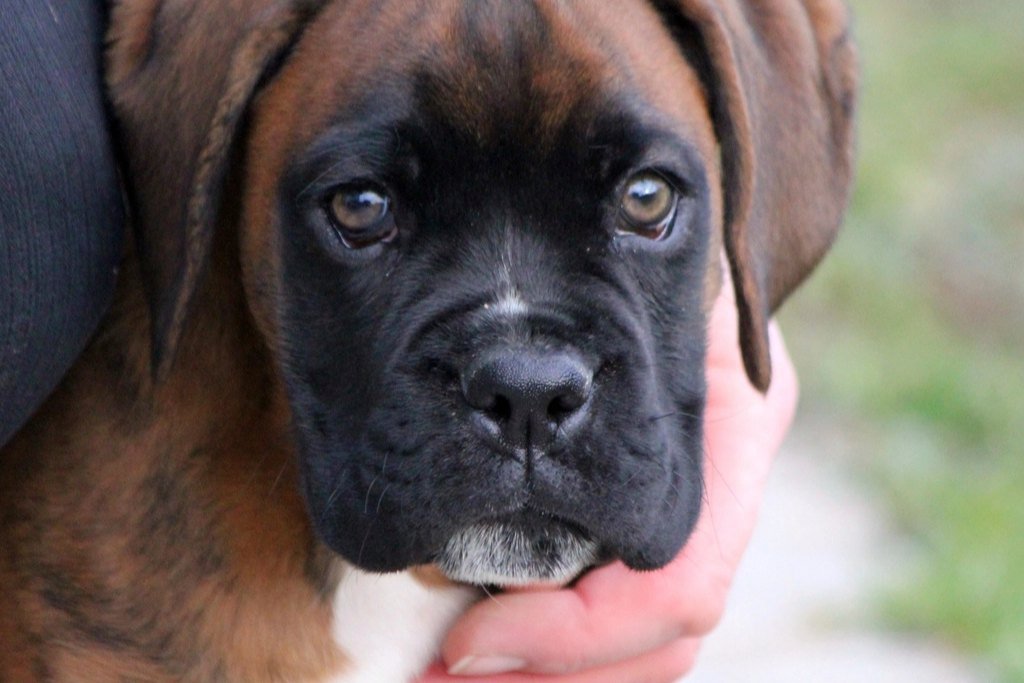
The breed standard calls for males 23 to 25 inches tall at the withers and females 21½ to 23½ inches. It doesn’t set a weight, but Britannica gives 65 to 80 pounds, and VCA Animal Hospitals gives a wider range of 50 to 85 pounds, so individual dogs vary quite a bit.
The standard recognizes two colors, fawn and brindle. White markings are allowed as long as they don’t cover more than a third of the coat, and a plain fawn or brindle with no white at all is “perfectly acceptable.” Some brindles carry so much black striping that the fawn barely shows through, which the standard says can create the look of “reverse brindling.” Boxers of any other color, or with white over more than a third of the coat, are disqualified in the show ring.
So where do white Boxers come from? Purdue geneticist Dr. Dayna Dreger, in research shared by the American Boxer Club, explains that white spotting is inherited in a co-dominant way, and that two “flashy” (white-marked) Boxers bred to each other will produce about 25% white pups. The American Boxer Club estimates that about 20 to 25% of Boxers are born with a mostly white coat, and that an estimated 18% of white Boxers are deaf in one or both ears. Hard numbers are surprisingly thin, though: Dreger points out that at the time of her research, only five Boxers were recorded with the OFA as having had a BAER hearing test. Louisiana State University’s deafness resource, from veterinary neuroscientist Dr. George M. Strain, lists the Boxer among breeds with reported congenital deafness, and Mental Floss explains why white dogs are at risk: there’s less pigment in the inner ear. The American Boxer Club adds that white Boxers are prone to sunburn. Here’s the reassuring part: a 2023 VetCompass study of 3,219 UK Boxers found little evidence of health differences between white and non-white Boxers, and no significant difference in lifespan.
Grooming is the easy part. The AKC says a weekly brush keeps that short, shiny coat looking good, though their nails grow fast and need regular trims. VCA rates their shedding as average.
Personality: the clown who takes a while to grow up
The AKC describes Boxers as “both patient and protective by nature,” and calls them affectionate, fun-loving, and eager to please. VCA says they’re playful and gentle with children and fairly outgoing with strangers.
Then there’s the dance. Boxer owners call it the “kidney bean.” When a Boxer is overjoyed, iHeartDogs writes, “their bodies curl into a crescent moon” and “they start wiggling side to side like a happy bean.”
Why do Boxers stay so bouncy? Part of it is simply that they’re babies for a long time. Mental Floss says Boxers take about three years to reach adulthood, which gives them one of the longest puppyhoods of any breed. That two-year-old still chewing your shoes? Still a puppy, technically.
The Korean outlet Pet Asia News (펫아시아뉴스) recommends at least one to two hours of active exercise a day. The AKC says Boxers get bored with repetitive training, so it helps to keep lessons varied. One honest caution from the AKC: because Boxers can be so excitable, they may not be the best fit for homes with very young children or frail adults.
Boxers in Korea

In a November 2025 article, Pet Asia News reported renewed interest in Boxers among people thinking about adopting a dog. It called the Boxer a breed that demands responsibility, stressing exercise and focused socialization until about two years of age. Dr. Choi Kyung-seon (최경선), who runs the YouTube channel 강사모TV, told the outlet that beyond their good looks, Boxers have intelligence, loyalty, and a deep love for their families.
💡 Good to know: That short muzzle makes Boxers struggle in hot weather. VCA says Boxers are intolerant of heat because of their short muzzle, and intolerant of very cold weather because of their short coat. In summer, walk early or late and keep them somewhere cool.
Health: what the research shows

This part can feel heavy, so I’ll go gently. Boxers carry some serious health risks, but screening exists for several of them, and early signs matter.
Boxer cardiomyopathy (ARVC). Arrhythmogenic right ventricular cardiomyopathy is so tied to the breed that it’s often just called “Boxer cardiomyopathy.” The MSD Veterinary Manual explains that muscle in the right ventricle is replaced by fat or fibrous fatty tissue, which triggers dangerous rhythm problems. The most common sign is fainting, caused by bursts of heartbeats that can top 400 per minute, and sudden death is a real risk. The disease is linked to a mutation in the striatin gene, and Purina Pro Club says one copy is enough to be affected. In studies of nearly 2,000 Boxers at North Carolina State University, 41% carried one copy and 6% carried two. Signs appear at about 6 years of age on average, though Dr. Kathryn Meurs, who led the gene discovery, notes that some carriers stay only mildly affected. Because the abnormal beats come and go, a quick ECG can miss them, so vets use a 24-hour Holter monitor. The American Boxer Club recommends a Holter test from 12 months of age, repeated yearly for breeding dogs, plus a DNA test for ARVC.
Cancer, especially mast cell tumors. In the 2023 VetCompass study, cancer was the most common recorded cause of death among the 346 Boxers that died, at 12.4%, though about a fifth of deaths had no recorded cause. A 2024 study of nearly 5,000 dogs that died in Italy found that cancer accounted for 46% of Boxer deaths, among the five highest shares of any breed. A 2015 study of dogs in England found that Boxers had 10.7 times the odds of mast cell tumors compared with crossbreeds, and the highest prevalence of any breed in the study. These tumors usually show up as skin lumps, which is one more reason to run your hands over your Boxer often.
That short face and the heat. The 2023 VetCompass study describes the Boxer as having a moderately brachycephalic, or short and broad, skull. In a 2020 study of heat-related illness in UK dogs, brachycephalic dogs as a group had higher odds of heatstroke than dogs with medium-length muzzles, and about three-quarters of cases with a known trigger happened during exercise. The Boxer’s own numbers weren’t statistically clear, but caution in summer still makes sense.
Degenerative myelopathy. This disease of the spinal cord can lead to paralysis in older dogs. Purina Pro Club says the mutation, in the SOD1 gene, was identified in 2009, and that 57% of Boxers tested are considered at risk. It usually affects dogs at least 9 years old. The first sign owners tend to notice is scuffing of the back nails, and paralysis typically follows within about 11 months. A DNA test is available, though neurologist Dr. Joan Coates notes that it identifies a risk factor and isn’t a diagnosis on its own.
How long do Boxers live? It depends on the study. A 2024 UK study of more than 584,000 dogs, published in Scientific Reports, put the Boxer’s median life expectancy at 11.3 years, compared with 12.7 years for purebreds overall. An Italian study from the same year found a median age at death of 9 years among 137 Boxers, and the 2023 VetCompass study found a median of 10.46 years. A slightly shorter-than-average life is part of loving this breed, which makes every healthy year feel like a gift.
⚠️ Please don’t brush off a faint or a new lump. If your Boxer suddenly collapses, faints, or seems weak after exercise, call your vet right away and ask about a heart workup, including a Holter monitor. And have any new skin lump checked rather than waiting to see if it goes away.
Fun facts and true stories 🐾
A Boxer held the record for the longest dog tongue. Mental Floss says a Boxer named Brandy from Michigan held the Guinness record with a tongue of 43 cm, or about 17 inches. She died in 2002.
One champion became a national celebrity. According to the AKC, CH Bang Away of Sirrah Crest won Best in Show at the 1951 Westminster Kennel Club Dog Show and went on to win 121 Best in Show awards. In 2020, a Boxer nicknamed “Wilma” became the top-winning Boxer in breed history with her 133rd.
A Boxer stuntman lost only one claw. In Der Deutsche Boxer (1937), translated by the American Boxer Club, Philipp Stockmann and his wife describe a Boxer in a movie thriller who jumped through a closed window to rescue his master, then leapt from one speeding car into another to grab a criminal. The dog was heavily insured and came away missing a single claw.
A Boxer was a Hollywood wedding gift. The AKC says Humphrey Bogart and Lauren Bacall got their first Boxer, Harvey, as a wedding present, and he showed up in many of their publicity photos.
Is a Boxer right for you?
A Boxer could be a wonderful match if you want a loyal, playful, people-loving dog and you have the time to keep them busy. They’re easy to groom, eager to please, and they’ll greet you like a hero every single day.
It’s worth pausing if you’re away for long hours, live somewhere hot without reliable air conditioning, or aren’t ready for a bouncy dog who’ll act like a puppy for years. If you do go ahead, look for a breeder who follows the American Boxer Club’s guidelines, including Holter monitoring, ARVC and DM DNA tests, and hip screening, and ask to see the results.
Angel Jake Note 🐾
Boxers were built for hard work, from holding on during the hunt to guarding patrols in wartime. Somewhere along the way, they also became some of the silliest, most affectionate dogs you’ll ever meet.
They don’t need fancy grooming or a big house. What they need is your time, a cool place in summer, a vet who knows the breed, and someone who’ll laugh along with the kidney bean dance. In return, you get a friend who throws their whole heart at you, every day.
Medical Disclaimer
I’m not a vet, and nothing here replaces a real exam. If something about your dog feels off, please trust that feeling and call your veterinarian.
Sources
- American Kennel Club: The History of the Boxer
- American Kennel Club: Fun Facts About the Boxer That You May Not Know
- American Kennel Club: Is a Boxer Right for You?
- American Kennel Club: Boxer Health Statement (American Boxer Club Testing Guidelines)
- American Boxer Club: Official AKC Breed Standard for the Boxer
- American Boxer Club: ABC Position Statements (Coat Colors and White Boxers)
- Dayna Dreger, Purdue University, via the American Boxer Club: The Boxer Dog: Genetic Research, Coat Color, and Breed Ancestry
- American Boxer Club: The German Boxer
- Boxer-Klub München: Chronik
- Encyclopaedia Britannica: Boxer
- The Victorian Web: “Boxer” by Edwin Landseer, illustration for Dickens’s The Cricket on the Hearth
- Louisiana State University (George M. Strain): Dog Breeds with Reported Congenital Deafness
- Mental Floss: 10 Sporty Facts About Boxers
- VCA Animal Hospitals: Boxer
- iHeartDogs: 7 Weird Quirks Only True Boxer Owners Understand
- MSD Veterinary Manual: Arrhythmogenic Right Ventricular Cardiomyopathy in Dogs and Cats
- Purina Pro Club: Boxer DNA Tests Aid Understanding of Heart & Neurologic Diseases
- Purina Pro Club: Research on Drug Therapy for Degenerative Myelopathy & Hemangiosarcoma in Boxers
- O’Neill et al. (2023): Demography, common disorders and mortality of Boxer dogs under primary veterinary care in the UK (Canine Medicine and Genetics)
- Royal Veterinary College VetCompass: Disorders of Boxers (O’Neill et al., 2023)
- McMillan et al. (2024): Longevity of companion dog breeds: those at risk from early death (Scientific Reports)
- Dogs Trust: Life Expectancy for 155 Breeds and Crossbred Group (2024 table)
- Roccaro et al. (2024): Factors related to longevity and mortality of dogs in Italy (Preventive Veterinary Medicine)
- Shoop et al. (2015): Prevalence and risk factors for mast cell tumours in dogs in England
- Hall, Carter & O’Neill (2020): Dogs Don’t Die Just in Hot Cars—Exertional Heat-Related Illness (Heatstroke) Is a Greater Threat to UK Dogs
- 펫아시아뉴스: 강아지인데 경비도? 복서, 반려견 그 이상의 존재