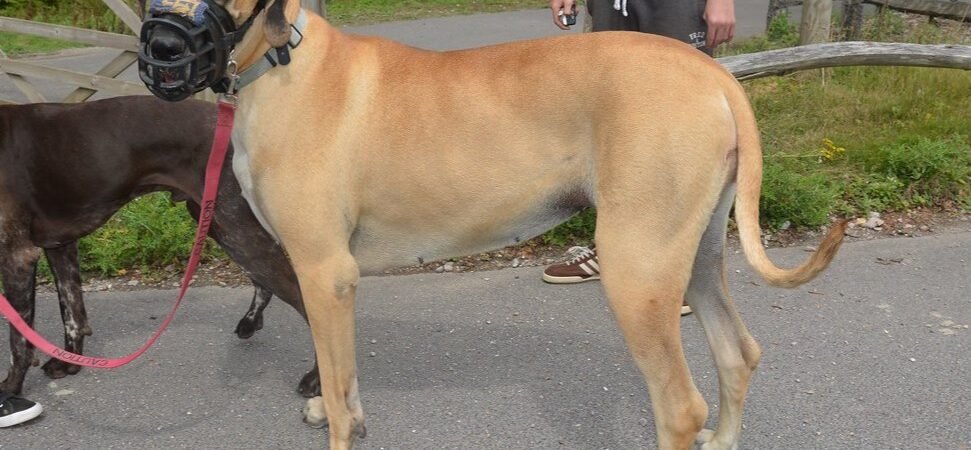

Meeting a Great Dane up close can make anyone take a small step back. Then the dog leans against your legs and sighs, and the fear tends to melt. A Dane can stand taller than a kitchen counter and still act like a lap dog who hasn’t been told about the size problem.
That combination of a huge body and a soft heart is what draws people in. It also comes with real costs. Danes live shorter lives than most dogs, their stomachs can twist without warning, and their puppies need careful feeding. Below you’ll find where the breed came from, what the research says about their health, and a few true stories worth knowing.
Where does the Great Dane really come from?
Let’s clear up the name first. The Great Dane isn’t Danish. The AKC sums it up neatly: “This breed is indeed great, but not a Dane.”
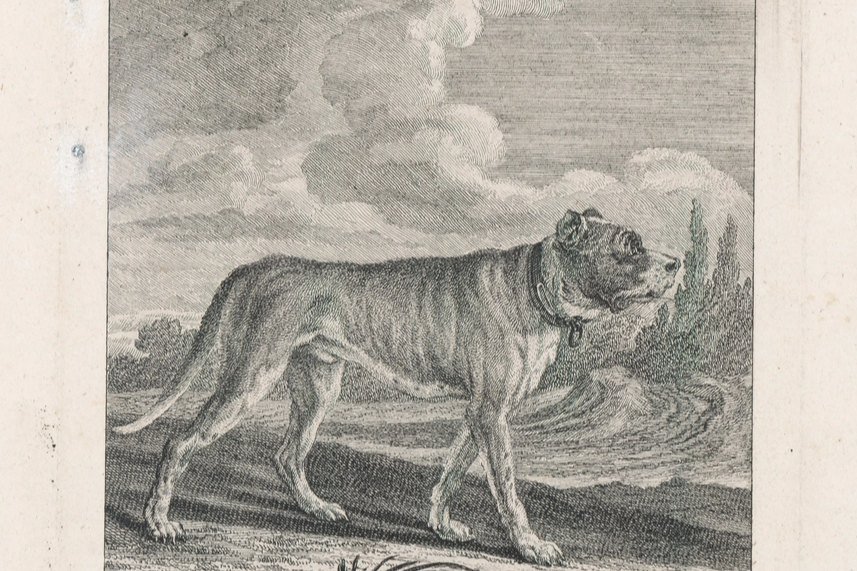
The breed’s roots are German. The AKC says that in the 16th-century Germanic principalities, or perhaps earlier, the old Mastiff type took the form of a giant boarhound, described as “savage, swift, and powerful.” As catch dogs, they seized a bear or boar and held it for the huntsman. German nobles had been importing strong, long-legged dogs from England and Ireland since the 16th century, which is why early names included “Englische Docke” and “Englischer Hund” (English dog).
The best of these dogs didn’t sleep in kennels. Favored dogs, called Kammerhunde (chamber dogs), slept in their lords’ bedchambers, wore ornate collars, and helped protect princes from assassins. Firearms later made the big catch dogs rare.
In 1878, a Berlin committee renamed the “Englische Dogge” the “Deutsche Dogge” (German mastiff), and the AKC notes that the breed had already been declared the national breed of Germany in 1876. Otto von Bismarck prized the dogs and kept them as bodyguards, and the breed was sometimes called the “Reichshund,” or “Empire dog,” because of him. The German breed club wrote a standard in 1881.
So where does “Great Dane” come from? The English name is a literal translation of the French “Grand Danois,” meaning “big Danish.” Mental Floss says some believe the French naturalist Georges-Louis Leclerc, Comte de Buffon, gave the name after seeing the breed while traveling in Denmark. The AKC admits nobody really knows why the French chose it.
Size, coat colors, and the harlequin puzzle

Under the AKC standard, males must be at least 30 inches at the shoulder and females at least 28 inches, and dogs under the minimum are disqualified. The Westminster Kennel Club lists heights up to about 32 inches and weights up to 175 pounds. Royal Canin Korea gives males about 63 to 77 kg and females about 50 to 63 kg.
The coat is short and easy. Westminster rates grooming at 1 out of 5 and shedding at 3 out of 5. The bigger chore may be drool: Royal Canin Korea rates it 4 out of 5.
The colors are where things get interesting. Purina Pro Club describes the breed’s color families as fawn and brindle, black and blue, harlequin, and mantle, and notes that merle Great Danes became eligible for AKC shows on January 1, 2019. Harlequin, the white coat with torn black patches, isn’t a simple trait. UC Davis’s Veterinary Genetics Laboratory says a dog needs a merle gene as well as the harlequin gene to show it, and that two copies of harlequin are presumed to be lethal before birth. Merle has its own catch. Breeding two merles together can produce “double merles,” mostly white dogs with a higher risk of deafness and vision problems. In a 2009 study cited by Purina Pro Club, 25% of double merles were deaf in one or both ears. That’s why careful breeders plan these matings so closely.
Why giant puppies need a careful diet
A Great Dane puppy grows at a pace that’s hard to believe. Mental Floss says they weigh one or two pounds at birth, can reach 100 pounds in half a year, and keep maturing until they’re 2 or 3 years old. That’s why their food matters so much.
Much of what we know comes from studies on Great Dane puppies. In a chapter of the Encyclopedia of Canine Clinical Nutrition, veterinary orthopedic professor H.A.W. Hazewinkel and Dr. J. Mott write that “Puppies less than 6 months of age are unable to protect themselves from an excess of calcium.” Young puppies absorb a big share of their calcium no matter how much is in the bowl, so the extra doesn’t get filtered out. In those studies, Great Danes fed high-calcium diets developed growth-plate problems and bone deformities in the front legs, along with osteochondrosis.
Too many calories cause trouble, too. In a 1974 study described in the same chapter, Great Danes fed as much as they wanted had more osteochondrosis than pair-mates fed about two-thirds as much. The authors put it plainly: “Puppies should not be fed to achieve maximum weight gain as this will reduce the period of growth.”
💡 Good to know: More isn’t better for a giant puppy. Royal Canin Korea advises feeding a diet made for the puppy’s growth stage and avoiding calcium supplements unless your vet prescribes them. A slow, steady growth curve is kinder to those long bones.
Personality: why they lean on you

The early boarhounds were tough animals, and that toughness had to be softened over time. The AKC says that once the breed’s hunting job disappeared, “the breed’s savage nature was tamed,” and judge Carolyn Thomas says breeders have “very deliberately bred away from dogs with unreliable temperaments.” Today the AKC calls the Dane “easygoing.” Westminster still rates protectiveness at 5 out of 5, which fits a dog whose ancestors guarded princes.
Then there’s the lean. Picture well over 100 pounds of dog slowly settling against your hip. A vet-reviewed article on Hepper says Great Danes most often lean when they want attention, affection, or comfort, or because the habit got rewarded. An anxious dog may lean for reassurance, and a tired one may simply be glad of the support. The same article says it isn’t a dominance move, an idea that came from a disputed study of captive wolves.
They also need company. Royal Canin Korea warns that leaving a Dane alone for long hours can lead to anxiety and destructive behavior, and rates the breed only 1 out of 5 for apartment living. A bored dog this big can rearrange a room without meaning to.
Health: what the research shows
This is the hardest part of loving a Great Dane. The AKC says a common lifespan is 9 or 10 years, though some reach 13 or 14. A 2024 UK study by McMillan and colleagues in Scientific Reports found a median lifespan of 10.6 years for Great Danes, compared with 12.7 years for purebreds overall. And in a 2005 study of more than 350,000 insured dogs in Sweden, Great Danes had an 83% probability of dying by age 10, compared with 35% for all breeds.
A 2026 Royal Veterinary College VetCompass study of 28,345 giant dogs in the UK found that giant breeds lived an average of 8.9 years, and listed the Great Dane among the three heaviest of the 29 giant breeds it recorded, at 60.5 kg. Lead author Dan O’Neill said these short lives “should prompt wider discussion on the welfare limits of selective breeding towards extreme giantism.” (Why are size and lifespan linked at all? A new study points to “jumping genes,” and I wrote about it in the post linked at the end.)
Bloat (GDV). This is the one every Dane family needs to know by heart. In gastric dilatation-volvulus, the stomach fills with gas, fluid, or food and then twists. In a Purdue University study led by Dr. Larry Glickman, which followed 1,914 dogs of eleven large and giant breeds starting in 1994, Great Danes had the highest average lifetime risk of bloat: 42.4%. The same research found that raised food bowls were linked to a 110% increase in risk, which turned an old piece of advice upside down. Eating fast and having a close relative with bloat raised it, too. Cornell’s Riney Canine Health Center adds that the survival rate with medical and surgical treatment is greater than 80%, and that a preventive gastropexy (tacking the stomach in place), often done at spay or neuter for at-risk breeds, can cut the recurrence risk to as low as 3 to 5%. It reduces twisting but doesn’t prevent bloating.
⚠️ Please don’t wait if your Dane’s belly looks swollen or they’re trying to vomit and nothing comes up. Cornell lists these signs of GDV: non-productive retching, excessive drooling, panting, a bloated or painful abdomen, restlessness or pacing, pale gums, weakness or collapse, and a “praying” position with the front legs stretched forward. Without treatment GDV is fatal, so go straight to an emergency vet, even at 2 a.m.
Dilated cardiomyopathy (DCM). A 2012 UK screening paper by Stephenson and colleagues describes Great Danes as “predisposed to dilated cardiomyopathy,” a condition in which the heart muscle weakens and the heart enlarges. A 2023 University of Liverpool study followed 124 Great Danes screened for DCM and found that 30.6% eventually died from cardiac causes, including sudden cardiac death. Ask your vet about heart screening.
Osteosarcoma. This aggressive bone cancer is rare in dogs overall, but not in giants. A 2023 RVC VetCompass study of more than 905,000 dogs found that Great Danes had 34 times the risk of osteosarcoma compared with crossbreeds. A new limp in a large adult Dane deserves a vet visit, not a wait-and-see.
Wobbler syndrome. The Ohio State University veterinary hospital says Dobermans and Great Danes are the breeds most commonly affected by this neck-spine disease, and that Great Danes tend to show it young, at a mean age of 3 years. The usual first sign is a wobbly gait in the back end, sometimes only on slippery floors. For affected dogs, OSU recommends a chest harness instead of a neck leash.
Fun facts and true stories 🐾
The tallest dog ever measured was a Great Dane. Guinness World Records says Zeus, from Otsego, Michigan, stood 111.8 cm (44 inches) at the withers and reached 7 ft 4 in on his hind legs. He died in 2014 at age 5. His owner, Kevin Doorlag, said the family would miss letting Zeus sit on their laps while they grilled on the deck.
Before Zeus, there was Giant George. Phoenix New Times reported that this Tucson Great Dane weighed 245 pounds, slept in his own queen-size bed, and was declared the world’s tallest dog by Guinness on the same day he appeared on The Oprah Winfrey Show. According to the show, he flew to Chicago with his own row of seats on an American Airlines flight.
Scooby-Doo was designed to be a “bad” Great Dane. When Hanna-Barbera designer Iwao Takamoto died in 2007, the Television Academy recalled how a Great Dane breeder had shown him pictures and described the breed’s ideal traits, and he did the reverse. “I decided to go the opposite and gave him a hump back, bowed legs, big chin and such,” he said. “Even his color is wrong.” The show premiered on CBS on September 13, 1969, according to the Great Bend Tribune.
Marmaduke has been misbehaving since 1954. According to Lambiek Comiclopedia, Brad Anderson’s strip first appeared in newspapers on November 15, 1954, with Phil Leeming assisting from 1955 to 1962, and Anderson kept drawing it until his death in 2015. When the live-action movie came out in 2010, the AKC and the Great Dane Club of America urged moviegoers to research the breed first. As the club’s president put it, “Everything is bigger when you own a Great Dane.”
Korean TV compared them to the Jindo. Back in 2002, SBS’s TV Animal Farm (TV 동물농장) introduced the breed with the line “If Korea has the Jindo, Germany has the Great Dane,” and noted that Germany had named it its national dog in 1876. In a 2011 episode, the show featured a Dane named Dolce who weighed about 70 kg and stood about 185 cm tall on his hind legs.
💡 Did you know? The Great Dane is Pennsylvania’s official state dog. Mental Floss says a painting of William Penn and his Great Dane hangs in the Governor’s reception room.
Is a Great Dane right for you?

A Great Dane could be a wonderful fit if you want a calm, affectionate companion who likes to stay close, and you have the space for a dog who takes up a whole sofa. Grooming is easy, and the AKC says adults are calm indoors.
It’s worth thinking hard if you live in a small apartment, are away for long days, or would struggle with large food and vet bills. Their lives are short, and the health risks above are real. If you go ahead, look for a breeder who screens for heart disease and other breed issues, feed the puppy for slow growth, ask your vet about a preventive gastropexy, and learn the signs of bloat before you need them.
Angel Jake Note 🐾
Great Danes were bred to catch boars, then to guard princes, and finally to live on our couches. Somewhere along that road, they learned to lean on the people they trust.
Their time with us is shorter than it should be, and that’s hard to read. But knowing the risks means you can feed a puppy wisely and act fast on a bad night. That’s how you give a gentle giant the longest, happiest life they can have.
Medical Disclaimer
I’m not a vet, and nothing here replaces a real exam. If something about your dog feels off, please trust that feeling and call your veterinarian.
Sources
- American Kennel Club: Great Dane
- American Kennel Club: Great Dane History: The Apollo of Dogs
- American Kennel Club: Release of “Marmaduke” Prompts AKC to Remind Potential Dog Owners
- Westminster Kennel Club: Great Dane
- Mental Floss: 10 Mighty Facts About Great Danes
- Hazewinkel & Mott: Consequences of Nutritional Excesses and Imbalances (Encyclopedia of Canine Clinical Nutrition, IVIS)
- Hepper: Why Does My Great Dane Lean on Me?
- Jerold S. Bell, DVM: Risk Factors for Canine Bloat (VIN)
- Cornell Riney Canine Health Center: Gastric Dilatation-Volvulus (GDV or Bloat)
- El Sharkawy et al. (2023): Long-term outcome and troponin I concentrations in Great Danes screened for dilated cardiomyopathy
- Stephenson et al. (2012): Screening for dilated cardiomyopathy in Great Danes in the United Kingdom
- Vet Times: Giant dogs could be up to 118 times more likely to develop rare form of bone cancer
- VetSurgeon.org: Giant dogs die younger and suffer more health problems
- The Ohio State University Veterinary Medical Center: Wobbler Syndrome
- Guinness World Records: Zeus, the world’s tallest dog, passes away at the age of 5
- Phoenix New Times: Guinness Book of World Records Declares Tucson Great Dane the Tallest Dog in the World
- The Oprah Winfrey Show: Giant George, the World’s Tallest Dog
- Television Academy: Animator Iwao Takamoto Dies
- Great Bend Tribune: Scooby-Doo, Where Are You! (1969)
- Lambiek Comiclopedia: Brad Anderson
- Purina Pro Club: Merle Great Danes: Genetics
- UC Davis Veterinary Genetics Laboratory: Harlequin Pattern in Great Danes
- McMillan et al. (2024): Longevity of companion dog breeds: those at risk from early death, Scientific Reports
- Stacker: Shortest-living dog breeds
- Egenvall et al. (2005): Mortality in over 350,000 Insured Swedish Dogs from 1995–2000: II, Acta Veterinaria Scandinavica
- 로얄캐닌: 그레이트 데인
- SBS TV 동물농장 74회: 미지의 동물 대탐험
- SBS TV 동물농장 543회: 그레이트데인 부부 두 쌍의 ‘사랑과 전쟁’