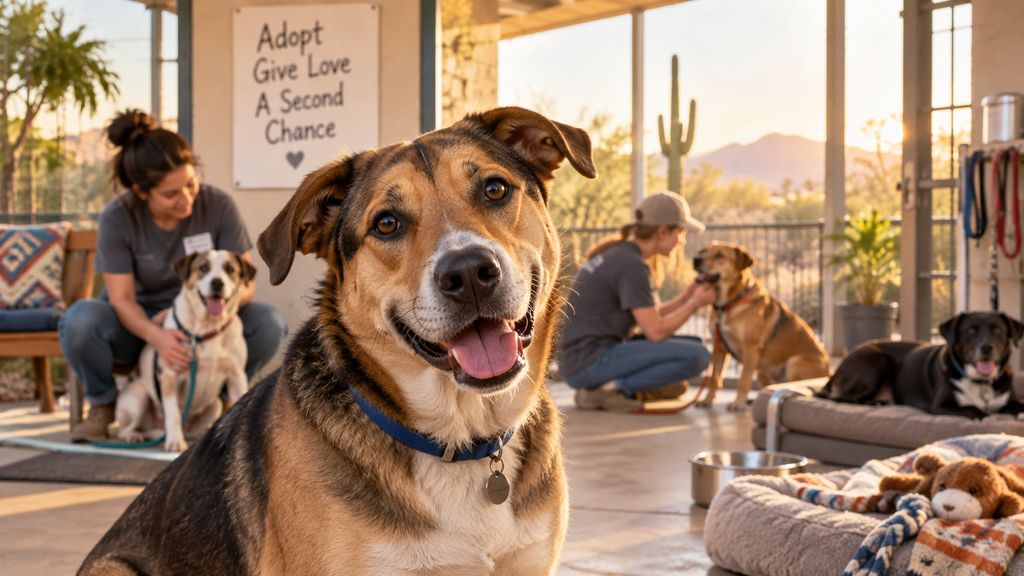
Some shelter dogs are adopted quickly.
Others wait.
And wait.
And wait a little longer.
Sometimes people assume that a dog who has been in a shelter for a long time must have a serious behavior problem.
But that is not always true.
In Phoenix, a new program is trying to help dogs who may have simply been overlooked.
Heidi’s Village recently launched its “Village Dogs” program in partnership with Maricopa County Animal Care & Control.
The first group includes nine dogs who had already spent a long time waiting at the county shelter.
The idea is simple:
move them into a different environment, introduce them to a new audience, and give people another chance to notice them.
Sometimes a Good Dog Is Just One of Hundreds
Maricopa County Animal Care & Control is one of the largest open-admission shelters in the area.
According to FOX 10, the shelter can have as many as about 700 dogs at a time.
That is a lot of faces.
A lot of kennels.
And a lot of dogs hoping someone will stop in front of theirs.
Heidi’s Village said the dogs chosen for the new program are highly adoptable.
The problem is not necessarily that something is “wrong” with them.
Sometimes they are simply surrounded by so many other dogs that it is hard to stand out.
A Change of Place Can Mean a New Chance
That is where Heidi’s Village comes in.
The organization moved long-term shelter dogs into its own facility so they could be seen in a different setting.
They also plan to give the dogs more individual attention and social media exposure.
The goal is not to hide where the dogs came from or pretend they are different dogs.
It is to give adopters a fresh chance to see them.
Sometimes a dog that blends into a large shelter can suddenly connect with the right person in a smaller setting.
The dog did not change overnight.
The audience did.
Why Some Dogs Wait Longer
There is no single reason a shelter dog waits a long time for a home.
Age can play a role.
Size can matter.
Energy level can matter.
Some adopters are looking for puppies.
Others want very small dogs.
Some dogs may need to be the only pet in the home.
Others may simply be shy in a kennel and do not show their personality well when someone walks past.
And sometimes timing matters.
A wonderful dog can be available during a period when shelters are already crowded and adopters have many choices.
That is why a long shelter stay does not automatically tell you what kind of pet a dog will be.
Shelter Behavior Is Not Always Home Behavior
A shelter is not a normal home environment.
There can be barking.
New smells.
Strangers.
Dogs coming and going.
Limited quiet time.
For some dogs, that environment is stressful.
A dog who seems withdrawn in a kennel may become playful in a foster home.
A dog who jumps and barks at the front of a kennel may simply be excited or overstimulated.
That does not mean every shelter behavior should be ignored.
Adopters should always ask staff about what they have observed.
But one quick look through a kennel door does not always show the whole dog.
Adoption Programs Can Help Dogs Get Seen Again
Programs like Village Dogs try to solve one very basic problem:
visibility.
The dogs already exist.
They are already waiting.
The question is how to help the right people find them.
Heidi’s Village told FOX 10 that the first group came from MCACC long-timers and that the organization wanted to give those dogs another venue and more opportunities to be noticed.
That may mean different photos.
Different introductions.
More time with staff.
More social media posts.
Or simply a quieter environment where a dog’s personality is easier to see.
There Is Also an Adoption Special
Heidi’s Village said its Village Dogs were being offered with a $100 adoption package that included a goodie bag.
The dogs were also described as having received a medical exam and bloodwork, and as being microchipped and spayed or neutered before adoption.
At the same time, Maricopa County Animal Care & Control is running a separate September adoption special with 50% off dog adoption fees through September 20. The county says standard adoption fees include services such as spay/neuter, microchipping, core vaccines, Bordetella vaccination, flea/tick treatment, and rabies vaccination for eligible dogs.
Reduced fees can help remove one barrier to adoption.
But the bigger challenge is often getting someone to stop long enough to meet the dog.
What Adopters Can Do Differently
If you are visiting a shelter, it can help to look beyond the first kennel that catches your eye.
Ask staff:
Which dogs have been here the longest?
Which dogs behave differently outside the kennel?
Which dogs have done well in foster homes or playgroups?
Which dog might be a good match for my actual lifestyle?
You may end up meeting a dog you would have walked past.
And sometimes that is exactly the dog you were looking for.
Long-Term Shelter Dogs Are Still Individuals
It is easy to turn shelter dogs into categories.
Senior.
Large breed.
Shy.
High energy.
Long-timer.
But those labels are only part of the story.
A dog may be older and still playful.
Large and gentle.
Shy at first and deeply affectionate once comfortable.
A long shelter stay tells you how long they have been waiting.
It does not tell you everything about who they are.
Angel Jake Note 🐾
I think one of the saddest things about crowded shelters is that a good dog can become almost invisible.
Not because nobody cares.
Not because the dog did something wrong.
There are just so many animals waiting at the same time.
You walk past one kennel.
Then another.
Then another.
And sometimes the dog who has been waiting the longest becomes part of the background.
That is why I like the idea behind programs like Village Dogs.
They are not trying to create a new story for these dogs.
They are giving people another chance to actually see them.
Maybe all one dog needs is a better photo.
A quieter room.
A different person walking through the door.
Or one person asking:
“Which dog has been waiting the longest?”
Sometimes a second look really can become a first step home.
Sources
This article was prepared using current reporting from FOX 10 Phoenix and information from Heidi’s Village and Maricopa County Animal Care & Control.
FOX 10 reported on September 13, 2026 that Heidi’s Village launched the Village Dogs program with nine long-term dogs transferred from Maricopa County Animal Care & Control to help give them more visibility and another opportunity to find homes.
Maricopa County Animal Care & Control identifies itself as a large open-admission public shelter and is currently running a September adoption special for dogs.