

Every Miniature Schnauzer seems to have an opinion. Maybe it’s the eyebrows. Maybe it’s the beard, which gives even a young puppy the face of a wise old grandpa. Either way, they watch the world with a very serious expression, and then they bark at the mail carrier like it’s the most important job on earth.
For this breed, it kind of was. Before they were family dogs, Miniature Schnauzers were working dogs on German farms, and almost everything about the way they look today started out as part of that job.
A farm dog with a rat problem to solve
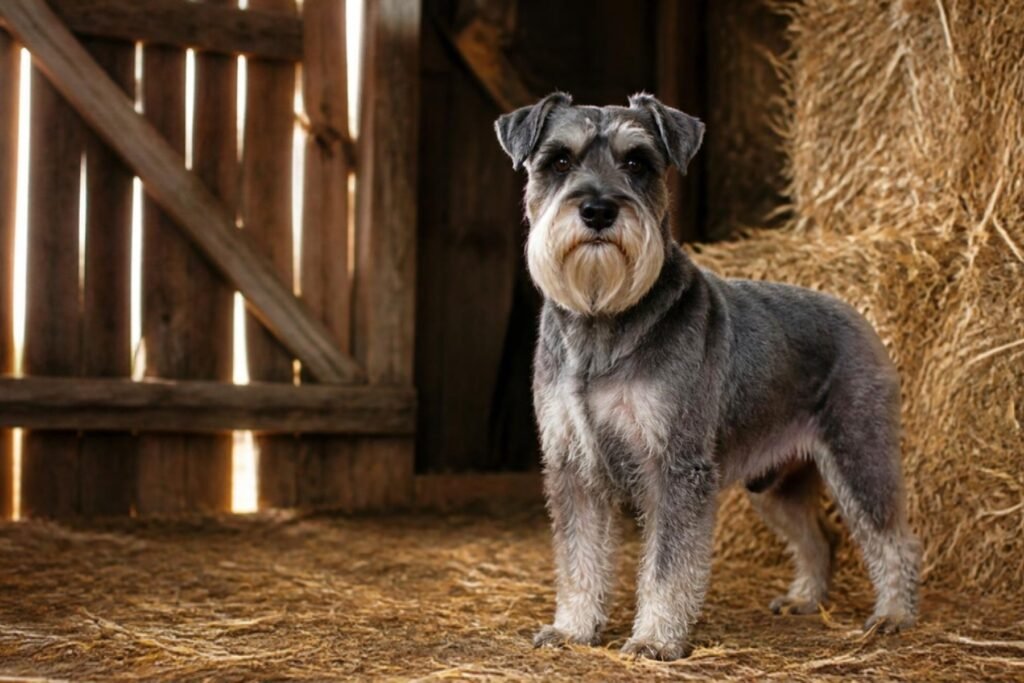
The AKC says the Miniature Schnauzer comes from Germany, where farmers wanted a small dog to chase rats, voles, and other rodents out of the house and barn. The bigger Standard Schnauzer was already working there as a herder, guard dog, and ratter.
To make a smaller version, the AKC explains, breeders crossed small Standard Schnauzers with Affenpinschers, Miniature Poodles, and Miniature Pinschers. Wikipedia points out that the exact recipe isn’t fully known.
The AKC names the first Miniature Schnauzer registered in Germany as a black female called Findel, born in 1888. Britannica says the breed was first shown in its own right in 1899.
The dogs reached America in the 1920s. The American Miniature Schnauzer Club notes that the Wire-Haired Pinscher Club of America formed in 1925, which tells you what these dogs were called at first. The AKC recognized the breed in 1926, and the American Miniature Schnauzer Club was founded in August 1933. The Miniature has been judged in the Terrier Group ever since.
What does “Schnauzer” actually mean?
This one makes me smile. The German word “Schnauze” means snout, while “Schnauzbart” means a walrus mustache, according to Wikipedia. The AKC simply says the name comes from a German word meaning “mustached.”
The whole breed is named after their face, which seems fair.
Why the beard and eyebrows?
This is my favorite detail. That famous beard isn’t just for looks. According to the AKC, when these dogs hunted vermin, the thick beard, eyebrows, wiry coat, and longer leg hair protected them from rodent bites. A rat fighting back would get a mouthful of hair instead of skin.
Pet insurer Trupanion adds that working Schnauzers’ beards were often left to tangle and mat into a kind of shield around the face.
The next time you see a Schnauzer with a perfectly groomed beard, remember it started out as armor.

That wiry coat and the stripping question
Wikipedia describes the Miniature Schnauzer’s coat as a double coat, with wiry hair on the outside and a soft undercoat underneath. The AKC calls the breed low-shedding.
Wire coats come with a grooming choice most people have never heard of: hand-stripping. Hand-stripping, as the AKC describes it, means plucking out dead hairs so the coat keeps its coarse texture. A bristly wire coat helps insulate the dog, repels burrs, and protects against dense underbrush, which makes sense for a dog that worked outdoors.
Clipping is quicker and easier, but the AKC notes that clippers can disrupt the hair’s natural growth cycle and, over time, soften the coat. Many pet owners are happy with a clip, and VCA says a clipped trim needs to be repeated every other month, with combing once or twice a week in between.
The colors, including white
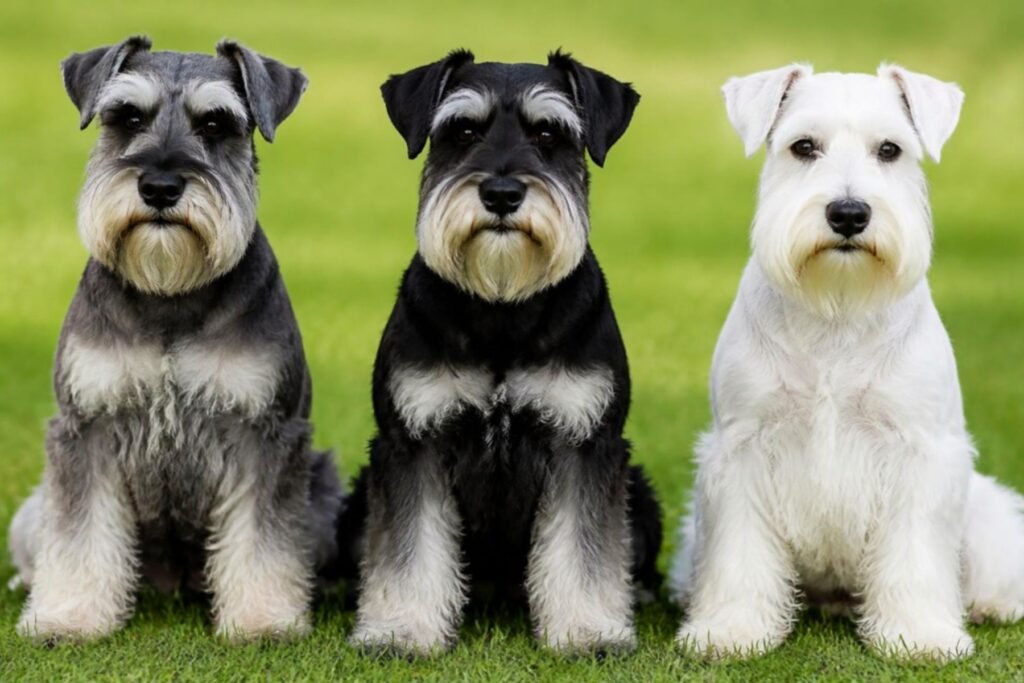
The AKC accepts three colors: salt and pepper, black and silver, and solid black. Salt and pepper is the look most people picture when they hear the name.
White is a little more complicated. The FCI breed standard, used by kennel clubs in many countries, includes “pure white with white undercoat.” But Wikipedia notes that white is not accepted for conformation showing by the American Kennel Club or the Canadian Kennel Club.
That means white Miniature Schnauzers are real Miniature Schnauzers. They just can’t compete in AKC show rings.
Size
VCA lists the Miniature Schnauzer at 12 to 14 inches tall and 13 to 15 pounds.
Real dogs often run a bit heavier. A UK study found the average adult pet Miniature Schnauzer weighed 9.9 kg, or about 22 pounds. Keep that number in mind, because weight and fat come up again in the health section.
Personality: the little dog who notices everything
The FCI standard sums up the breed in four words: intelligence, fearlessness, endurance, and alertness. It adds that a Miniature Schnauzer can live happily “even in a small apartment.”
VCA describes them as “bold, watchful, busy, and often mischievous,” and gives them 4 out of 5 for barking. Britannica agrees that they make good alert watchdogs, bark often, and can be wary of strangers. VCA’s take is kinder: they take a second to get to know new people, and then they’re usually quite friendly.
That barking comes straight from the job description. A dog whose work was to notice every scratch in the barn is going to notice every footstep in the hallway. It’s best to discourage heavy barking from an early age, VCA advises, and a calm “thank you, that’s enough” taught to a puppy is a lot easier than one taught to a grown dog.
In Korea, Schnauzers have a funny nickname. They’re often listed with Beagles and Cocker Spaniels as one of the “3대 악마견,” or “three devil dogs.” Kyunghyang Shinmun says the label came from their rather too “bubbly” personality. The Korean pet site Bemypet Life explains the reason: Schnauzers were farm ratters with lots of energy and a strong urge to chase, and as terriers, they dug into the ground to show where prey was hiding. A bored Schnauzer is really just a ratter without a job. Bemypet Life’s advice is simple: plenty of walks to burn off that energy.

Health: what to watch for
The AKC calls the Miniature Schnauzer generally healthy and long-lived, and VCA gives a lifespan of 12 to 14 years. In 2019, the Royal Veterinary College’s VetCompass program published a study of 3,857 Miniature Schnauzers in UK vet clinics. The dogs’ median longevity was 11.6 years, similar to the 12.0 years reported across all breeds.
The most common problems were periodontal disease (17.4%), being overweight or obese (8.3%, compared with 6.1% of dogs overall), anal sac impaction, vomiting, and ear infections.
Hyperlipidemia and pancreatitis. Science for Animal Welfare says about one-third of Miniature Schnauzers have abnormally high blood triglycerides for no known reason. It shows up most often in middle-aged and older dogs and tends to get worse with age. The Merck Veterinary Manual shows why that matters. Severely high triglycerides are a risk factor for pancreatitis, and Miniature Schnauzers are “dramatically overrepresented” among dogs with pancreatitis, possibly because of a genetic predisposition.
This is why you’ll hear vets talk about low-fat diets for this breed. Merck says feeding a low-fat diet is crucial when treating pancreatitis in dogs, and its owner guide names table scraps and trash as common risk factors. In a 2022 study in the Journal of Veterinary Internal Medicine, 15 Miniature Schnauzers with high triglycerides were put on an ultra-low-fat diet, and five of them saw their levels return completely to normal. Talk with your vet before changing food, though.
⚠️ Please don’t wait. If your Schnauzer stops eating, keeps vomiting, seems weak, or has a sore belly, get them to a vet today. Merck lists these, along with diarrhea and dehydration, as the most common signs of severe pancreatitis.
Bladder stones. The University of Minnesota’s Canine Genetics Lab says Miniature Schnauzers have more than 20 times the risk of calcium oxalate stones compared with mixed-breed dogs. Science for Animal Welfare describes one reason: in a study, Schnauzers urinated less often and made smaller amounts of more concentrated urine, with more calcium in it, than Labradors. These stones can’t be dissolved with diet, so they have to be removed, sometimes with surgery. Watch for straining, pain when peeing, or blood in the urine.
“Schnauzer bumps.” Veterinary dermatologists at Animal Allergy & Dermatology of Colorado describe Schnauzer comedo syndrome as a breed-related, acne-like condition that causes blackheads along the middle of the back. Mild cases don’t bother the dog, but the bumps can get infected. It can be controlled with special shampoos, but not cured.
Diabetes and eyes. Science for Animal Welfare reports that Miniature Schnauzers are about three times more likely to develop diabetes than mixed breeds. Extra thirst, more peeing, weight loss, and a bigger appetite are the classic signs, and cataracts are very common in diabetic dogs. The breed also has a hereditary form of cataract, and changes can appear as early as 8 weeks of age. There’s no DNA test for it yet, so regular eye checks matter.
💡 Good to know: Science for Animal Welfare says drinking more water and peeing more often can help lower the risk of calcium oxalate stones. For a Schnauzer, a full water bowl and plenty of potty breaks are small habits that really count.
Fun facts and true stories 🐾
One Schnauzer won more than 100 Best in Show titles. The AKC reports that a Miniature Schnauzer named “Baby Joe” (officially GCHP2 CH. Carmel Mr. Joe Adamis CGC) won his 100th Best in Show on February 13, 2026. He retired with 102 Bests in Show, 88 of them in 2025 alone, and the AKC calls him the top-winning Miniature Schnauzer in breed history.
They’re a worldwide favorite. Wikipedia says an FCI census published in 2013 listed the Miniature Schnauzer as the tenth most registered breed in the world.
Korea fell for them through a dog food ad. Kyunghyang Shinmun reports that the Schnauzer, with a beard like a grandfather’s, became hugely popular in Korea after appearing in dog food commercials and on packaging in the 1990s. Tastes have changed, though. In KB Financial Group’s 2025 report, the Schnauzer doesn’t appear among Korea’s top seven breeds.
💡 Did you know? Schnauzer-type dogs appear in art from long before Findel. The American Miniature Schnauzer Club notes that the German painter Albrecht Dürer pictured a Schnauzer back in 1492.
Is a Miniature Schnauzer right for you?
A Miniature Schnauzer might be a great fit if you want a small, sturdy, low-shedding dog with a big personality. They’re alert, clever, and fine in an apartment as long as they get real walks.
It might be harder if you need a quiet dog, since barking is part of the package. You’ll also want to plan for regular grooming, careful treat habits (fatty scraps are a bad idea for this breed), and a vet who knows about the Schnauzer’s triglyceride and bladder stone risks.

Angel Jake Note 🐾
This breed is personal for me. Angel Jake is named after Jake, a white Schnauzer my family brought home around 2010. If you want to know how he came into our lives, I wrote about it in Jake’s Story, Part 1.
It’s nice to know that white is written right into the FCI breed standard, even if white Schnauzers can’t walk in an AKC ring. To me, every Schnauzer is a little farm guardian with a beard, whatever their color. If you share your home with one, keep the fatty snacks out of reach, keep the water bowl full, and let them do their job of watching the door. They take it very seriously.
Medical Disclaimer
I’m not a vet, and nothing here replaces a real exam. If something about your dog feels off, please trust that feeling and call your veterinarian.
Sources
- American Kennel Club: Miniature Schnauzer History
- American Kennel Club: Miniature Schnauzer Dog Breed Information
- American Kennel Club: Everything You Need to Know About Hand-Stripping Dog Coats
- American Kennel Club: Miniature Schnauzer “Baby Joe” Reaches 100 BIS Wins Milestone
- American Miniature Schnauzer Club: History of the Miniature Schnauzer
- American Miniature Schnauzer Club: A History of the AMSC (PDF)
- FCI Breed Standard No. 183: Miniature Schnauzer (PDF)
- Britannica: Miniature Schnauzer
- Wikipedia: Miniature Schnauzer
- VCA Animal Hospitals: Miniature Schnauzer
- Trupanion: Miniature Schnauzer
- O’Neill et al. (2019): Miniature Schnauzers under primary veterinary care in the UK in 2013
- Merck Veterinary Manual: Pancreatitis in Dogs and Cats
- Merck Veterinary Manual: Pancreatitis and Other Disorders of the Pancreas in Dogs
- Xenoulis et al. (2022): Serum insulin, calprotectin, and C-reactive protein in Miniature Schnauzers with idiopathic hyperlipidemia
- Science for Animal Welfare: Pancreatitis and Hyperlipidaemia in the Miniature Schnauzer
- Science for Animal Welfare: Calcium Oxalate Urolithiasis in the Miniature Schnauzer
- Science for Animal Welfare: Diabetes Mellitus in the Miniature Schnauzer
- Science for Animal Welfare: Hereditary Cataract in the Miniature Schnauzer
- University of Minnesota Canine Genetics Lab: Calcium Oxalate Urinary Stones
- Animal Allergy & Dermatology of Colorado: Schnauzer Comedo Syndrome
- 비마이펫: 악마견? 비글, 슈나우저, 코카 스파니엘은 왜 이런 별명을 갖게 되었을까
- 경향신문: 그 많던 요키·시츄 어디로 갔나
- KB Think: 한국 반려동물 현황 (KB Financial Group, 2025)