

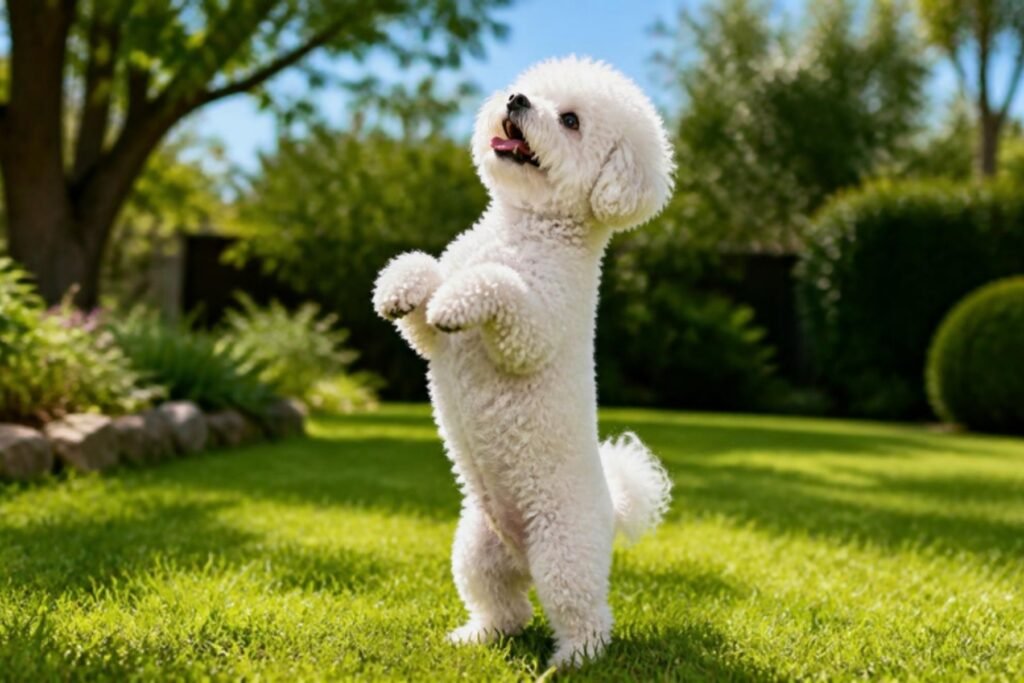
A Bichon Frise walks into a room like they’ve been expecting you. That round, powder-puff head, the dark eyes, the plumed tail curled over the back. It’s hard not to smile back.
The more I read about this breed, the more amazed I was by how much life they’ve lived. Bichons have ridden on ships, lived in royal palaces, been carried around by a king, performed tricks in the street, and, much more recently, stood in the center ring at Westminster. Twice.
So where did the Bichon actually come from?
The Bichon Frise belongs to an old family of small white dogs called the Barbichon types. The AKC uses that as an umbrella term for breeds like the Bolognese, the Maltese, the Havanese, and the Bichon Frise. According to Wikipedia, the word “bichon” is believed to be a shortened form of “barbichon,” which means “little barbet.” (The Barbet is a curly-coated water dog.)
The Bichon’s own branch of the family grew up on Tenerife, one of the Canary Islands off the coast of Africa. Wikipedia says Spanish seamen brought the early dogs to the island, and in the 14th century, Italian sailors “rediscovered” them on their voyages and carried them back to mainland Europe. For a long time the breed was simply called the Bichon Tenerife, and the AKC describes that dog as the primary ancestor of today’s Bichon Frise.
I love picturing it. A little white dog on a wooden ship, going back and forth between islands and ports, long before anyone had written a breed standard.

A king who wore his dogs around his neck
In Europe, Bichons moved up in the world quickly. The AKC traces their close bond with European nobles back as far as the 13th century, and they became favorites in the courts of Spain, Italy, and France. You can even spot them in Renaissance portraits by painters like Titian.
The best story belongs to King Henry III of France, who ruled from 1574 to 1589. According to the AKC, he loved his Bichons so much that he carried a few of them with him wherever he went, in a tray-like basket hung from ribbons around his neck.
I completely understand.
From the palace to the circus ring
Royal favor didn’t last. After the French Revolution in 1789, the aristocrats who had pampered these dogs were gone, and many Bichons ended up on the streets.
This is where their story could have ended. It didn’t, mostly because Bichons are smart, cheerful, and happy to perform. The AKC says street entertainers and circus performers trained them to turn somersaults, walk on their hind legs, and wave both paws in the air. The Bichon Frise Club of America puts it beautifully: “the dog of the aristocrats became the circus dog, the dog of many tricks at the fair and as legend has it the dog of the organ grinder.”
💡 Did you know? A Bichon’s love of showing off has deep roots. For generations, performing for a crowd was how many of them earned their keep.
How a “fluffy little dog” got its name
It took until the 1930s for the breed to get an official description. The Bichon Frise Club of America says the French breed standard was adopted on March 15, 1933, and was written by Madame Bouctovagniez.
The name came with a small, very human story. During a heated discussion about what to call the breed, Madame Nizet de Leemans asked what the dog looked like. The answer was “a fluffy, little white dog.” So it became the Bichon Frise, the fluffy little dog. The breed was entered in the French stud book on October 18, 1934.
The Bichon reached America in 1956, when a French couple, Helene and Francois Picault, brought their dogs over and joined their daughter in Milwaukee. The Bichon Frise Club of America was founded in San Diego in 1964, the AKC accepted the Bichon into its Miscellaneous Class in 1971, and full recognition came in April 1973.
Why is that coat so curly and so much work?
A Bichon’s coat has two layers. The AKC explains that it’s a double coat of hair, not fur, and this hair keeps growing to an undetermined length rather than stopping at a set length the way fur does. Wikipedia describes the outer coat as loosely curled in spirals or corkscrews, over a thick, soft undercoat, and it’s always white.
That setup is also why Bichons shed so little. Their loose hairs get caught in the undercoat instead of falling onto your sofa. The catch is that those trapped hairs will tangle and mat if nobody brushes them out. The AKC suggests brushing daily (or at least two or three times a week) and a trim every four to six weeks.
In Korea, the classic Bichon look has its own nickname. Namuwiki says the traditional cut, which grooms the fluffy coat into a big round ball, is called “하이바” (haiba), and it makes the dog look a bit like a snowman. A Bichon who comes home trimmed too short gets the teasing nickname “빡숑” (ppaksyong).
💡 Good to know: Bichons are often called hypoallergenic, but the AKC says there’s no breed that is truly hypoallergenic. People can react to dander and saliva, not only hair. A low-shedding dog may help some allergy sufferers, but spend time with a Bichon before bringing one home.

How big do Bichons get?
The AKC lists Bichons at 9.5 to 11.5 inches tall at the shoulder and 12 to 18 pounds, and places them in the Non-Sporting Group rather than the Toy Group. They’re still small dogs, though, so a ramp and a little care around stairs and high furniture go a long way.
Personality: cheerful, curious, and a friend to everyone
The AKC calls Bichons “peppy, curious, and playful,” and describes them as lovers, not fighters. They’re so friendly with strangers that, as the AKC puts it, they’re simply too open to make good watchdogs. If someone knocks on the door, a Bichon is more likely to greet them than guard you from them.
They’re also clever, learning basic commands easily, and often do well in obedience and rally. VCA Animal Hospitals adds a few honest notes: Bichons are easily excited, can get yappy without enough exercise or attention, and may take longer to housetrain. VCA also says they’re curious enough to get into mischief when left alone, so a bored Bichon is a creative Bichon.
What is the “Bichon blitz”?
If you’ve ever seen a Bichon suddenly tear around the living room in circles, ears flying, then flop down like nothing happened, you’ve seen the Bichon blitz. The AKC describes it as short bursts of running in the house or yard, and notes that these dogs are “surprisingly fast.”
Korean owners have their own word for it: “비숑 타임” (Bichon time). Namuwiki describes it as running around wildly, like a dog doing “우다다,” the Korean sound for a frantic scamper.
The scientific name for zoomies is “frenetic random activity periods,” or FRAPs. Cornell University’s College of Veterinary Medicine says there’s no known specific cause, but they seem to be a way to release pent-up energy or maybe relieve stress. They’re normal and most common in puppies and young dogs. Cornell suggests keeping zooming dogs away from stairs, slippery floors, and roads. Grass is the kindest surface for all that joy.

Health: what to watch for
Bichons are known for long lives. The AKC says they average 14 to 15 years. A 2024 UK study, reported on Wikipedia, found a life expectancy of 12.5 years, close to the purebred average of 12.7.
A few health issues come up more often in the breed:
- Bladder stones. The Bichon Frise Club of America says the two most common types in Bichons are struvite and calcium oxalate. Oxalate stones show up more often in males, and struvite more often in females. The club calls free access to fresh water “the most important preventative.”
- Dental disease. Small mouths build up plaque quickly. The AKC recommends brushing their teeth at least two or three times a week.
- Cataracts. PetMD notes that cataracts in Bichons are likely hereditary and can start in puppies as young as 6 months.
- Allergies and skin trouble. VCA lists allergic dermatitis among the breed’s concerns, and the AKC says those floppy ears are prone to infections.
- Diabetes. Both VCA and PetMD list it. Watch for more thirst, more peeing, weight loss, and a bigger appetite.
Wikipedia also notes a predisposition to immune-mediated hemolytic anemia and gallbladder disease, which are good reasons to keep up with regular checkups and bloodwork.
⚠️ Please don’t wait. If your Bichon is straining to pee, going often in small amounts, having sudden accidents, or passing bloody urine, call your vet the same day. Bladder stones and infections can get serious quickly, especially if urine flow is blocked.
Fun facts and true stories 🐾
Two Bichons have won Best in Show at Westminster. The first was J.R., who won in 2001. Flynn followed in 2018, only the second Bichon ever to take the title, according to the AKC. His handler, Bill McFadden, said Flynn was actually related to J.R.
Flynn’s full show name was “Belle Creek’s All I Care About Is Love.” The AKC says he was five when he won, loved belly rubs, and liked rolling in the snow. After the win, his handler joked, “I’m pretty sure I can drop the mic and say he’s retired.”
They’re climbing fast in Korea. KB Financial Group’s 2025 Korean Pet Report found that the Bichon Frise went from 14th place in 2018 to 5th place in 2025 among the breeds Korean dog owners keep, rising from 1.9% to 7.0%.
1973 was a big year. The Bichon got full AKC recognition in April 1973, and according to Wikipedia, that was also the year the breed arrived in the United Kingdom.
Is a Bichon Frise right for you?
A Bichon might be a wonderful fit if you want a small, happy dog who loves people, you enjoy teaching tricks, and you’re ready for regular grooming, brushing, and teeth cleaning. They tend to like just about everyone, which makes them easy to bring along to family gatherings.
It might be harder if you’re away for long hours, since Bichons love company and can get into trouble when bored. And if you’re hoping for a truly allergy-free dog, please spend time with one first.

Angel Jake Note 🐾
The Bichon has gone from a king’s neck basket to a street performer’s act and back into our living rooms. Somehow they kept the same happy nature that made people want them close in the first place.
If a Bichon shares your home, keep that water bowl full and that coat brushed. And when the blitz starts, just move the coffee table and enjoy the show.
Medical Disclaimer
I’m not a vet, and nothing here replaces a real exam. If something about your dog feels off, please trust that feeling and call your veterinarian.
Sources
- American Kennel Club: Bichon Frise History
- American Kennel Club: Is the Bichon Frise the Right Breed for Your Lifestyle?
- American Kennel Club: Does a Completely Hypoallergenic Dog Exist?
- American Kennel Club: Meet Flynn, the 142nd Westminster Best in Show Winner
- Bichon Frise Club of America: History
- Bichon Frise Club of America: Management of Bichons with Urinary Stones
- Wikipedia: Bichon Frisé
- Wikipedia: Bichon
- VCA Animal Hospitals: Bichon Frise
- PetMD: Bichon Frise Dog Breed Health and Care
- Cornell University College of Veterinary Medicine: What Are Zoomies?
- 나무위키: 비숑 프리제
- KB Think: 한국 반려동물 현황 (KB Financial Group, 2025)