

A Shih Tzu has a way of looking at you that feels a little bit like being judged by royalty. Big dark eyes, a round face framed in hair, and a tail curled proudly over the back. They carry themselves like they know something you don’t.
And in a way, they do. This breed spent centuries inside the Chinese imperial palace, then nearly vanished in the 20th century before being rebuilt from a very small group of dogs. The Shih Tzu snoring on someone’s couch right now has quite a family story behind them.
From Tibet to the Forbidden City
Most people think of the Shih Tzu as a Chinese dog, and China is where the breed was shaped. But the AKC points out that the roots lie farther west, in Tibet, and says documentation of the breed goes back at least 1,000 years.
According to the Shih Tzu Club of Victoria, small “Bearded Lion Dogs” were often given as gifts by the Dalai Lama and other Tibetan dignitaries to the Chinese court. Wikipedia notes that the breed is believed to have come from crosses of the Pekingese and the Lhasa Apso, and that these little dogs were prized by Chinese royalty during the Ming Dynasty.
Inside the palace, their care became a serious job. The Shih Tzu Club of Victoria writes that palace eunuchs had been involved in breeding small dogs within the Forbidden City since 1700. In the palace’s final decades, its most famous dog lover was Empress Dowager Cixi. She set the standard for what her dogs should look like, and the eunuchs competed with each other to produce the dog she had in mind.
The last time the Dalai Lama visited Peking was in 1908, and the club notes that several more dogs were presented to the Empress Dowager during that visit. She died later that same year.
Why the “little lion” has a flat face
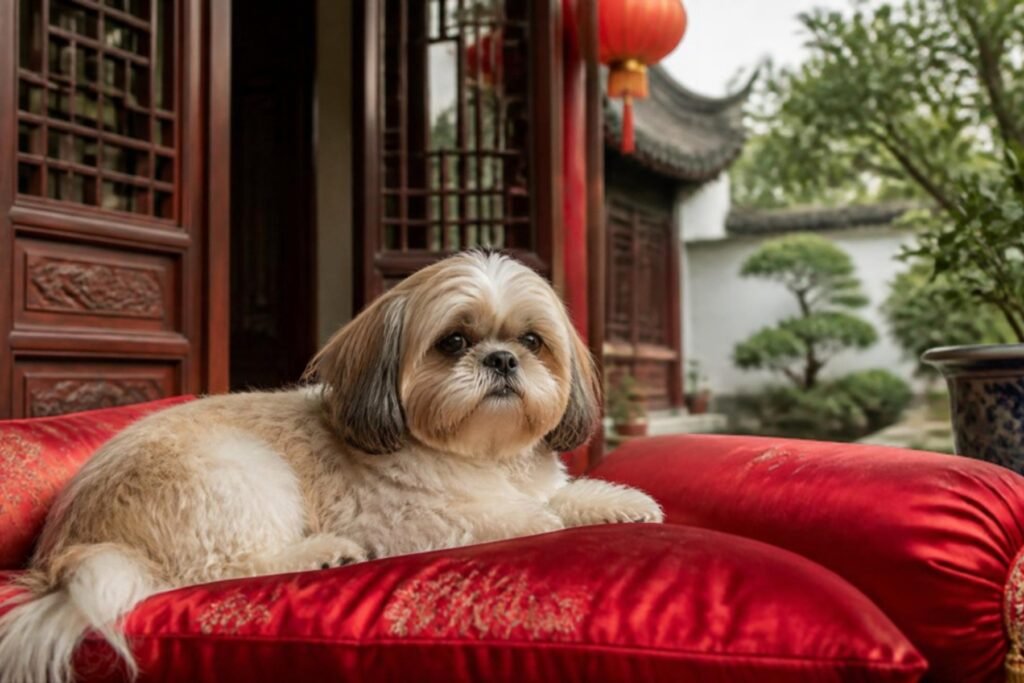
The name tells you a lot. Wikipedia explains that “Shih Tzu” comes from the Mandarin word for lion, because the breed was bred to resemble the lion as it appears in traditional Chinese art. The AKC translates the name as “little lion.”
Think about those stone guardian lions outside temples: round heads, wide faces, short muzzles, flowing manes. That was the look people were aiming for. Over generations, breeders chose dogs with shorter and shorter faces, which is how the Shih Tzu ended up brachycephalic, the veterinary term for a short-nosed, flat-faced dog.
There’s a fun twist, too. In modern Mandarin, the breed is usually called the “Xi Shi dog,” after Xi Shi, one of the legendary Four Beauties of ancient China. So depending on who you ask, this dog is named after a lion or after one of the most beautiful women in Chinese history. Both fit, if you ask me.
A near-disappearance and 14 dogs
This is where the story takes a turn.
The American Shih Tzu Club says the breed became extinct in China after the empress died. The AKC describes a second blow: after the 1949 Communist revolution, the dogs still left in China were wiped out because of their association with wealth.
Luckily, a few had already left. Lady Brownrigg, an Englishwoman living in China, brought the first Shih Tzu to England in 1928. Others went to Ireland and Norway. Those small groups became the foundation of every Shih Tzu in the West.
💡 Did you know? The AKC says every Shih Tzu alive today can be traced to one of 14 dogs, seven males and seven females. And according to the American Shih Tzu Club, one of those foundation dogs was actually a Pekingese.
That Pekingese came from a controversial cross made in England in 1952 by breeder Freda Evans. The American Shih Tzu Club notes it became one stumbling block on the way to AKC acceptance. In the end, the AKC gave the breed full recognition in 1969.
Why they’re called “chrysanthemum dogs”
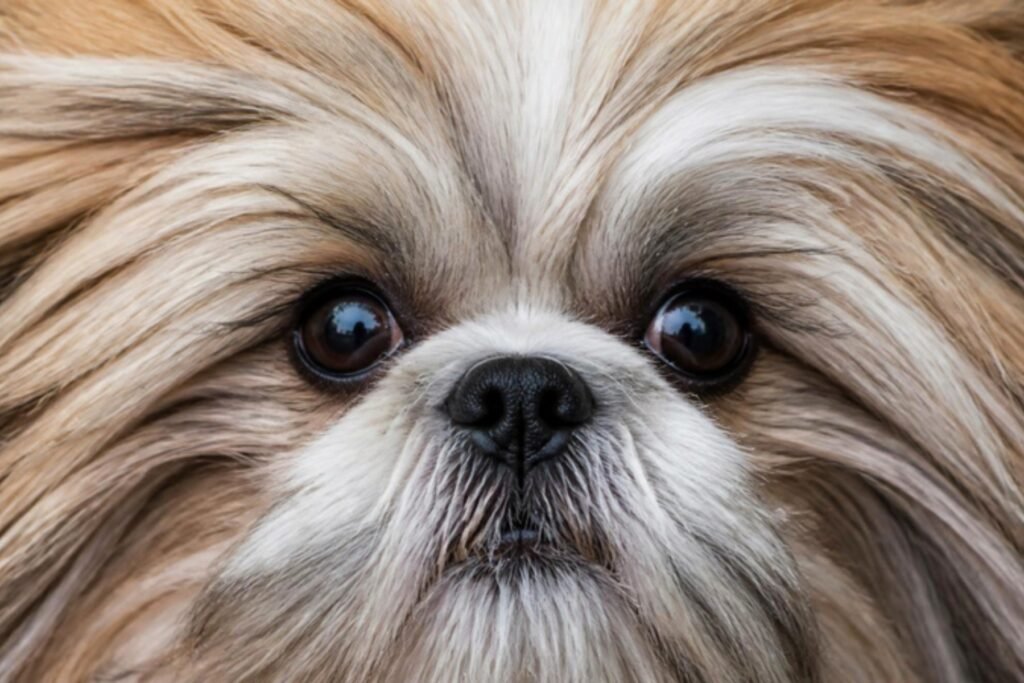
If you’ve ever looked closely at a Shih Tzu’s face, you might have noticed the hair doesn’t lie flat. The AKC explains that it grows in every direction, which is why people call them “chrysanthemum-faced.”
The nickname began in 1930s England. The Shih Tzu Club of Victoria describes one of Lady Brownrigg’s original dogs, Shu-Ssa, as having a coat that stuck out on her head and face so that she looked like a baby owl, or like a chrysanthemum. I love that one little dog’s fluffy face gave a whole breed its nickname.
That coat: why so little hair on your floor?
Shih Tzu have a long double coat that keeps growing. Canine Journal describes it as long, slow-growing hair that doesn’t fall out easily. The loose hairs they do shed usually get caught in the longer outer coat instead of dropping onto your couch.
So the “they don’t shed” idea is partly an illusion. They do shed. You just find it in the brush instead of on the floor. PetMD adds an important note: no dog is 100% hypoallergenic, even if a low-shedding coat helps some people with mild allergies.
The catch is that trapped hair turns into mats quickly. Wikipedia notes that a long coat needs brushing every two to three days, and VCA says brushing and combing every other day is needed to prevent mats. Plenty of pet Shih Tzu wear a short “puppy cut,” which makes life simpler for everyone.

Size
VCA Animal Hospitals lists the Shih Tzu at 9 to 16 pounds and about 8 to 11 inches tall. That makes them small but sturdy, and a bit heavier than many toy breeds.
One unusual detail: an underbite is part of the breed standard. That little bottom-teeth grin you sometimes see is exactly what the breed is supposed to have.
Personality: sweet, social, and quietly stubborn
The AKC sums up the breed’s charm nicely: “Where Shih Tzu go, giggles and mischief follow.” VCA describes them as both an affectionate lap dog and a fun-loving companion. They learn quickly but tend to have a stubborn streak, and VCA notes they do much better with reward-based training than with force.
In Korea, Shih Tzu have an unfair reputation. Some people jokingly call them “바보개,” or “dumb dogs.” But the Korean pet site Bemypet explains that it has more to do with personality than brains. Shih Tzu tend to be calm and easygoing, so they don’t always react quickly, and if something doesn’t interest them, they’d rather sit it out.
I think that’s a very different thing from not being smart. A dog who looks at you, thinks about it, and decides “no, thank you” is making a choice.
That’s why short, fun training sessions with treats or games work much better than repeating a command louder. And since this breed was made for companionship, many Shih Tzu really don’t like being left alone for long stretches.

Health: what to watch for
Here’s some good news first. In 2024, researchers from the Royal Veterinary College’s VetCompass program published a study of 11,082 Shih Tzu in UK vet clinics. The median age at death was 12.7 years, and the authors found the breed was relatively long-lived compared to French Bulldogs and Bulldogs. VCA gives a typical lifespan of 11 to 14 years.
The most common problems in that study were:
- Dental disease. Periodontal disease was the most common single diagnosis, at 9.5%. Crowded teeth in a short jaw trap plaque easily.
- Anal sac impaction. 7.4% of the dogs, compared with 4.8% of dogs overall.
- Ear problems. Long, heavy ears can trap moisture.
- Skin and eye issues. Skin problems were the most common group overall, followed by dental and eye conditions.
Remember the lion face? It comes with a cost, and the eyes often pay it. Science for Animal Welfare explains that breeding for a short skull left the Shih Tzu with shallow eye sockets, so the eyes sit forward and are more exposed. Some dogs can’t fully close their eyelids, and extra skin folds near the nose can rub the eye. Flat-faced breeds also tend to have less sensitive corneas, so they may not react to a small injury right away.
That helps explain why the VetCompass study found corneal ulcers in 3.5% of Shih Tzu, versus 0.77% of dogs overall.
⚠️ Please don’t wait. If your Shih Tzu is squinting, holding an eye shut, pawing at their face, or has new discharge, call your vet the same day. VCA notes that corneal ulcers are extremely painful and deeper ones can lead to blindness.
Like other short-nosed dogs, Shih Tzu can develop brachycephalic airway problems. VCA warns that because of their short muzzle, Shih Tzu are prone to overheating in warm weather.
💡 Good to know: VCA also says swimming isn’t recommended unless your Shih Tzu is constantly supervised, because a full coat gets heavy when wet. On hot days, shade, water, and short walks are kinder than a long outing.
Fun facts and true stories 🐾
A Buddhist legend explains the white spot. Bemypet shares a Buddhist story in which a small dog traveled with the Buddha, turned into a lion to chase off robbers, and received a kiss on the forehead. The legend says that kiss is where the white mark on a Shih Tzu’s forehead came from. It’s a legend, of course, but a sweet one.
Their Chinese name honors a legendary beauty. Xi Shi lived around 490 B.C. and is remembered as one of the Four Beauties of ancient China. Her name is still attached to the breed today.
Korea went through a big Shih Tzu era. Kyunghyang Shinmun reported that Shih Tzu were one of Korea’s most popular dogs starting in the 1990s, and a 2001 animal TV show featuring a singer’s mother living with more than ten Shih Tzu helped make them a household favorite. KB Financial Group’s reports show the breed ranked 3rd in Korea in 2018, then slipped to 7th, at 5.1%, in the 2025 report.
Their coat color can change. The AKC notes that a Shih Tzu’s coat can change color around 10 to 12 months of age, so your puppy may look a little different a year later.
Royals, pop stars, and billionaires have loved them. The AKC lists Queen Elizabeth II, Beyoncé, Mariah Carey, and Bill Gates among famous Shih Tzu owners.
Is a Shih Tzu right for you?
A Shih Tzu might be a great fit if you want a gentle, affectionate companion who’s happy with a short daily walk and plenty of lap time. PetMD says a 30-minute walk plus some playtime at home is usually enough, which suits a lot of smaller homes.
It might be harder if you live somewhere very hot, can’t commit to regular grooming and eye checks, or expect a dog who follows every command right away. Patience matters with this breed. So does a good relationship with a vet who knows flat-faced dogs.

Angel Jake Note 🐾
I keep thinking about how close we came to losing this breed. A breed that lived in palaces for centuries almost disappeared, and it was saved by a handful of people who cared enough to keep a few dogs going.
If you share your life with a Shih Tzu, you’re part of that story now. Brush that coat, keep an eye on those beautiful eyes, and give them the calm, patient love they’ve been receiving since the days of the emperors.
Medical Disclaimer
I’m not a vet, and nothing here replaces a real exam. If something about your dog feels off, please trust that feeling and call your veterinarian.
Sources
- American Kennel Club: Shih Tzu History
- American Kennel Club: Facts About the Shih Tzu That You May Not Know
- American Kennel Club: Shih Tzu Dog Breed Information
- American Shih Tzu Club: Early Breed History
- Shih Tzu Club of Victoria: Breed History
- Wikipedia: Shih Tzu
- Wikipedia: Xi Shi
- O’Neill et al. (2024): Demography, common disorders and mortality of Shih Tzu dogs under primary veterinary care in the UK
- Science for Animal Welfare: Brachycephalic Ocular Syndrome in the Shih Tzu
- VCA Animal Hospitals: Shih Tzu
- VCA Animal Hospitals: Corneal Ulcers in Dogs
- PetMD: Shih Tzu
- Canine Journal: Do Shih Tzus Shed?
- 비마이펫: 시츄 성격과 특징 알아보기
- 경향신문: 그 많던 요키·시츄 어디로 갔나
- KB Think: 한국 반려동물 현황 (KB Financial Group, 2025)