

Have you ever sat across from your dog, looked into their eyes, and felt like a whole conversation was happening without a single word? It turns out there might be more to that moment than we think, right down to something as small as a blink.
A new study from Italy found that dogs blink more when they watch a person blink, and the effect was strongest when that person was their own owner.
What the researchers did
The study was published in Royal Society Open Science at the end of August 2026 by researchers from the University of Parma.
They worked with 35 dogs between 1 and 12 years old. Each dog watched short videos, about 40 seconds long, of three different people: their owner, an unfamiliar woman, and an unfamiliar man. In one set of videos, the people blinked about once every three seconds. In the other, they kept a still, neutral face.
Cameras recorded the dogs so the team could count every blink and note other behaviors, like licking their nose or looking away.
What they found
- Dogs blinked more when they watched faces that were blinking than when they watched still faces.
- The biggest difference came when they watched their own owner. Blinks from strangers didn’t have nearly the same effect.
- The dogs’ blinks didn’t line up neatly in time with the person’s blinks, so this doesn’t look like simple copying.
- Other behaviors, such as nose licking or looking away, didn’t change much between the videos.
As the researchers put it, communication between dogs and people may involve “very small facial movements that we normally overlook.”
💡 Did you know? Blinking seems to matter between dogs, too. A 2018 study found that dogs tend to blink back at other dogs, and many cat lovers know the famous “slow blink,” which cats seem to use as a friendly, relaxed signal.
Why would a blink matter?
The researchers aren’t sure yet exactly what the extra blinking means. It could be a sign of attention, of feeling relaxed, or of a social connection with someone they know well.
What makes this study interesting is that the effect was tied to the owner. Dogs didn’t respond the same way to strangers. That suggests a blink may mean something special when it comes from a familiar, trusted face.
Don’t take it too far
There are a few limits to keep in mind:
- The dogs watched videos, not real people. In real life, dogs and people can react to each other, which might change how blinking works.
- Only 35 dogs were tested, all living with families.
- The team couldn’t say what the blinks mean to the dog, only that they changed.
So this is an early clue, and there’s more to learn.
What this means for you and your dog
I love studies like this because they remind me to slow down and notice the small stuff:
- Soft eyes, not a hard stare. Many dogs find a long, direct stare uncomfortable. A relaxed face and a gentle blink may feel much friendlier.
- Watch their face. Squinty, soft eyes and a loose body usually mean a calm, comfortable dog. Wide eyes, a stiff body, or turning away can mean they need space.
- Your face matters. Your dog is reading you all day long, even in ways you don’t notice.
💡 Good to know: if you want to try this at home, sit quietly with your dog, keep your face relaxed, and blink slowly. Don’t worry if they don’t blink back. It’s not a test, just a little moment together.
Angel Jake Note 🐾
There’s something so sweet about this. With all the ways we try to talk to our dogs (words, treats, toys, and training), it might be the tiniest thing that means the most. A soft look. A slow blink. A quiet “I’m here.”
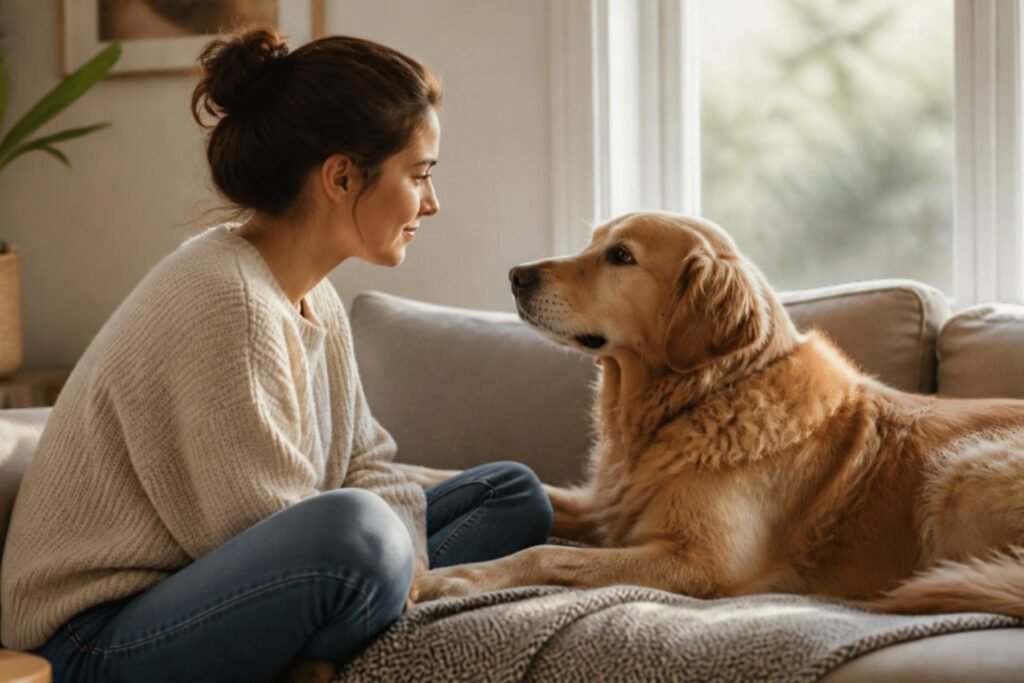
Tonight, when your dog looks up at you from the couch, maybe try blinking back.
Medical Disclaimer
I’m not a vet, and nothing here replaces a real exam. If something about your dog feels off, please trust that feeling and call your veterinarian.
Sources
- Earth.com: Dogs are watching their owners more closely than we realize (2026)
- ScienceAlert: Your dog might be reading your blinks, science suggests
- Phys.org: Dogs may use blinking as a subtle social signal