You are sitting on the couch.
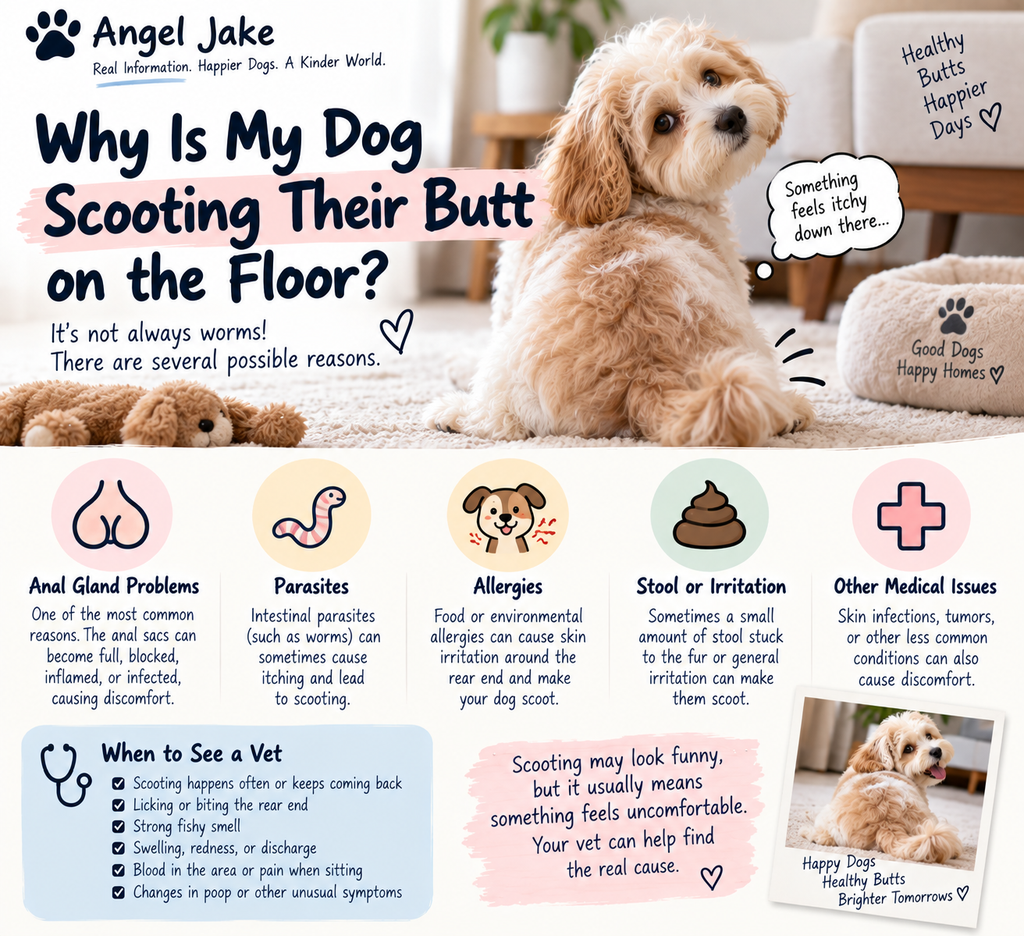
Your dog walks into the room, sits down, and suddenly drags their butt across the carpet.
It is funny for about two seconds.
Then you start wondering:
“Why are they doing that?”
A lot of people immediately think of worms.
But that is not always the reason.
Dogs may scoot because the area around their rear end feels itchy, irritated, uncomfortable, or painful.
And one of the most common reasons is actually the anal sacs.
What Are Anal Sacs?
Dogs have two small sacs located just inside the anus, roughly at the four o’clock and eight o’clock positions.
These sacs contain a strong-smelling fluid.
Normally, a small amount of that fluid is released when a dog has a bowel movement.
Most of the time, owners never even notice they are there.
But sometimes the sacs do not empty properly.
The material inside can become thick.
The sacs can become impacted.
And in some cases, they can become inflamed, infected, or even develop an abscess.
That discomfort can make a dog drag their rear end across the floor.
Scooting Does Not Automatically Mean Worms
This is probably the biggest misconception.
VCA notes that while parasites can sometimes contribute to irritation, many dogs who scoot repeatedly are doing it because of anal sac problems or allergies, not because they definitely have intestinal worms.
So if your dog scoots once, that does not immediately mean they need deworming.
And if they keep doing it, guessing the cause can waste time.
It is better to look at the whole picture.
What Does an Anal Sac Problem Look Like?
Scooting is one of the most common signs.
But you may also notice:
- licking or biting around the rear end
- a strong fishy smell
- swelling beside the anus
- pain when sitting
- discomfort when pooping
- blood or pus near the anus
Merck notes that anal sac disease can cause scooting, licking, biting, painful defecation, and in more severe cases abscesses or draining wounds.
If you see swelling, bleeding, or discharge, call your veterinarian.
Why Do Anal Sacs Get Blocked?
There is not always one obvious reason.
Merck notes that anal sacs can fail to empty normally during bowel movements, and obesity or changes in gland secretions may also contribute.
Some dogs seem to have recurring problems.
Small breeds may be more prone to anal sac disease than large or giant breeds.
But any dog can develop it.
Allergies Can Be Part of the Problem Too
This part surprises a lot of people.
Allergies can cause inflammation and itching around the skin, including the area near the anus.
VCA notes that allergic skin disease can sometimes contribute to scooting and may also make anal sac problems more likely.
So if your dog scoots and also has itchy paws, ear problems, red skin, or frequent scratching, mention all of those symptoms to your veterinarian.
They may be connected.
Could It Still Be Parasites?
Yes, sometimes.
Certain parasites can irritate the area around the anus.
But because scooting can come from several different causes, the behavior alone cannot tell you exactly what is wrong.
If parasites are suspected, your veterinarian may recommend a fecal test or other evaluation.
That is more useful than treating blindly.
Is One Scoot a Big Deal?
Not always.
A dog may occasionally scoot because something briefly irritated the area.
Maybe there was a little stool stuck to the fur.
Maybe the skin felt itchy for a moment.
If it happens once and your dog goes right back to normal, you may simply watch them.
But repeated scooting is different.
If your dog is dragging their rear end across the floor every day, licking constantly, smelling unusual, or acting painful, it is time to have them checked.
Should You Express the Anal Glands at Home?
This is where I would be careful.
Some dogs do need their anal sacs manually emptied from time to time.
But that does not mean every owner should do it routinely.
If the glands are painful, infected, abscessed, or difficult to empty, trying to squeeze them at home can hurt the dog or make the problem worse.
VCA notes that treatment for impaction may involve expressing and sometimes flushing the sacs, while infection can require additional treatment. Some cases are painful enough that sedation may be needed.
If you think your dog has an anal sac problem, ask your veterinarian whether expression is actually needed and who should do it.
When It Is More Urgent
Contact your veterinarian promptly if you notice:
- swelling beside the anus
- blood
- pus
- a wound near the anus
- severe pain
- difficulty passing stool
- sudden refusal to sit
- repeated biting at the area
An infected anal sac can progress to an abscess and may rupture through the skin.
That is not something to wait on.
What About a Fishy Smell?
That strong, sudden fishy odor many dog owners recognize often comes from anal sac fluid.
Sometimes a dog releases a small amount when frightened or excited.
But if the odor is happening repeatedly, especially with scooting or licking, it is worth checking for an anal sac problem.
Why This Behavior Is Worth Paying Attention To
Scooting can look silly.
But from the dog’s point of view, it may simply be their way of trying to relieve discomfort.
They cannot tell us:
“My rear end is itchy.”
“My anal sacs hurt.”
“Something feels swollen.”
So they drag across the carpet.
And that behavior is often the first clue we get.
Angel Jake Note 🐾
Scooting is one of those dog behaviors that makes people laugh first and worry second.
And honestly, it does look funny.
But I think it is a good reminder that even strange little behaviors can be communication.
A dog is not embarrassed.
They are not trying to be weird.
Something may simply feel uncomfortable.
One scoot may mean nothing.
But when the same behavior keeps happening, that is when I would pay attention.
Sometimes dogs tell us something is wrong in very quiet ways.
And sometimes they tell us by dragging their butt across the entire living room.
Either way, it is worth listening.
Veterinary Sources
This article was prepared using information from the Merck Veterinary Manual and VCA Animal Hospitals.
Veterinary references describe anal sac disease, allergies, irritation, and sometimes parasites as possible causes of scooting. Repeated scooting should be evaluated based on the dog’s other symptoms rather than assuming one cause.
Medical Disclaimer
This article is for general educational purposes only and does not replace veterinary examination, diagnosis, or treatment.
If your dog is scooting frequently or has pain, swelling, bleeding, discharge, a strong persistent odor, or difficulty passing stool, contact your veterinarian.