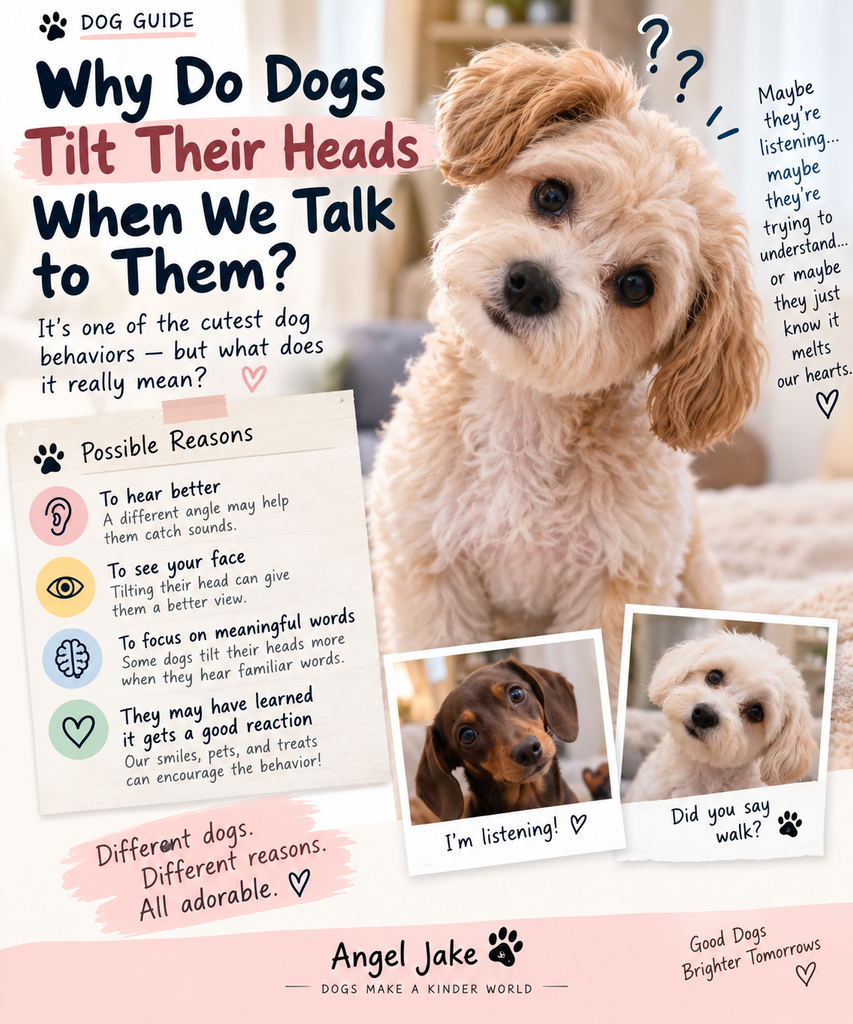
You say something to your dog.
Maybe it is:
“Do you want to go for a walk?”
And then it happens.
Their ears perk up.
Their eyes stay fixed on you.
And their head slowly tilts to one side.
It is one of those dog behaviors that almost instantly makes people smile.
But what are they actually doing?
Are they confused?
Are they trying to understand us?
Or have they simply figured out that tilting their head makes humans melt?
The answer is probably a little more complicated.
Scientists Still Don’t Know One Exact Reason
First, the most important part:
There is no single proven explanation for why dogs tilt their heads.
Researchers and behavior experts think hearing, vision, attention, learning, and communication may all play a role.
Different dogs may even do it for different reasons.
So while it is tempting to say:
“My dog is trying to understand every word I say.”
We cannot honestly know that from a head tilt alone.
What we can say is that the behavior often seems to happen when a dog is paying close attention to something interesting.
They May Be Listening More Carefully
Dogs can hear sounds at frequencies humans cannot.
But hearing a sound and figuring out exactly where it came from are different things.
One theory is that changing the position of the head and ears may help a dog gather more information about a sound.
Behavior experts cited by the American Kennel Club suggest that dogs may tilt their heads while listening to changes in pitch, tone, or inflection in our voices.
Think about how differently you probably say:
“Do you want dinner?”
compared with:
“Time for a bath.”
Even if the words themselves are different, dogs are also paying attention to how we sound.
They May Be Trying to See Your Face Better
Another idea has to do with vision.
For dogs with longer muzzles, their own nose may partly block their view of the lower part of a person’s face.
Tilting the head could potentially give them a slightly different view.
That matters because dogs are very good at watching our body language and facial expressions.
There has been some small-scale research suggesting dogs with longer muzzles may tilt their heads more often than dogs with flatter faces.
But this is still a theory, not a settled fact.
Some Dogs May Tilt Their Heads When They Hear Something Meaningful
One especially interesting study looked at dogs that were unusually good at learning the names of toys.
Researchers called them “Gifted Word Learner” dogs.
When their owners asked for a specific toy by name, these dogs tilted their heads much more often than typical dogs in the study.
That led researchers to suggest that head tilting might sometimes be connected to processing familiar or meaningful information.
But there is an important limitation.
The study involved a very specific task with a small group of unusually talented dogs.
It does not mean that every time your dog tilts their head, they fully understand what you said.
It is simply an interesting clue.
We May Be Teaching Them to Do It
This part is probably familiar.
Your dog tilts their head.
You immediately say:
“Oh my gosh!”
You smile.
You pet them.
Maybe you give them a treat.
Dogs are very good at noticing what gets a positive reaction from us.
So even if the first head tilt happened naturally, our response may make the behavior more likely to happen again.
In other words, your dog may not know they look adorable.
But they can certainly learn that something good happens when they do it.
Behavior experts describe this as positive reinforcement.
Does a Head Tilt Mean My Dog Is Confused?
Not necessarily.
A brief head tilt while listening to a sound, watching you, or hearing a familiar phrase is often just normal behavior.
It may simply mean your dog is interested and gathering information.
But we should be careful not to assign a specific emotion every time.
A head tilt does not automatically mean:
“I am confused.”
“I understand.”
“I love what you are saying.”
Dogs communicate with their whole bodies.
Their eyes, ears, tail, posture, movement, and the situation around them all matter.
When a Head Tilt Is NOT Cute
There is an important difference between:
a dog briefly tilting their head while listening to you
and
a dog whose head stays tilted to one side.
A persistent head tilt can be a medical sign.
The vestibular system helps control balance and posture, and problems affecting this system can cause a dog to hold the head tilted.
Merck Veterinary Manual notes that persistent head tilt can occur with vestibular dysfunction and may be accompanied by problems such as loss of balance or abnormal eye movements.
Inner-ear disease can also cause head tilt.
Call a Veterinarian If You Notice These Signs
A head tilt deserves veterinary attention if it is new and persistent, especially when combined with:
- stumbling
- falling or leaning to one side
- walking in circles
- trouble standing
- rapid or unusual eye movements
- vomiting or nausea
- ear pain
- sudden behavior changes
Those signs are very different from the playful little head tilt dogs often give us during conversation.
If you are unsure which kind you are seeing, recording a short video can be helpful to show your veterinarian.
Do Dogs Understand Our Words?
Dogs can learn associations between certain sounds and things that happen afterward.
Words like:
“walk”
“outside”
“dinner”
“toy”
or a favorite person’s name can become meaningful to them through repetition.
Some individual dogs can learn an impressive number of object names.
But dogs do not necessarily understand human language in the same way we do.
They also rely heavily on our tone, gestures, routines, expressions, and body language.
So when your dog tilts their head while you talk, they may be paying attention to much more than the words themselves.
Maybe That Is What Makes It So Special
There is something almost funny about how hard we try to understand our dogs while they are probably doing the same thing to us.
We watch their ears.
Their tails.
Their faces.
They watch ours.
And sometimes, in the middle of that exchange, the dog tilts their head.
We may never know exactly what they are thinking in that moment.
But we do know one thing:
they are paying attention.
Angel Jake Note 🐾
The head tilt has always been one of my favorite dog expressions.
You can say one sentence and suddenly they look at you like you have just told them the most important secret in the world.
Of course, I would love to believe they understand every word.
But I think the truth is actually more interesting.
Dogs do not need to understand language exactly the way we do to understand us.
They learn our voices.
Our routines.
Our expressions.
The way we say their names.
The sound we make before a walk.
The tone we use when something is wrong.
Maybe that little head tilt is not a translation of one exact thought.
Maybe it is simply a dog saying, in their own way:
“I’m listening.”
And honestly, I think that is pretty special too.
Sources
This article was prepared using information from the American Kennel Club, published canine cognition research, and the Merck Veterinary Manual.
Current evidence suggests that normal head tilting may involve attention, hearing, vision, learning, or a combination of these factors. Researchers have not identified one universal explanation that applies to every dog.
Medical sources also distinguish a brief behavioral head tilt from a persistent head tilt, which can be associated with vestibular or inner-ear disease.
Medical Disclaimer
This article is for general educational purposes only and does not replace veterinary diagnosis or treatment.
A brief head tilt during normal interaction is different from a persistent or sudden abnormal head position. If your dog develops a lasting head tilt, balance problems, abnormal eye movements, vomiting, pain, or difficulty walking, contact a veterinarian promptly.