Sometimes a rescue story begins with something almost impossible to imagine.
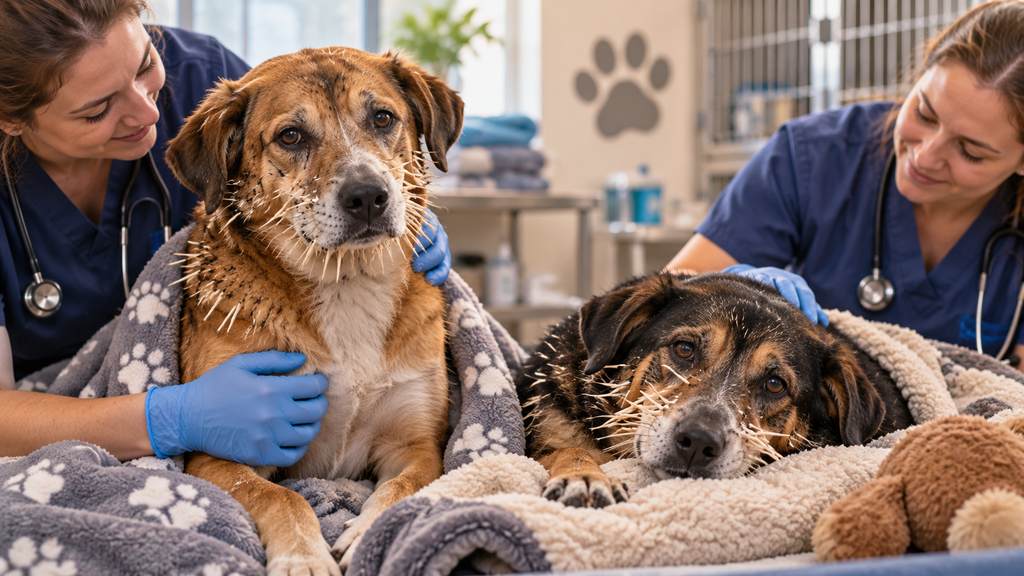
Two stray dogs in Fargo, North Dakota, were recently found with hundreds of porcupine quills embedded in their faces and bodies.
By the time rescuers were able to get them help, the dogs had reportedly been living with the quills for several days.
They were struggling to eat and drink normally.
And infections had already begun to develop.
The two dogs were eventually brought to Homeward Animal Shelter, where veterinary teams began the difficult process of removing the quills one by one.
In total, 673 porcupine quills were removed.
One dog, later named Miss Prickle Pants, had 561 quills removed.
The second, Cactus Jackie, had 112.
Both dogs required sedation during treatment and were also treated for infections.
How Did the Dogs End Up in This Condition?
The exact circumstances of the encounter are not fully known.
The dogs were strays when they were found, and rescuers believe they had come into contact with a porcupine.
Porcupines do not “shoot” their quills.
Instead, the quills detach when another animal makes contact with them.
Dogs are especially vulnerable because curiosity can lead them to approach, sniff, or bite at a porcupine.
Once quills become embedded, they can be extremely painful.
And because the tips can work deeper into tissue, they should not simply be ignored.
Why Porcupine Quills Can Become Serious
At first glance, a porcupine encounter may seem like a painful but straightforward injury.
But quills can create more complicated problems.
They may become embedded around the mouth, nose, eyes, or other sensitive areas.
Some may break beneath the skin.
And the longer they remain in place, the greater the concern for inflammation, infection, and migration into deeper tissues.
In this case, rescuers said the dogs had already developed infections by the time they received veterinary treatment.
That is why removing porcupine quills is generally a job for a veterinarian rather than something owners should try to handle casually at home.
Depending on how many quills are present and where they are located, sedation or anesthesia may be needed so they can be removed safely.
Rescue Took More Than One Organization
One of the most important parts of this story is that the dogs did not reach safety because of one person or one organization alone.
Journey Home Animal Rescue first became involved and helped coordinate assistance.
The dogs were then transported to Homeward Animal Shelter, where the veterinary team provided treatment.
Transporters, shelter staff, volunteers, and veterinary professionals all played a role.
That kind of cooperation is easy to overlook when we see a dramatic rescue photo.
But many animal rescues happen because several people each do one part of the job.
Someone notices.
Someone calls.
Someone transports.
Someone provides medical care.
And eventually, the animal gets a chance to recover.
Why Immediate Veterinary Care Matters
If your dog ever encounters a porcupine, the safest response is to contact a veterinarian promptly.
Trying to pull out large numbers of quills at home can be difficult and painful, especially if they are near the eyes, mouth, or deep in the skin.
A veterinarian can examine the dog, determine whether sedation is needed, look for hidden or broken quills, and treat pain or infection when necessary.
The longer quills remain embedded, the more difficult the situation can become.
That does not mean every porcupine encounter will become as severe as this one.
But it is not something I would wait several days to address.
The Dogs Are Now Recovering
The good news is that both dogs made it through treatment.
Homeward Animal Shelter said they were recovering after the procedures and receiving care for their infections.
The organization also asked the public for help covering the unexpected veterinary costs connected to the rescue.
For the dogs, this was probably not the beginning anyone would have wanted.
But it is not the end of their story either.
They are no longer wandering alone.
They are receiving treatment.
And they are finally somewhere people are paying attention to what they need.
Why This Story Matters
It is easy to focus on the number.
673 quills.
It sounds almost unbelievable.
But behind that number were two dogs who had apparently been living in pain for days.
They could not explain what happened.
They could not remove the quills themselves.
And they could not ask anyone to take them to a veterinarian.
They needed someone to notice them.
That is what rescue often looks like.
Not always dramatic.
Not always simple.
But one person noticing something wrong can set off a chain of events that completely changes an animal’s outcome.
Angel Jake Note 🐾
When I read that these dogs had hundreds of quills stuck in them for days, the part that stayed with me was not only how painful it must have been.
It was the fact that they were still out there trying to survive.
Dogs have a way of continuing even when they are uncomfortable, scared, or hurting.
Sometimes that makes it difficult for us to understand just how much help they need.
I am grateful someone found these two when they did.
And I am grateful that several rescue groups, transporters, and veterinary professionals were willing to step in.
For me, stories like this are a reminder that helping an animal often starts before the hospital.
It starts when somebody decides:
This dog needs help, and I am not going to walk away.
Sources
This article was prepared using reporting published on September 10, 2026 about the rescue of two stray dogs in Fargo, North Dakota, and information provided by the rescue organizations involved.
At the time of publication, the dogs were recovering following veterinary treatment.
Veterinary Note
Porcupine quills can cause pain, tissue injury, infection, and other complications. If your dog has been quilled by a porcupine, contact a licensed veterinarian promptly rather than attempting extensive removal at home.
This article is for general educational purposes only and does not replace veterinary diagnosis or treatment.