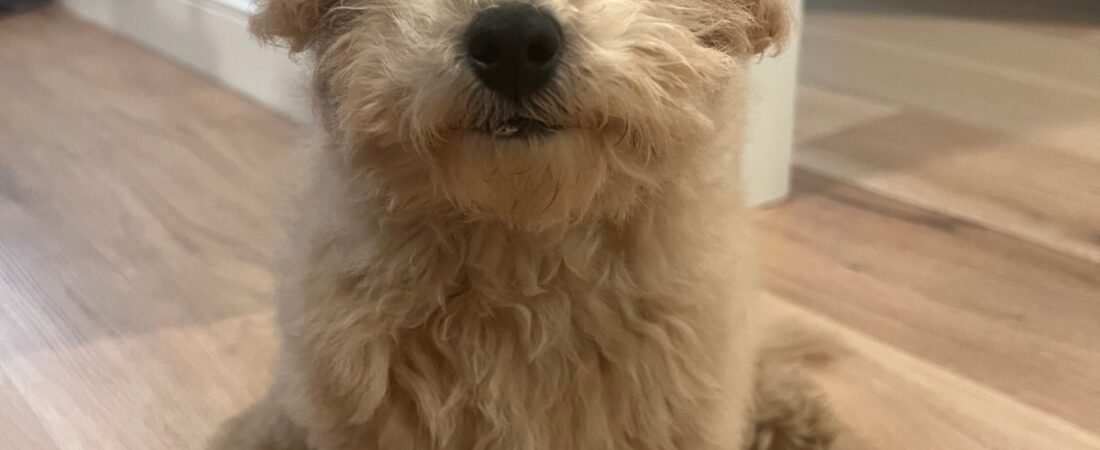
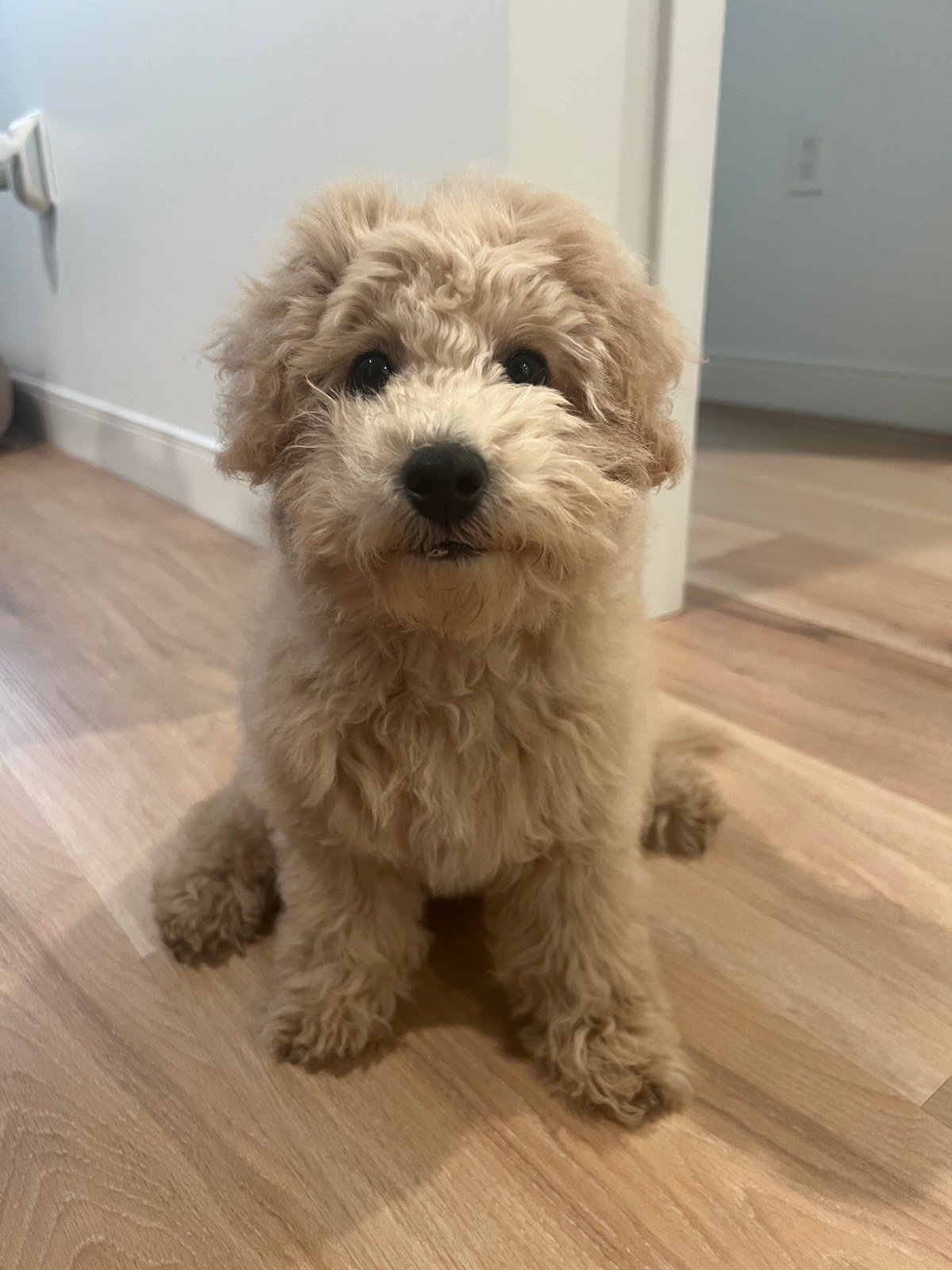
A Poochon is what you get when a Poodle and a Bichon Frise have puppies. Picture a small, curly, teddy-bear dog with a big heart, and you’re close.
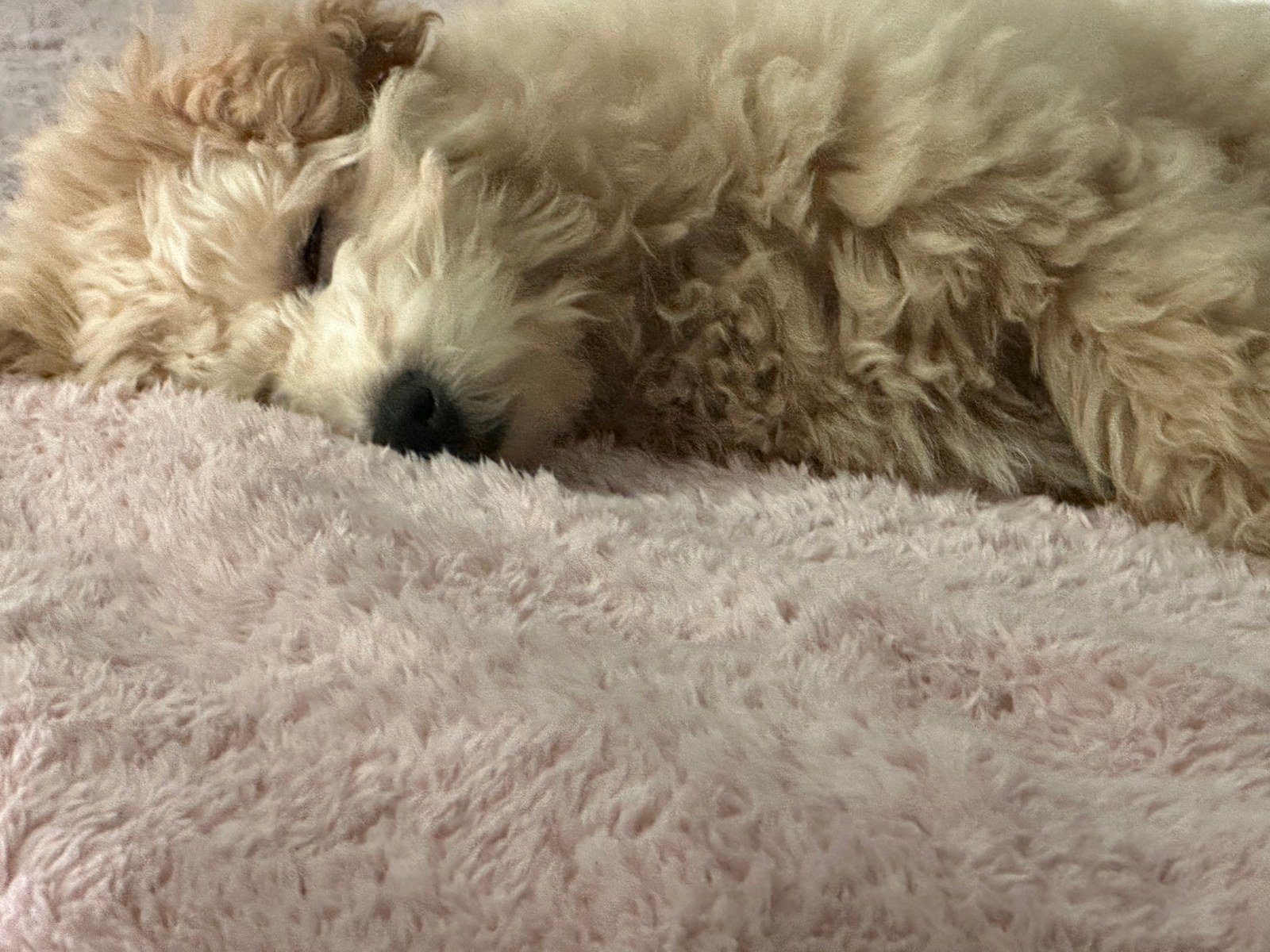
We know this mix well, because our Terry is a Poochon. She joined our family after we lost Jake, and she’s 9 months old now.
Here’s what we’ve learned about Poochons, from research and from life with Terry.
Poochon at a glance 🐾
- Parents: Poodle (Toy or Miniature) × Bichon Frise
- Breed status: a mixed breed, not recognized by the American Kennel Club (AKC)
- Likely size: about 4 to 18 pounds, depending on the parents
- Likely lifespan: about 12 to 15 years, based on the parent breeds
- Coat: curly or wavy, usually low-shedding, needs regular grooming
- Hypoallergenic? no dog truly is, according to the AKC
- Best for: people who want a small companion and don’t mind brushing and regular grooming
What is a Poochon, exactly?
A Poochon is a cross between a Poodle and a Bichon Frise. It’s often called a “designer” mix, like the Cockapoo or Labradoodle.
Because it’s a mix, there’s no official breed standard. Two Poochons can look and act quite differently, even in the same litter. Each puppy gets a different blend of genes from its Poodle parent and its Bichon parent.
How big do Poochons get?
There’s no official size, so the best clue is the parents. Here’s what VCA Animal Hospitals lists for each:
- Toy Poodle: about 4 to 8 pounds
- Miniature Poodle: about 10 to 15 inches tall and 12 to 18 pounds
- Bichon Frise: about 10 to 12 inches tall and 10 to 16 pounds
So a Poochon with a Toy Poodle parent will usually be on the smaller side, and one with a Miniature Poodle parent may be a bit bigger. Terry weighs 14 pounds at 9 months, which is more than she should (more on that below).

That curly coat: grooming comes first
If there’s one thing every Poochon owner learns fast, it’s that the coat needs care. Both parent breeds have coats that mat easily without regular care.
VCA says Toy Poodles need brushing and combing every other day, and Miniature Poodles need brushing every other day, and most Toy Poodles are professionally clipped about every six weeks. For Bichons, VCA also recommends brushing every other day, and most are clipped about once a month.
A Poochon’s coat needs about the same care. Plan on:
- Brushing at least every other day, all the way down to the skin
- A professional trim every four to six weeks
- Checking ears, eyes, and paws often, since hair can trap dirt and moisture
For Terry, we brush her every single day, and she goes to a groomer for grooming. (Bath time has its own story, which you can read in our HYPONIC shampoo review.)
Are Poochons hypoallergenic?
This is the question people ask most, and the honest answer is no. The AKC says plainly that no breed, or mix of breeds, is truly hypoallergenic.
The proteins that trigger dog allergies come mainly from dander (tiny skin flakes) and saliva, not just loose hair. The AKC even points to a 2012 study that found low-shedding Poodles had some of the highest levels of Can f 1, a major dog allergen, in their coat samples.
Poochons tend to leave less hair around the house than many dogs. VCA puts it carefully for Bichons: no breed is non-allergenic, but Bichons “may cause fewer allergies” for some people.
💡 Good to know: If someone in your home has allergies, spend real time with a Poochon before you bring one home. A short visit can’t tell you how you’ll feel living together.
Poochon personality
Since the Poochon has no breed standard, personality varies from dog to dog. The parents give a few clues. VCA describes the Toy Poodle as a “biddable and affectionate companion” that is playful and very good with children, though very young or unruly children may hurt a tiny dog with rough play. It describes the Miniature Poodle as affectionate and fun-loving.
Terry is very gentle and loves people. She likes other dogs too, and she’s full of curiosity. She hardly ever barks.
She does have separation anxiety, though, so being left alone is hard for her. If your Poochon struggles when you leave, our guide on how to tell if your dog is stressed can help you spot the signs.
Are mixed breeds healthier?
You may have heard that mixes are healthier than purebred dogs. A large 2024 study from the Royal Veterinary College (RVC) in London looked at this question for Poodle mixes.
The team compared Cockapoos, Labradoodles, and Cavapoos with their parent breeds, including Toy, Miniature, and Standard Poodles, using survey answers from 9,402 owners and looking at 57 health problems. In 86.6% of comparisons, they found no difference. The crosses had higher risk in 7.0% of comparisons and lower risk in 6.4%.
Dr. Rowena Packer, one of the authors, summed it up: “although the health of designer Poodle-crosses is no worse than their parent breeds’, it is also no better.”
The study didn’t include Poochons, but the takeaway is likely similar: being a mix doesn’t guarantee better health. A Poochon can inherit health problems from either side of the family.
Health problems to watch for
On the Poodle side, the Poodle Club of America lists several conditions seen in Toy and Miniature Poodles, including:
- Progressive retinal atrophy (PRA): an inherited eye disease that slowly leads to vision loss. One type, prcd-PRA, is the main form in Toy and Miniature Poodles and is usually diagnosed around 3 years of age.
- Patellar luxation: a kneecap that slips out of place. The club requires knee checks for Toy Poodle breeding dogs.
- Hip dysplasia: the club requires hip checks for Miniature Poodle breeding dogs.
- Epilepsy: the club calls idiopathic epilepsy a common cause of seizures in all sizes of Poodle.
For Toy Poodles, VCA also warns that very small puppies can be at risk of low blood sugar (hypoglycemia), and that “small snacks can cause weight problems in tiny dogs.”
Terry is healthy overall, but her tummy seems a bit sensitive. She gets diarrhea after eating chicken or fish, so we think she may have a mild sensitivity to them. Weight is something we’re watching too. She gained weight after she was spayed, and she’s overweight right now.
If your dog often has diarrhea after certain foods, it’s worth telling your vet, who can help you figure out what’s behind it.
💡 Good to know: Talk to your vet if your Poochon starts bumping into things, limps or skips a step, or has a seizure. These can be signs of the problems above, and early care helps.
Choosing a Poochon responsibly
Because “designer” mixes are popular, they can also attract puppy farms. Dr. Packer warned that Poodle crosses are at high risk of coming from puppy farms and illegal imports. She advises buying from breeders who let you visit in person and who sell puppies where they were bred, with the mother present.
A few good questions to ask:
- Can I visit in person, meet the mother, and see where the puppies are raised?
- Have the parents had health checks, such as eye and knee exams?
- Which Poodle size is the parent, Toy or Miniature?
Mixes like Poochons also end up in shelters and rescues, so adoption is worth a look too.
Poochons and Korea
Both parent breeds are well loved in Korea. In August 2026, DailyVet (데일리벳) reported on an analysis of 4.13 million dogs in Korea’s national animal registration system. A veterinary student in Prof. Yu Dae-sung’s veterinary epidemiology lab at Chonnam National University did the analysis.
The Poodle ranked third overall at 11.5%, behind mixed-breed dogs (19.9%) and the Maltese (17.1%). The Bichon Frise came in fifth at 6.1%.
The trends are interesting, too. Among dogs born in 2017 to 2019, Bichons made up 7.0% of registrations. Among dogs born in 2023 to 2025, that share rose to 12.9%. Poodles moved the other way, from 13.8% to 7.5%, while mixed-breed dogs climbed from 18.4% to 35.4%. The article notes that these trends are exploratory, based on only 10 yearly data points. The data doesn’t track Poochons separately, so they would fall under mixed-breed dogs.
Life with Terry: the best part and the hard part 🐾
The best part of life with Terry is how gentle she is. She’s so sweet that she happily goes to anyone. She loves pretty much everything, too, from people to other dogs to whatever new thing she can investigate.
The hard part is how attached she is to us. Terry has separation anxiety, and being apart from her people is hard for her. If you’re thinking about a Poochon, it’s worth thinking about how much time your dog would spend alone.
Fun facts 🐾
No two Poochons are quite alike. With no breed standard, coat, size, and personality can vary a lot, even among littermates.
Low-shedding isn’t the same as allergy-free. The AKC notes that allergens come from dander and saliva, so even a dog that sheds little can still bother sensitive people.
Mixed doesn’t mean healthier. The RVC study found Poodle crosses were neither healthier nor less healthy than their parent breeds overall.
Is a Poochon right for you?
A Poochon might be a great match if you want a small, affectionate dog, enjoy grooming (or have a groomer you trust), and want a dog that sheds less around the house.
A Poochon might be harder if you don’t have time for regular brushing, need a truly allergy-free dog, or have very young children who might play roughly with a tiny dog.
Angel Jake Note 🐾
Terry is such a gentle, good-hearted dog.
But I know that mixes like the Poochon can become a trend. Too often, people bring a puppy home because it’s popular, and then give the dog up once it grows bigger and gets harder to care for. I don’t want that for any dog. And I really hate that, sometimes, it’s the gentlest dogs who end up getting hurt.
So if you’re thinking about bringing home a Poochon, or any dog, please don’t do it because of a trend. Plan for the brushing, the grooming, and the company they need, for their whole life. My hope is simple: that every dog goes to someone who will take responsibility for them, all the way to the end.
Medical Disclaimer
I’m not a vet, and nothing here replaces a real exam. If something about your dog feels off, please trust that feeling and call your veterinarian.
Sources
- VCA Animal Hospitals: Toy Poodle
- VCA Animal Hospitals: Miniature Poodle
- VCA Animal Hospitals: Bichon Frise
- Poodle Club of America: Health Concerns
- American Kennel Club: Does a Completely Hypoallergenic Dog Exist?
- Bryson, Packer & O’Neill (2024): The doodle dilemma: How the physical health of designer-crossbreed Cockapoo, Labradoodle and Cavapoo dogs compares to their purebred progenitor breeds, PLOS ONE
- 데일리벳: 수의대생이 413만 마리 동물등록 데이터 전부 분석하자..믹스견 늘고 말티즈 줄었다