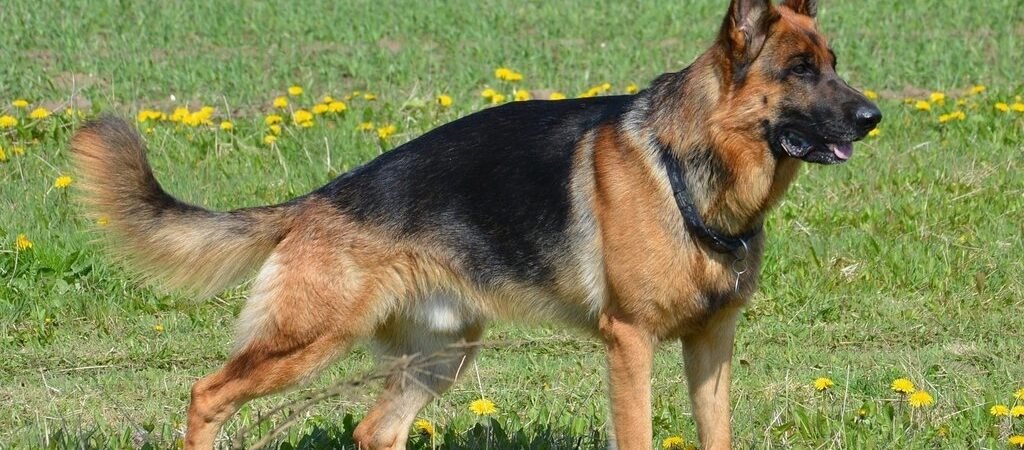

Most of us can picture a German Shepherd without even trying. The tall ears, the dark saddle, that steady look that seems to be taking notes on everything around them. They’re the dog in the back of the police car and the one walking beside someone who can’t see the curb.
Here’s the surprising part: the breed is young. The German Shepherd as we know it is only a little over 125 years old, and it started with one man and one dog. The story after that includes a Hollywood star found in a bombed-out kennel, a guide dog who crossed one of New York’s busiest streets, and a Korean air base that chose Shepherds over Jindos for a reason you might not guess. Their health story deserves just as much attention, because these dogs give us so much.
One man, one dog, and a plan
Britannica says the breed was created chiefly by a German cavalry captain, Max von Stephanitz, and the AKC credits him and Artur Meyer with developing it. In 1899, at a German dog show, Stephanitz spotted a medium-sized, yellow-and-gray, wolf-like dog called Hektor Linksrhein and bought him.
He renamed the dog Horand von Grafrath. That same year, Stephanitz founded the Verein für Deutsche Schäferhunde (the SV), and Horand became the first registered German Shepherd Dog. The GSDCA describes him as a working sheepherder who was “supple and powerful, and possessed endurance, steadiness, and intelligence.” That sounds like a lot of Shepherds today.
The German Shepherd Dog Club of America (GSDCA) says Stephanitz’s motto was “Utility and intelligence,” and that he considered beauty secondary. His club grew fast, and the GSDCA notes it went on to become the largest breed club in the world.

The war, a new name, and a movie star
World War I changed how the world saw this dog, in two different ways.
In Britain, the word “German” became a problem. As the GSDCA puts it, “In England, the name of the breed was changed to the Alsatian.” That name stuck for almost six decades.
💡 Did you know? According to Britannica, the German Shepherd was known as the Alsatian in the United Kingdom from 1919 all the way to 1977.
Across the Atlantic, the war gave the breed its first superstar. On September 15, 1918, an American corporal named Lee Duncan was near Flirey, France, when, as Warner Bros. tells it, he found a bombed-out kennel. According to Military.com, it had housed military working dogs meant for the German army. Inside were a starving German Shepherd mother and her litter of five newborn puppies, their eyes not yet open.
Duncan kept two puppies and named them after French good-luck dolls: Nanette and Rin Tin Tin. Rin Tin Tin’s first Warner Bros. film, Where the North Begins, was a hit in July 1923, and his films are often credited with saving the studio from bankruptcy. Warner Bros. says he was known on the lot as “The Mortgage Lifter.” The AKC says he starred in 23 silent Warner Bros. films, and his fame helped make the breed a household name.
Size and coat
The AKC breed standard, published by the German Shepherd Dog Club of America, calls for males of 24 to 26 inches at the shoulder and females of 22 to 24 inches. The standard doesn’t set a weight range at all; it simply asks for a dog who “looks substantial and not spindly.” Purina gives a typical range of 65 to 90 pounds for males and 50 to 70 pounds for females.
The standard describes “a double coat of medium length,” with an outer coat that’s dense, straight, and harsh, lying close to the body. That double coat is the reason Shepherd homes come with tumbleweeds of fur. The AKC says they “shed quite a bit,” and Purina adds that shedding gets heavier once or twice a year. Brushing every few days helps you keep up. Most colors are allowed, though the standard treats blues and livers as serious faults and disqualifies white dogs from the show ring. Long-haired Shepherds exist too. UC Davis’s Veterinary Genetics Laboratory explains that long hair in dogs is inherited as a recessive trait, so a puppy needs two copies of a long-hair variant, and the FCI’s breed standard, valid since 2010, recognizes two coat varieties: double coat, and long and harsh outer coat.
💡 Good to know: The AKC says a German Shepherd’s double coat should never be shaved or cut. Regular brushing and a de-shedding tool are the way to manage all that fur.

Personality: loyal, watchful, and a little reserved
If a Shepherd has ever looked at you politely and stayed put, that’s the breed doing exactly what it was meant to do. The breed standard asks for a “direct and fearless, but not hostile, expression, self-confidence and a certain aloofness.” The AKC puts it even more plainly: Shepherds have a “certain aloofness that does not lend itself to immediate and indiscriminate friendships.”
Once you’re in, though, you’re in. The AKC describes them as “courageous, confident, and smart,” reserved with strangers but friendly with people they already know. They tolerate other dogs, the AKC says, but tend to prefer their own family. That’s a guardian’s instinct. A dog who loves everyone equally would make a poor watchdog.
The AKC is also clear that this is a dog who needs a job, even as a pet. You’ll need to provide “extensive physical and mental exercise every day.” A bored Shepherd is a smart dog with too much free time, and that rarely ends well for the sofa.
Why they move (and listen) the way they do
Watch a German Shepherd move across a field and you’ll notice they don’t bounce. They glide. The breed standard says it outright: “A German Shepherd Dog is a trotting dog.”
There’s a reason for that. The AKC explains that Shepherds were historically used to manage flocks of as many as 1,000 sheep, acting as a “moving fence” around the edges. A dog patrolling a boundary like that all day needs a gait that covers plenty of ground with as little effort as possible. That smooth trot was a work tool long before it was a show-ring trait.
Those famous ears have a job, too. The AKC says their erect ears and the classic head tilt may help Shepherds track sounds and focus on what they’re hearing. When your Shepherd tilts their head mid-sentence, they may really be trying to work out what you said.

German Shepherds in Korea
Shepherds have a place in Korea’s military, too. In 2013, the Seoul Shinmun visited the military dog platoon of the Air Force’s 16th Fighter Wing and reported that every dog in the unit except one Cocker Spaniel detection dog was a German Shepherd.
The reason they gave is fascinating, especially for anyone who loves Jindos. According to the article, the Air Force chose Shepherds because they’re sociable. Jindos were passed over because they stay loyal to one handler and won’t follow a new handler after the first one finishes military service and leaves. Since handlers leave when their service ends, a dog who can bond with the next person is worth a great deal.
Health: what the research shows
This part is the hardest to read, but it’s also what helps you protect your dog most.
A 2022 Royal Veterinary College study of UK dogs (Teng et al.) estimated a life expectancy at birth of 10.16 years for German Shepherds, compared with 11.23 years for dogs overall. Purina gives a typical lifespan of 7 to 10 years. Every dog is different, but it’s a useful starting point.
An earlier RVC VetCompass study, led by Dr. Dan O’Neill and published in 2017, looked closely at German Shepherds under primary veterinary care in the UK. It found a median longevity of 10.3 years. The most common problems were ear infections (otitis externa, 7.89%), osteoarthritis (5.54%), diarrhea (5.24%), being overweight (5.18%), and aggression (4.76%, more common in males). What stood out most was how these dogs died. The leading causes of death were musculoskeletal disorders (16.3%) and inability to stand (14.9%). In other words, mobility problems end a lot of Shepherd lives.
Several conditions help explain that:
- Hip and elbow dysplasia. VCA lists both among the health issues to watch for in German Shepherds. The Orthopedic Foundation for Animals explains that hip dysplasia typically develops from an abnormally formed hip joint, and that severity varies a lot: some dogs with significant arthritis show few signs, while others with minimal changes are badly lame.
- Degenerative myelopathy (DM). UC Davis describes DM as a slowly progressive difficulty walking in the hind legs, usually in dogs six years or older, and lists German Shepherds among the breeds most affected. Most dogs can’t walk within several months to a year after signs appear, though affected dogs don’t seem to be in pain. A mutation in the SOD1 gene is involved, and a 2014 UK study by Holder and colleagues found that among 50 Shepherds under six years old, 16% had two copies of the mutation and 38% were carriers.
- Exocrine pancreatic insufficiency (EPI). The Merck Veterinary Manual says EPI caused by pancreatic acinar atrophy is most frequent in young adult German Shepherds. Weight loss and loose stools are the most common signs, often in a dog who seems constantly hungry.
The good news is that responsible breeders screen. Purina notes that good breeders test for hip and elbow dysplasia and myelopathy, so it’s always worth asking to see those results before you bring a puppy home.
There’s one more thing every Shepherd family should know about: bloat. Purina lists it as a risk for the breed, and VCA explains that gastric dilatation-volvulus (GDV) happens most often in large, deep-chested dogs when the stomach fills with gas and can twist on itself.
⚠️ Please don’t wait. If your Shepherd is restless, drooling heavily, retching without bringing anything up, or has a swollen belly, go to a vet immediately. VCA says GDV needs veterinary attention “within minutes to a few hours” to save a dog’s life, and it’s worth asking your vet whether a preventive gastropexy makes sense for your dog.

Fun facts and true stories 🐾
A German Shepherd helped start the guide dog movement in America. The Seeing Eye says a Shepherd named Kiss was born in Vevey, Switzerland, in 1926, at Dorothy Harrison Eustis’s Fortunate Fields kennel. After Eustis wrote about guide dogs in The Saturday Evening Post, a 19-year-old from Tennessee named Morris Frank wrote to her: “Is what you say really true? If so, I want one of those dogs!” He trained with Kiss in Switzerland and renamed her Buddy. On June 11, 1928, with doubtful reporters watching, the two crossed New York’s busy West Street. Frank then sent Eustis a one-word telegram: “SUCCESS.”
Rin Tin Tin’s Oscar is a myth. A popular legend says he was voted Best Actor at the first Academy Awards and then quietly passed over for a human. Bruce Davis, the Academy’s former executive director, wrote in TheWrap that the 1928 ballots are still stored at the Academy’s Margaret Herrick Library, with not a single one of them mentioning a dog.
The world mourned Rin Tin Tin. Warner Bros. says his death on August 10, 1932, made international news.
Korea once exported most of its Shepherds. In a 2008 Maeil Shinmun interview, a Korean dog-show judge recalled that during the 1997–98 financial crisis, Korean dog lovers started a movement to export Shepherds. He said about 80% of the country’s Shepherds were sold abroad, to China, Japan, Taiwan, and Hong Kong, earning an estimated 10 to 20 billion won.
They’re still one of America’s favorites. In the AKC’s 2025 registration rankings, the German Shepherd Dog held steady at No. 4.
Is a German Shepherd right for you?
A Shepherd could be a wonderful match if you want a loyal, intelligent dog who’ll be devoted to your family, and if you truly enjoy training, long walks, and giving a dog something to think about every day. The AKC describes them as gentle family dogs and steadfast guardians by nature.
It’s worth thinking carefully if your days are already full, if you don’t have room for a large dog, or if dog hair on everything would drive you up the wall. The AKC also suggests asking yourself whether you have a steady income for possible health costs. And because Shepherds can be reserved with strangers, early socialization really counts. Choose a breeder who screens hips, elbows, and DM, and keep your dog lean. Their joints will thank you later.

Angel Jake Note 🐾
Stephanitz built this breed around one idea: a dog who was useful and smart. More than a century later, German Shepherds are still guiding, guarding, searching, and herding, and most of all, watching over the people they love.
If you share your life with one, the kindest gifts are simple ones. Give them work for their mind, keep their weight down, brush that coat, and pay close attention to how they’re getting up and walking as the years go by. They spend their whole lives looking out for us. It’s our turn to look out for them.
Medical Disclaimer
I’m not a vet, and nothing here replaces a real exam. If something about your dog feels off, please trust that feeling and call your veterinarian.
Sources
- American Kennel Club: German Shepherd Dog Facts You May Not Know
- American Kennel Club: Is a German Shepherd Dog Right for You?
- American Kennel Club: The Most Popular Dog Breeds of 2025: French Bulldog Holds Top Spot
- German Shepherd Dog Club of America: German Shepherd Dog Breed Standard
- German Shepherd Dog Club of America: Captain Max von Stephanitz Founds a New Breed
- German Shepherd Dog Club of America: The History of the German Shepherd Dog
- Encyclopaedia Britannica: German Shepherd
- FCI: German Shepherd Dog (Standard No. 166)
- UC Davis Veterinary Genetics Laboratory: Long Hair
- Warner Bros.: Happy Birthday, Rin Tin Tin
- Military.com via Doughboy Foundation: Rescued From a WWI Battlefield, This Dog Became Hollywood’s Biggest Star and Saved Warner Bros. From Bankruptcy
- TheWrap: No, Rin Tin Tin Didn’t Really Win the First Best Actor Oscar
- Holder et al. (2014): Prevalence of the degenerative myelopathy SOD1 mutation in a referral population of German Shepherd dogs from the UK
- Merck Veterinary Manual: Exocrine Pancreatic Insufficiency in Dogs and Cats
- VCA Animal Hospitals: German Shepherd
- Orthopedic Foundation for Animals: Hip Dysplasia
- The Seeing Eye: The Seeing Eye’s Early Beginnings: Buddy
- Purina: German Shepherd Dog
- O’Neill et al. (2017): Demography and disorders of German Shepherd Dogs under primary veterinary care in the UK
- Royal Veterinary College: German Shepherd Dogs in the UK: Demography and disorders
- Teng et al. (2022): Life tables of annual life expectancy and mortality for companion dogs in the United Kingdom
- UC Davis Veterinary Neurology Service: Degenerative Myelopathy
- VCA Animal Hospitals: Bloat: Gastric Dilatation and Volvulus in Dogs
- [서울신문: [이종원 선임기자의 카메라 산책] 공군 제16전투비행단 군견소대를 가다](https://www.seoul.co.kr/news/2013/03/04/20130304018001)
- [매일신문: [일가를 이루다] 한국애견학회 회장·한국애견협회 부심사위원장 정병곤](https://www.imaeil.com/page/view/2008091806514444602)